Hooked On Tragic Love Stories
By Anastasia Rubis
I have a friend whose fiancé was paralyzed in a skiing accident and later died of complications. She still can’t speak his name, though this happened a decade ago, and she refers to him simply as my love. When I told her I was writing a novel about Oriana Fallaci, the legendary Italian journalist, and I sheepishly admitted it was a tragic love story, she lit up and said, “My favorite kind!”
Her reaction threw me. Didn’t she want to steer clear of sad stories, given the sorrow she’d been through? I held the naïve notion that I was the only one attracted to doomed love, that somehow it was my awkward secret, akin to being a sap or rubbernecking at highway accidents.
I had not yet articulated to myself that the main reason I stuck with Oriana Fallaci’s story for the eleven years it took to write and publish was her gut-wrenching, poignant fate: Oriana overcame poverty, sexism, and the lack of a university education to become the greatest reporter in the world by the 1970s, yet she had her heart ripped out in love. “A legend” according to Dick Cavett and a “role model” according to Christiane Amanpour, yet personal happiness slipped through her fingers. Fame and success in one realm, loneliness and pain in the other. It’s an agonizing message: you can’t have everything, not even if you try very, very hard—life always exacts a price. Tragedy comes for everyone.
And it’s a true story.
Oriana understood very well the risky reality of giving yourself over to another human being. In interviews, she claimed that love leaves you with empty pockets, that the moment your heart becomes attached to another person, you’re screwed. “I hate love,” she said.
Not exactly the stuff of Valentine’s Day cards.
Somehow, for me, her words rang true. I was born a romantic, but I’d been imprinted with the myths we read in Greek school: Orpheus looking back at Eurydice and losing her; Medea punishing Jason by murdering their children; Achilles grieving over his best friend Patroclus. In high school, the books that kept me reading under the covers on Saturday mornings were Wuthering Heights, The Great Gatsby, Romeo and Juliet. Much more recently The Paris Wife, Euphoria, Me Before You, The Dutch House, books I continue to gift and recommend. Like a bedtime story, I listen to The Dutch House on audio if I wake up in the middle of the night; my subconscious and I have memorized whole passages. That voice of Danny’s cuts straight to my soul, so subtly elegiac about his sister Maeve who raised him, while self-deprecating about his own “idiocy.” Tragedy and comedy. Moving and brilliant.
Of course there were movies that undid me throughout adolescence. Brian’s Song on television’s Movie of the Week, the true story of football players Brian Piccolo and Gale Sayers. Love Story at the Linwood theater in Fort Lee, NJ, where I can still remember standing dizzily outside the strip mall, eating the last of my Milk Duds, torn up by Jenny’s young death from leukemia. Equally gutting was Out of Africa: Why didn’t Denys want to marry Karen if he loved her—why did he have to go and crash his plane? More recently, movies that landed inside me with a thud (and that I’ve watched over and over to relive said thud) were The Notebook, Brokeback Mountain, One Day, and the Lade Gaga A Star is Born.
It’s not just books and movies that embody tales of tragic love. So many famous people have lived these stories out loud: Joe Biden and his first wife Neilia, who died in a car crash with their baby daughter. John and Jackie Kennedy, Diana and Charles. Anderson Cooper hosts a podcast on grief in which he is vulnerable and forthcoming about the death of his father and suicide of his brother.
Surprisingly, it turns out that I’m not unique in loving tragic love stories. According to Aristotle in The Poetics, tragedy captivates us because it arouses pity and fear, the recognition that this could happen to us, and finally brings catharsis, a purging or cleansing by seeing someone else go through it.
In classical tragedy, there is a “scene of suffering,” as Aristotle calls it. Boy, is there ever. That scene in Brokeback Mountain is undoubtably when Ennis hugs Jack’s shirt and inhales its scent at the very end. In Out of Africa, it’s when Karen’s voice cracks as she’s reading the poem “To An Athlete Dying Young” at Denys’s burial. She throws a fistful of dirt on his coffin and stumbles away before the ceremony is officially over.
The scene of suffering moves me, but I don’t cry easily. I embrace the scene in a way that feels safe, often rewinding two and three times for another “hit,” and I head for bed whirring with emotion, my heart cracked open, my insides jolted and rearranged as if I’ve been electrified with defibrillator paddles. Before I go to sleep, I’ll often Google the true story behind the movie or the filmmakers or the cast, but the next day I wake up cleansed, moving purposefully on to my calendar and to-do list. Does a little bit of the tragic love story stay with us? I think so. To expand our humanity and empathy. We start seeing the tragedy of love—and sensing it— in our own lives and those around us.
Death is not the only tragedy that can befall a love story: it’s almost sadder when two people connect intimately but don’t end up together. A classic example is Casablanca. More recently La La Land, where in that jazz club, I wanted to shout at the screen But you belong together! Why didn’t you try harder? In Past Lives, I was both confounded and stricken when Nora breaks down in the last scene, as her childhood love and what ifs slip away. The movie that first did me in is The Way We Were. The image of Barbra Streisand’s hand reaching out to brush Robert Redford’s hair, and then his cheek, was seared into my middle school mind, again outside the Linwood Theater popping Milk Duds. It seemed as if I’d fallen through a trap door and landed in the mysteries of adulthood as I racked my brain: Why? Why did they break up?
Love stories like these aren’t tied up with a neat little bow. An explanation is left out or missing (quite literally, scenes were cut from The Way We Were). We don’t know why the relationship didn’t work out, it’s unknowable. The bond should have lasted, but it didn’t. Love is not always enough. That’s true, we recognize.
What is also true: I’m not always in the mood for tragic love stories, or the sensitive state they inspire. Some nights, I just want to reach for a rom-com and go to bed with happily ever after. But like so many of us who have lost someone dear, I’m drawn back to tragic love stories for the universal experience that reminds me I am not alone. For the opening of my heart to be a little wiser to the pain around me, and to appreciate what I have while I have it. No longer do I consider it a guilty secret: I’m hooked on the tragic pleasure of knowing more deeply this thing called Love.
—
Anastasia Rubis spent eleven years researching, writing and finding a publisher for her first novel ORIANA: A Novel of Oriana Fallaci, which has been called “sexy” and a “page turner.” ORIANA is based on the true story of glamorous Italian journalist Oriana Fallaci who paved the way for women like Barbara Walters and Christiane Amanpour but struggled in her personal life to find balance and happiness.
Anastasia Rubis has been published in The New York Times, Huffington Post, New York Observer, and literary journals. She holds a BA from Brown University and an MA from Montclair State University. She has worked in advertising and higher education. She spends summers in Greece where her parents were born.
Instagram @stacyrubis
Facebook Anastasia Stacy Rubis
Oriana
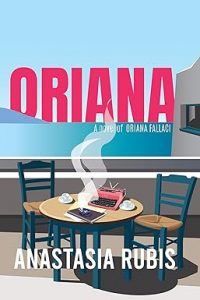 When a Hollywood producer comes to Oriana at the end of her life to propose a movie, the story unfolds of her gutsy career rise as a journalist, her tragic love, and her greatest regret.
Oriana Fallaci was born a rebel. She fought beside her father at age fourteen in Italy’s Resistance against the Nazis and overcame poverty, the lack of a university education, and relentless sexism in the newsroom. By 1973 when she moved to New York, Oriana Fallaci was hailed by Newsweek as the greatest interviewer of her day. She became famous for her courageous and hard-hitting interviews with Kissinger, Arafat, Meir, Khomeini and other world leaders—not to mention the most prominent celebrities and artists of her day.
That same year, 1973, she did what no journalist is supposed to do: she fell in love with one of her subjects, Alexander Panagoulis, the Greek poet and hero. She was 44, he was 34; they lived in different countries. It didn’t matter. Oriana had finally found what she longed for: a full life. But can a woman ever have it all, or does life always exact a price?
Oriana is the first novel about the glamorous and fearless Italian journalist whom Christiane Amanpour has called her role model for asking tough questions—and who holds a place beside Mike Wallace and Barbara Walters when naming world-class interviewers. This biographical novel tells the story of one of the first women to break through the glass ceiling of journalism, a woman who wasn’t afraid to speak truth to power and who revolutionized her field, all while trying to balance her career with love and happiness.
For readers who loved Hidden Figures and stories about women who succeed as women in realms traditionally reserved for men.
BUY HERE
Category: Contemporary Women Writers
Subscribe
If you enjoyed this article, subscribe to receive more just like it.