How to Use Eno and Ono While Revising Stories by Alex Behr
 While revising stories for Animal Kingdom, my second collection, I turned to Brian Eno and Yoko Ono as patron saints of risk and ingenuity. I’m blessed with untreated ADHD, discovered in adulthood. That means, for me, the first burst of a story or a poem can feel like a high: anticipation and adrenaline leading to flow. Coffee, optional. Music, necessary. However, it might not be complete. It might veer off into voice-y meanderings. It might be, as one workshop person said of one of my experiments, “All icing and no cake.”
It’s taken years of distance from my MFA program to enjoy rewriting stories. While in grad school, revising often followed tense workshop sessions in which people looked to the professor for guidance. Would it be a shark attack on the chum of my imagination? Could I even take in praise, or was I too suspicious? Equating revision to meet a professor’s standards to get a grade stripped joy from writing. I won writing awards in grad school, but the workshop environment eroded my confidence.
After publishing my first story collection, Planet Grim, I took poetry classes with Matthew Dickman at the Attic Institute. Mostly generative, the classes fed my curiosity and confidence. How Dickman viewed revision opened paths for me. He said, paraphrased: Make revision more of a practice and less of an act. And make it a continuation or extension of a first draft rather than a point of arrival. I also explored Brian Eno’s and Yoko Ono’s methods as I revised fiction—their approaches aligned philosophically with Dickman’s.
In the 1960s, Ono and Eno collaborated with Fluxus artists such as John Cage. The Fluxus art movement had an anti-commercial outlook and incorporated chance, humor, and absurdity. Ono’s book Grapefruit contains playful yet strange instructions such as, “Draw an imaginary map. / Put a goal mark on the map where you want to go. / Go walking on an actual street according to your map.” Ono wasn’t afraid to follow her whims.
This Fluxus approach helped me enter revision as play rather than labor. Different steps I took: Cut up a story and tape sections in a notebook. Leave space for sketches and writing. Speak “into” the story using the Word microphone feature. Or, borrowing form from Ono, write a story as a set of instructions and, as I revise, revel in the whatever strangeness occurs.
I also consulted a famous set of cards called Oblique Strategies. Created by Eno and the artist Peter Schmidt, each card contains an instruction for musicians who might feel stuck in the recording studio. In a story for Animal Kingdom called “Rock Widow,” I reached a plot crisis. It vibrates at the start—an older woman playing a power game with a young biographer who’s obsessed with her dead husband. But I overworked one revision pass by adding more scenes, a convoluted backstory, a secondary character, and even a murder weapon in a few pages. They diluted the story. One card offered a way out: “Discover the recipes you are using and abandon them.”
At a Portland, Oregon, café, I met with my writing coach, Margaret Malone, to rehab “Rock Widow.” First, I highlighted the actions on the page to see the ratio of movement versus “drum fills”—my tendency to write extraneous interior meanderings. To change this recipe, I changed some of the streams of consciousness into dialogue to see how the other character could respond. Others got recycled.
Then, I cut most of the secondary plot and dug deeper into the connection between the two main characters and the one who lurked unseen: the dead rock star. By staying tuned to what the character wanted and what was preventing her from getting it, I let the emotions drive the story to tighter scenes and a more devastating ending.
In “Dutch Tilt,” another story from the collection, a teenage pop star named Brooke has a breakdown onstage, but I couldn’t nail the choreography between her, the band—including her domineering father—the crowd, and the photographer who’d sexually assaulted her. An Oblique Strategies card offered a revision option: “Faced with a choice, do both.”
At another meeting with Malone, I talked through multiple endings. Because nothing was set, it felt like play. I visualized the actions in my head, driven by Brooke’s shifting emotions. Malone guided me, “How did she feel?” “Then what?” I blurted out what I imagined, unfiltered, knowing I could change it. Pouring all the onstage choreography through a strong emotional funnel helped me get to the ending.
I always knew I wanted it to end after the confrontation onstage, Brooke alone with her best friend. And keeping close to the feelings and actions helped get me there: “‘When I turn eighteen, things will change. Have to,’ Brooke said. The teens opened the trailer door and sat on the steps, smoking, waiting. The pine trees outside the fairground seemed to wait for night, too. Their tops too tall to see. Terminal buds, edging upward.”
I hope these techniques shake up your resistance to revising, too. The results, I promise, are worth it.
—
Award-winning writer Alex Behr is the author of the story collections Animal Kingdom and Planet Grim Stories (7.13 Books) and the poetry chapbook Grief Stick (Picture Frame Press), which accompanies a short documentary of the same name. She received an MFA in creative writing from Portland State. Behr’s writing appears in Tin House, Oregon Humanities, Vol. 1 Brooklyn, The Rumpus, and Epiphany, among many others. She lives in Portland, Oregon, and plays bass guitar and piano.
Animal Kingdom
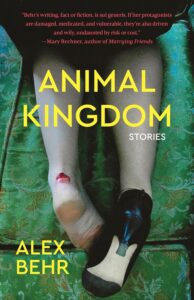 In late 2019, award-winning Portland author Alex Behr reunited with Chris Hartman, a lost love, after thirty years. Their brief, intense romance in San Francisco left behind no photos, and yet they’d never forgotten each other. Chris soon moved to Portland to start a new life with her. Tragically and suddenly, he was diagnosed with a rare, aggressive prion illness, Creutzfeldt-Jakob disease, and died just months after the move.
Tender, erotic, and damned, the nineteen stories in Animal Kingdom are inspired by Behr’s grief. It explores desire and searches for meaning from chaos and loss. With piercing humor, the collection explores a couple bonding over alien visitations, the brutal accommodations in a marriage between musicians, sexuality during menopause, and a teen girl’s bruising path to feminism via her Fender guitar. The stories share the theme that humans can’t escape their primal urges and are intelligent animals in the flawed kingdom we all share.
BUY HERE
Category: Contemporary Women Writers
Subscribe
If you enjoyed this article, subscribe to receive more just like it.