How to Write a Memoir in Six Short Years (And Still Wonder If You Got It Right) By Karen McKinney
When I began writing MISJUDGED: An Unlikely Friendship Between a Prosecutor and a Convict, I had stories from decades as a prosecutor, including years prosecuting gang members. What I didn’t have was a clear idea what the book was about. The bigger story: my friendship with Joseph, a man I sent to prison for life who, twenty-five years later, became my dear friend, was the bookend. But what were the pages?
I’ve read a gazillion memoirs. I think I hoped that by osmosis I’d be able to craft my own. Instead, it took more than six years to find the meaning in writing it.
The memoirs I loved most read like novels, with complicated characters who face obstacles and ultimately believable transformation. If you’re a celebrity, you can get away with telling us what you ate for breakfast in 1987 to stay skinny. The rest of us need more magic.
Having lived an interesting life, I learned, is not the same as knowing how to write about it. A memoir is a selection of moments that illuminate something larger. The trick is figuring out which moments matter, and why. That sounds simple. It isn’t easy.
So I talked to myself, literally. I’d go for walks with “Just press record” app running and tell stories as though I were talking to a friend over martinis. This loosened the tension of blank pages.
Still, writing memoir remains like the worst therapy session that goes on for years and is recorded in your own voice. If you’ve never heard yourself recount your deepest insecurities, questionable decisions, and occasional moments of self-importance, know that it can be painful – yet educational. That’s memoir.
Still, somewhere between the cringe and the transcription, I assembled a collection of stories. But a collection of interesting moments is not necessarily a book. What, exactly, was I trying to say?
The answer came from Summer, editor extraordinaire. What I was really writing about, she insisted, was choices, judgment and misjudgment: the assumptions we make about other people, whether anyone is truly incapable of change, and how well we really know anyone at all. I’d thought of myself as a human lie detector, only to discover that maybe I knew nothing about anyone, including the people I loved. That was the thread running through my story and Joseph’s.
Suddenly, the stories could be woven together.
What fascinated me most was that Joseph, after decades of confinement, seemed in some ways freer than I was. He had found a self-acceptance that had eluded me despite years of therapy and meditation. Apparently, knowing yourself isn’t quite the same as accepting yourself. The memoir wasn’t simply about his transformation. It was about what his transformation had done to me.
Then came the hardest part: deciding which stories didn’t belong.
I’d included a chapter about another gang member I’d prosecuted. He had shot someone. Because of mitigating factors, I reduced the charges, which meant he never went to prison. That decision haunted me for twenty years. What if I’d been wrong? What if he killed someone and that was now on me.
Years later, I learned he’d become an English professor and an author. It seemed like a perfect story about second chances.
But when he sent me portions of his writing, I discovered he had cast me as the villain, an evil prosecutor determined to destroy him. Back then, he was young and understandably saw me as his enemy. But holding onto that view twenty-some years later, after never spending a day behind bars, suggested he hadn’t done the harder work. Maybe because he’d never had to do time, either in prison or on himself.
Joseph had far more reason to resent me. I’d cross-examined him, challenged his credibility, and argued he was a man without redeeming qualities. Yet he had let that narrative go. And I’d had to let go of mine: my certainty that a person who committed terrible acts was incapable of becoming someone different.
I saw what that made possible when Joseph and I spoke to a group of men serving life sentences in a maximum-security prison, through his work with the Anti-Recidivism Coalition. I opened with a question: “How many of you think I have nothing to offer you because I was law enforcement? How many of you don’t trust me?”
Hands went up across the room.
“As long as you hold onto that narrative,” I told them, “we’ll never find connection. And if I see you only as a rap sheet, how can I ever understand what you’ve been through, your trauma or your transformation?”
When Joseph and I both dropped those narratives, we made room for something neither of us could have imagined.
Connection. Friendship. Even love.
In the end, the contrast between the two men told me which story to tell. The other man never let go of the story he told about me: that I was the enemy, that law enforcement was the enemy, that authority itself was the enemy. He had stayed free, and yet, in my mind, stayed confined. Joseph spent decades behind bars and found a freedom he never did.
So I cut the story of a prosecutor’s gamble that paid off. It was a simple success story, not a true transformation. What Joseph taught me was how he found hope during and after his confinement, and how we both found friendship by dropping the narratives we’d held onto out of fear. In a world where we are so polarized and desperately need connection in the most unlikely of places, that was the story I needed to tell.
—
Karen McKinney is a career prosecutor and former public defender who rose to the highest ranks of the gang unit in Orange County, California. She is also a screenwriter and producer who has developed a pilot script with Law & Orderproducer Robert Nathan and another with producer partner Gary Hart, former head of Paramount TV. A graduate of the University of Pennsylvania and the Charles Widger School of Law at Villanova University, Karen lives with her husband and two children in Orange County, California, where she continues to work in the district attorney’s office.
—
Misjudged
An Unlikely Friendship Between a Prosecutor and a Convict
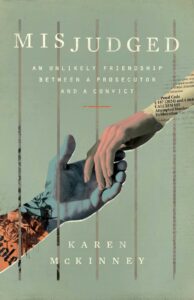 For fans of Just Mercy and What My Bones Know, the story of a gang prosecutor who reunites with the man she sent away for life twenty years after the fact—and learns the true meaning of justice, compassion, redemption, and connection.
Born to Holocaust survivors and trained in the black-and-white world of law, veteran gang prosecutor Karen McKinney believed in justice, punishment, and moral certainty—so when she was asked to oppose the parole of a man she sent away for life twenty years earlier, she expected to confirm his ongoing danger. Instead, she was confronted with something she had never encountered: true transformation.
Misjudged chronicles McKinney’s radical rethinking of justice through her evolving friendship with Joseph Herrera—a man she once believed to be irredeemable. Woven with personal reckonings, family trauma, and courtroom tension, this powerful memoir of healing and self-discovery reveals how the silent burdens of inherited trauma, family shame, and generational judgment shaped McKinney’s worldview—and how, through great effort, she began to break free and learned that the stories that shape us don’t have to define us. For anyone who has ever felt stuck, spiritually hungry, or disconnected from their true self, Misjudged is a compelling and hope-filled exploration of what it means to understand another person’s capacity for change and how to drop our fear-forged narratives in order to find true connection and humanity in this polarized world.
PREORDER HERE
Category: Contemporary Women Writers
Subscribe
If you enjoyed this article, subscribe to receive more just like it.