How to Write Fiction That’s True by Jann Alexander
If Virginia Woolfe was right when she wrote, “the truer the facts the better the fiction” in her classic A Room of One’s Own, there’s no better inspiration for writing a story than a true one. Find an old news clipping from 1892 or a web article published yesterday—you can’t invent anything stranger than the truth.
Fiction that reimagines real-life tragedies and outcomes is popular with readers because it yields complicated characters, facing real-life dilemmas and impossible choices, under tough circumstances. Themes that are ripe with difficult challenges resonate with readers, and make for page-turning fiction.
Think about a news story that catches your eye. Don’t you find yourself wondering how that could have happened? Could it have been prevented, who was at fault, was anyone at fault? And now you have the makings of a book.
When you adapt the history or news you uncover into your own novel, keep these things in mind, as I do in writing my novels in The Dust Series.
Start with the actual known facts.
My ideas for Vacancy: Secrets and Second Chances in Small-Town Texas, began percolating when I read two news articles on the front page of a large metro newspaper, about two decades ago. One article reported a joyful coincidence of reunited love, and the other told of a horrific tragedy no one saw coming, with blame already assigned. I couldn’t stop wondering about the circumstances behind each story, and I followed every bit of news I could find.
Learn everything else you can about the people involved.
By parsing the smallest details of every news article, diary entry, oral history, or quote, and learning about each person involved, you can combine real events and actual people into new fiction that reads like it’s true. Track down not just names and locations, but visual details, ages, personal histories, work and recreation habits, their manner of speaking, where they live, their town’s personality and weather, anything that puts the reader in the midst of the action, feeling the emotions the actual people must have felt—before, during, after.
These techniques helped me convey the feelings and reactions of people caught in the ecological disaster we call the Dust Bowl, in my first novel, Unspoken: Secrets and Survival in the Texas Dust Bowl.
Think through the many emotions people feel when unspeakable tragedy strikes, before you fictionalize it. When you assign a fictional character a role corresponding with a real person’s, create a character study first, to get her behavior right. Put your research into scene settings to achieve a sense of the place before you write. Ultimately, the more real the stories, places, characters, and emotions, the more believable the novel will be.
Change the names, places, dates as necessary.
If a horrendous event you’re adapting is the kind of tragedy that drew journalists to the scene, chances are the actual people involved are desperate for privacy after the news cycle moved on. Use sensitivity with real names and real places that could identify the accused, the victims, or the ones who got away. While you show empathy for the real-life people you’ll be turning into characters in your book by changing the details, you’ll also be protecting yourself from potential legal action.
So consider changing names, identifying characteristics, and places, and you’ll be protecting their privacy, along with your creativity. In writing Vacancy, I relocated the real stories that inspired the plot and characters, moving everything to a mythical town in Texas (which was the site for my first novel in The Dust Series, Unspoken). I renamed the actual people in Vacancy, added new fictional characters to expand the actual story, and imagined what I could never know about their real motivations—before I put my words in their mouths.
Examine what’s known, and reimagine everything in many ways.
Here’s where the fictionalizing of real events gets fun for the writer, and even more compelling for the reader. Turn over the facts you’ve gathered, the real events and people involved, and think through the many actions that must have led up to the tragedy. In Vacancy, I took the opposite approach of the common understanding of the shocking event. By reimagining how things could have gone awry unintentionally, I presumed innocence, even though some were being judged guilty in real life. Each option was plausible, which gave the fictional telling more depth. I explored the many ways a tragedy becomes one, either by intention, or with no one intending harm, before I turned the real events into realistic fiction. Those many possibilities can become part of the plot, and keep the reader guessing.
Put yourself in your characters’ shoes.
The true test of how realistic your fictional retelling plays will come when you step into the shoes your characters are wearing. Try those shoes on before you ask your readers to. As the writer, it’s been your choice to make characters unwitting, intentional, or unaware, all motivations that could lead to innocence or guilt. Ask yourself, has my storytelling been persuasive, engaging, believable? Are my characters as sympathetic as I intended, or as darkly-intentioned as I meant them to be—or perhaps, too much so?
It’s up to you to make the reader truly feel the story.
Creating realistic fiction from real events requires an understanding of human nature in life’s most challenging moments, where impulses uncover the best, and the worst, in anyone. When the event you’re writing about is as dramatic as tragedy gets, the emotions should run high enough to match. This is your chance to ratchet up the tension for the reader, so her heart is pounding as loud as your character’s. Because you started with a dramatic real-life story, with the plot points known but the participants’ feelings unknowable, your retelling must evoke a full range of emotions and dramatic reactions. Put your reader in the moment. Otherwise, she might just as well have read the dry news reports.
I realized I’d put a reader of Unspoken in the moment, when she called my Dust Bowl novel, “vividly descriptive.” She continued, “I’m holding my breath, finding it a little harder to inhale, wondering if that’s how Ruby Lee and the rest of her family felt … breathing in dust instead of oxygen. Just when I’m wanting to take a break to go outside to inhale, the author fixates my attention on the next scene: the black blizzard, and I can’t put the book down … Page after page, I’m reading the captivating scenes that seamlessly burn from the pages, the descriptions authentically bringing alive the characters and storyline.”
That’s what I always aim for.
—JANN ALEXANDER writes characters who face down their fears, in novels as true as fiction gets. She is the author of THE DUST SERIES, including the best-selling historical novel, UNSPOKEN, set in the Texas Panhandle during the Dust Bowl and Great Depression eras, her first book in the series. With a dozen years of research into Texas, she’s also a speaker on its hidden histories. Her next novel in The Dust Series, VACANCY, is fictionalized true crime with second-chance romance, and releases in September 2026. Her third Dust Series novel, OVERDUE, releases in May 2027. Jann always brakes for historical markers.
Web and Social Links:
Website
Amazon Author Page
https://www.amazon.com/stores/author/B0F2KKHPZ9/about
The Dust Series Books
Social Media
https://www.facebook.com/JannAlexanderAuthor
https://bsky.app/profile/jannalextx.bsky.social
https://www.instagram.com/jannalextx/
https://www.linkedin.com/in/jannalextx/
Vacancy: Secrets and Second Chances in Small-Town Texas (Dust)
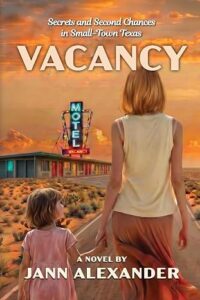 A sudden widow. A single mother. Both have a habit of hiding from hard truths until a brutal accident-or was it?-forces them to face what they’re hiding, and what they want, in an unforgiving Texas town.
Helen is childless and widowed after a long marriage, and gets a second chance with a long lost love. But she’s grieving her hidden regrets. She bonds with her quiet kindergarten student, and doubts the girl’s struggling single mother, Charlene, is fit to parent.
Charlene’s hiding a secret of her own, and she resents Helen’s interference. She’s determined to make a better life for her young daughter, the teenage boy her ex left behind, and the baby on the way, when a scarred veteran offers to lend a hand.
A tragedy no one sees coming forces the two women to unite, as small-town bias threatens to destroy innocent lives. But first, Helen and Charlene must confront the vacancy in their hearts, to find newfound strength, acceptance, and a second chance at love.
Based on a true story.
BUY HERE
Category: How To and Tips
Subscribe
If you enjoyed this article, subscribe to receive more just like it.