Imposter or Outsider?
By Mary Camarillo
Feeling like you don’t “fit in” to certain spaces, that any personal success is undeserved because it’s unearned, and to always be certain you’ll eventually be called out as a fraud are signs of Imposter Syndrome.
I’ve claimed this particular malady.
When my family moved to Southern California from North Carolina in the mid 1960’s, I was an awkward fourteen-year-old with a southern accent who looked nothing like a “California Girl.” When I went to work at the Santa Ana Post Office after high school I felt conspicuously “working-class” around my college-educated friends and family, but at the post office, I told myself I wasn’t like the other employees since I wasn’t planning on working there forever.
I ended up doing just that. I kept the job, went back to school, got a business degree, and then a promotion to the accounting office. When I was promoted to a management position at the Long Beach Post Office, I always felt like an outsider because I wasn’t an original member of the Long Beach “family.” When I hired on with the Office of Inspector General and earned a Certificate of Internal Auditing and a CPA, I never felt like a “real auditor” compared to my coworkers.
When I started writing fiction ten years ago with no MFA, English degree, or creative writing credential, some folks didn’t take me seriously. Including me. I hesitated to call my fiction “literary” because it sounded pretentious. I’m still reluctant to read my poems in public, even when they’ve won prizes and cash awards.
Acknowledging these feelings is a first step toward recovery. When I mentioned these tendencies in a recent issue of my newsletter, “Life with Riley,” I was shocked when several writers I admire wrote back and admitted that imposter syndrome basically defines their lives. It’s helpful to realize you aren’t the only one who feels like a fraud.
If you can help another author realize that their work has value by showing up for their readings, writing reviews, and sharing their good news, you’ll find that most authors are very grateful. After publishing two novels, I’ve personally experienced how generous other authors can be to those who have been generous to them. What goes around comes around.
Writing is a solitary endeavor and being part of a supportive literary community is another effective way to combat imposter syndrome. Community can be found in writer’s clubs, local libraries, book clubs, and local bookstores. Online writing communities are another terrific option for finding community. For example, I’ve been part of Lindsay Merbaum’s Study Coven for years now and have met helpful writers from all over the world.
Polishing your skills can only improve your confidence. Put in your 10,000 hours. Read widely, as much as you can, and read as a writer. Study craft books, join a workshop, and take classes at local community colleges.
A caution, however. Writing critique groups can be extremely helpful but also completely devastating. Some writing groups can be mean-spirited by focusing only on what is wrong with a piece. Effective writing group members are specific, mention what is working, where they had questions, and what they’d like to see more of. Workshops should leave the writer excited to get back to work, not ready to abandon the entire project.
It takes time, but a writer needs to learn to trust their own voice. Writing group advice is often conflicting and it’s impossible to recognize early that we can’t please every reader.
“Avoid comparing yourself with others” is something else folks like to suggest, that is much easier said than done. A quick scroll through my Facebook feed today revealed that two author friends have new books coming out, one got a blurb from musician Jason Isbell, one found her book on the shelf at Shakespeare and Company in Paris, and one received an “International Impact Award.”
I don’t even know what this award is, but am I a failure because I don’t have one?
Another common recommendation is to “Act as if you belong somewhere and people will eventually believe you do.” To many people, “successful authors” look like money. Their book is on Oprah’s list. It was a NY Times bestseller. There’s a movie coming out.
How does one act like a writer? Besides writing regularly, one might set up an author webpage or create a Facebook Author Page. Print out business cards. Raise your hand when anyone asks if there are writers in the room. Own it. Or not. Social media and constant self-promotion isn’t for everyone.
That’s the problem I have with “Faking it until you make it,” because it assumes there is some kind of “normal behavior” we strive for, so we can “make it” and “achieve success.” If we can’t or we won’t, we decide there is something wrong with us, when there isn’t.
There is a lot wrong with not recognizing the value of having an outsider’s perspective, of being able to inhabit other personalities, of putting ourselves in places where we’re not a perfect fit, of reaching slightly beyond our grasp and then reaching further. Our experiences—whether we perceive them as earned or fraudulent, normal or outside the box—inform our work, enrich our lives and deserve respect.
Especially from ourselves.
—
Mary Camarillo is the author of the award-winning novels The Lockhart Women and Those People Behind Us.
Her awards include the 2023 Finalist in the American Book Awards for General Fiction, the 2022 Willa Literary Award Finalist in Multiform Fiction, the 2021 First Place Award in the Next Generation Indies for First Fiction, the 2022 Finalist for the Screencraft Cinematic Book Award, the 2021 Finalist in the American Book Awards in Women’s Fiction, the 2023 Hawthorne Prize (shortlist,) the 2022 Silver Titan Award, and the 2022 Honorable Mention, Los Angeles Book Award for Regional Fiction and the 2022 Honorable Mention, Hollywood Book Award for Fiction.
Her poems and short fiction have appeared in publications such as TAB Journal, 166 Palms, Sonora Review, and The Ear.
THOSE PEOPLE BEHIND US
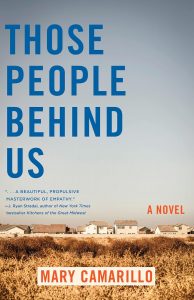 It’s the summer of 2017 in Wellington Beach, California, a suburban coastal town increasingly divided by politics, protests, and escalating housing prices—divisions that change the lives of five neighbors.
Each character confronts death, betrayal, financial decline, and loneliness as they search for home and community in a neighborhood where no one can agree who belongs.
Real estate agent Lisa Kensington juggles her job, her shopaholic husband, a mother who knows how to push her buttons, and teenagers with ideas of their own. Ray Gorman, a haunted Vietnam vet, lives with and cares for his aging mother. Keith Nelson, an ex-con, lives in his car, parked near his parents’ house. Sixteen-year-old Josh Kowalski works through the shock of his father’s abandonment by slamming on a drum set. Jeannette Larsen, an aerobics teacher numbed by horrific tragedy, turns away from her husband and toward reckless behavior.
In the end, they all discover that despite their differences, they are more connected than any of them would have imagined.
BUY HERE
Category: On Writing
Subscribe
If you enjoyed this article, subscribe to receive more just like it.