It Takes a Village to Write a Novel by Martha Conway
I spend a lot of time alone. I like it. I like writing, I like doing research, I like thinking about what I’m writing, and I like making notes and scene lists. When I’m alone, I can dig deep to explore what is meaning to me, and how best to express it.
But during the Pandemic, like most of us, my Alone Time ballooned out of proportion. I was just beginning to formulate a story about two American sisters trapped in Ireland during World War II. This novel, We Meet Apart, is a hybrid of historical fiction and alternate history. It explores two realities: one in which Ireland did not fight in the war (historically true), and one in which Nazi Germany invades Ireland and then runs the country (historically planned, but never executed).
All this meant I had to do research—part of the fun of writing historical novels—on lots of areas I knew very little about: domestic life in Ireland in 1940; domestic life in Nazi-controlled countries during World War II; Irish country manor life for both the rich and their servants; and Celtic lore about ghosts and the otherworld.
In the past, I would simply look for books and articles and web sites to help me. But during the Pandemic I spent more time emailing friends, acquaintances, and strangers—both professionals and non-professionals who might offer telling details. Of course, I still read books and visited web sites. But I craved more communication with actual people. And what I found was that their experiences inspired my creative imagination much more powerfully.
Who would have guessed? Real people helped me write a more interesting story.
An Irish contractor fixing our bathrooms gave me host of slang and idioms. (“Would your grandfather have said that?” I often asked. “He would, so.”) I had a long email exchange with a Facebook contact about “Petticoat Pilots”—female airplane pilots in Ireland in the 1940s. An English poet whose mother traveled back and forth from Ireland in 1942 did a huge amount of ground research for me. (Sidenote: when I finally was able to meet this poet, at the end of the Pandemic, we had scones and tea in the Irish manor house that I’d been envisioning for my novel.)
I corresponded with Cork librarians and historical journalists in Dublin, and Irish immigrants here in America. I don’t think I’ve ever talked to more people about the novel I was currently writing than during the time we were supposed to be keeping our distance from other people.
It was a huge lesson for me in reaching out, in listening, in keeping an open mind and an open creative spirit while generating a story. And lots of interesting, unlooked-for details found their way into my story, such as the Petticoat Pilots.
If you are like me, it might take something like a Pandemic to reach out to strangers—but I’m hoping this post will encourage you to reach out more, starting right now. For me, it’s become a habit that I didn’t know I needed.
Here are a couple of tips.
Admit You’re a Writer
This can be hard. Our work often feels private, and we want to protect that. I get it. I also know that it’s good for our souls to go public—and it is self-affirming. If you’re writing your first novel (or short story or memoir) or your tenth, saying so publicly will give you confidence. Try it out on a few close friends and see how it feels, then go wider.
Actively Seek Potential Sources
Certain professionals are used to being sources for writers, like librarians, journalists, and historians. I’ve had the best luck with talking to people I’m connected with, such as my neighborhood library resource specialists, or very specific historians, such as an Irish professor of World War II history.
Tips:
- Let them know how you found them and why you went looking. If possible, compliment them on the work that led you to them.
- Be as specific in your questions as you can.
- Don’t overwhelm them. They don’t want to feel like they are doing your work for you. One or two questions is probably the most you can hope for—and always end with asking for advice on additional sources, such as books or articles they can recommend. (These books or articles may be written by someone else you can tap!)
Listen
People love to talk, and they love to include strange details (one of the hallmarks of a good story). Pay attention to these details, because you can often repurpose them for your own project. I write historical fiction, but I can’t tell you how many details gleaned from 21st century Americans I’ve used in my 19th century novels. (A lot!) Keep your project in the back of your mind even in the midst of a casual conversation. I’ve gotten tidbits from my friends’ grandmothers and grandfathers, from dog groomers, from neighbors, and from people I’ve sat next to on airplanes.
Tips:
- Ask follow-up questions. Dig deeper if something lights a creative spark in you. You may not know what you will use that detail for yet, but if you’re interested in it, chances are your readers will be interested, too.
- Ask the person if you can use that detail—or not! I often say, “That’s going in a novel!” to my friends. This is their chance to say no, please don’t use it (they never have yet). To a casual, one-time acquaintance (like an airplane seatmate) I may not say anything but simply tuck the detail away in my mind.
Christina Baker Kline wrote a lovely substack post on the “generosity of the room,” and the many ways that writers in a community (large or small) give to and learn from each other. This is so important, and I’ve experienced it myself.
I’ve also experienced generosity in that wider room—the world. Most people, my husband likes to say, enjoy doing a favor if it’s not too difficult. Helping someone else makes many people feel good. And small details about someone’s life is a rich ore. You can’t find these things in books. Artificial Intelligence will not drag them up, because there is no digital record.
These details are unique as well as interesting. What could be better for a novelist?
Where have you found unexpected help? An odd, delightful anecdote related to you by chance? An encounter that shifted your fiction into wondrously new territory? A phrase you’d never heard of before? Please share them in the comments—I’d love to read about them!
Here’s to reaching out and connecting.
Martha Conway is the author of five novels including The Underground River, which was a New York Times Book Review Editor’s Choice in 2018. Her short fiction has been published in the Iowa Review, The Quarterly, The Carolina Quarterly, Folio, and other journals. She teaches creative writing for Stanford University’s Continuing Studies Program and writes short, humorous posts on the creative life on the Substack 500 Words.
WE MEET APART
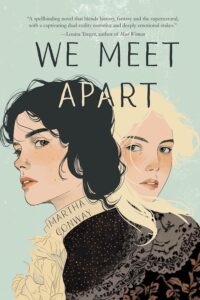 When World War II halts ocean travel in 1940, two American sisters find themselves stranded in Ireland— but in different realities. In 18-year-old Gaby’ s world, Ireland remains neutral, just as history records. But in 17-year-old Sabine’ s world, Germany has invaded Ireland, and she must survive on the run. Both sisters find refuge at the same remote Irish manor owned by distant relatives.
There, for one hour each dusk— ” the time of pookies and ghosts” in Celtic lore— their two worlds overlap, and they can be together again. But when Sabine falls in love with a German officer who is charming in her world but sinister in Gaby’ s, even that brief time is in danger. We Meet Apart evokes the dreamlike style of Haruki Murakami, revealing how thin the veil between worlds can be. It asks: If you lose the people you love in one world, how hard would you fight to keep them in another?
You can order her latest novel, We Meet Apart, at Barnes & Noble, Amazon, or your local bookstore.
Martha’s Bookbub link: https://www.bookbub.com/authors/martha-conway
Christina’s substack link: https://substack.com/home/post/p-179755939
We Meet Apart Barnes & Noble
We Meet Apart Amazon
We Meet Apart bookshop.org
Category: Contemporary Women Writers, On Writing
Subscribe
If you enjoyed this article, subscribe to receive more just like it.