It Was All French to Me
By Jane Harrington
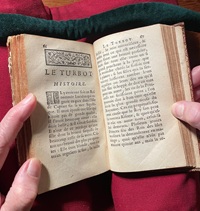 My new book, Women of the Fairy Tale Resistance, was born of a desire to bring to readers the lives and works of 17th-century salon writers who created the first fairy tale craze and then were pretty much left out of the history of the genre. I had first learned of these women when preparing a college course on the origins of the fairy tale, determined to include female tellers in the curriculum. (The only “classic” tale that is credited to a woman is “Beauty and the Beast.”) Poring through scholarship, I found these women peering from the margins: seven prolific writers who were even credited with coining the term “fairy tale,” or conte de fées. So began a quest to understand what they were about and why they were excluded from the canon.
When I pitched the idea for this book, it included only three of the women—Marie-Catherine d’Aulnoy, Henriette-Julie Murat, and Charlotte Rose La Force—because those were the only ones I’d been able to learn much about, whose tales I’d been able to read, who’d been the subjects of academic articles. But the editor who acquired the project was intrigued by references I’d made to “seven sisters of the salon.” Could we include them all? she wondered. So began a ratcheting-up of my quest, one that required moving beyond English-language scholarship to see what I could learn about the women from French sources.
I knew this would be a challenge, because I don’t read French! But, hey, I told myself, it’s the 21st-century and we’ve got translation technology. Plus I knew some fluent folk who could help me out in a pinch. But the trials were many, nonetheless. I felt like Psyche, the protagonist in Apuleius’s “Cupid and Psyche,” who was given impossible tasks by Venus: to sort a massive heap of the tiniest seeds, to gather golden fleece from elusive sheep, to retrieve water guarded by Cerberus, and to search the underworld for strands of Persephone’s beauty. (This ancient story was, in fact, vivid in my mind as I worked, because it was a favorite of the salon women’s and a source of motifs they wound into their fairy tales.) Walls of books rose around me and the ever-multiplying files on my computer defied all attempts at organization. My eyes hurt from reading, my back ached from hunching over my laptop, and my brain spluttered from trying to make sense out of conflicting information and often indecipherable translations.
Yes, turns out the translation technology was far from a magic wand. At the time (just before LLMs became so adept at translation…something lamentable for a variety of reasons) I would rely on Google Translate or DeepL, with varying success. When I had a digital file of a French article or chapter of a modern text, the apps would do a fairly decent job, but when it came to the rest of it, Ugh. For physical books, though I could perform the voodoo of translating a page by taking a picture of it, the results were usually garbled; even at its best, the process was a page-by-page effort, so getting through the books I’d amassed was laborious. As to archival materials, mainly 17th-century documents accessible as scans via France’s national library, there was nothing that could come even close to translating the typeface from that period. (ChatGPT is—to my surprise, again lamentable—capable of that now.) So those kinds of translations had to happen by hand, meaning I entered the texts word by word into Google Translate, and went from there. It was incredibly tedious and time-consuming.
There were moments when I thought there was no way I was going to complete the research and writing on schedule, given the language-based obstacles. But like Psyche—who got help from ants to sort her seeds and an eagle to bypass Cerberus—I had some divine helpers. The librarians at my university who gathered texts for me from far and wide were so dedicated that I lost no time between discovering new lines of research and having the sources in front of me. My French-fluent daughter pulled herself from her graduate studies when I needed emergency translations, and also served as my assistant on a research trip to France. I never would have made the headway I did without the swift delivery of library books, nor managed to hold in my hands the volumes I did with my daughter guiding me through the understories of the Bibliothèque nationale. Which is to say that I never would have come to fully understand who these women were and why they were excluded from the canon, nor place now their stories in the hands of readers.
—
Jane Harrington teaches wordcraft and fairy tales at W&L University and in the graduate program at Hollins University. Her research and writing passions include the 17th-century French salon writers who shaped the fairy tale tradition, Irish folklore and history (with a focus on the Wilde family), and the ecology and culture of the Appalachian region she calls home. Jane’s short fiction and creative nonfiction have been published widely in journals and anthologies, and her indie novel In Circling Flight was the winner of the Brighthorse Book Prize and longlisted for the Crook’s Corner Book Prize. Her newest book, Women of the Fairy Tale Resistance: The Forgotten Founding Mothers of the Fairy Tale and the Stories That They Spun (Black Dog and Leventhal, August 2025), is described by ALA’s Booklist as “meticulously researched and gorgeously presented” and “perfect for readers drawn to feminist literary history, narrative reclamation, or the enduring influence of myth.”
—
Women of the Fairy Tale Resistance: The Forgotten Founding Mothers of the Fairy Tale and the Stories That They Spun
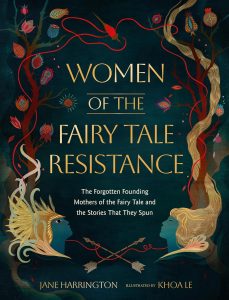 Long before The Brothers Grimm, there was a sisterhood of writers who defied the patriarchy and launched a literary craze with their feminist fairy tales—these are their stories.
In 17th century Paris, a group of women who called themselves conteuses (female storytellers) came together to weave the very first fairy tales. One of them, Marie-Catherine d’Aulnoy, coined the term ‘fairy tale,’ and some of these stories contain many familiar elements that appear in tales like Rapunzel and Beauty and the Beast. Unfortunately, these women and their tales have mostly been forgotten to history.
Women of the Fairytale Resistance uncovers seven of these writer’s biographies—which are just as compelling as their fairy tales—and retells 12 of their original stories. The women were mostly young noblewomen who were forced into undesirable marriages and did not have the freedom to give their opinions, travel, or choose who they wanted to love. They used their stories as a way of subtly complaining about their husbands and critiquing the oppressive reign of King Louis XIV. The female-empowering, gender-bending tales combine themes like romance, fantasy, escapism, and their protagonists control of their own destiny—something the writers deeply desired in their own lives.
Enchantingly designed with stunning full color illustrations throughout, this unique and entertaining book will have you rethink everything you know about traditional fairy tales.
BUY HERE
Category: On Writing
Subscribe
If you enjoyed this article, subscribe to receive more just like it.