Lights in Cold Rooms: A Psychologist Reflects on Family, Aging, Love & Loss
By Joan Cusack Handler
When I first started writing Lights in Cold Rooms and for a few years into it, I did not have plans for its future other than that it is/was a record of my depression and my efforts to bring myself to wellness during COVID when mandatory quarantine precluded working with a clinician, other than myself.
It was clear that I would be the patient and the therapist working together to treat my illness. My treatment would make use of what we know of in psychology and creative writing as stream of consciousness technique which requires a commitment to not editing, just recording everything that comes to mind, whether the material makes conscious sense or not. Beyond that, as my self-treatment proceeded, I began to see my notes as material that I would save for my son and granddaughters who would be the keepers of our family history.
The fact that I learned very little from my parents about their history until late in life when I recorded their stories, made it essential that I provide the story of my own. I wanted my family to know me. I was stunned by how much material came to me. As far as I was concerned every word was important. As was the order. Months, days, weeks fell on each other as my unconscious delivered my history— some of which was familiar, some weren’t. I continued to write. The darkness inside me slowly began to lighten.
The most challenging part of the work was facing my own flaws—my resentment of my older sister for her dependance on me and her reluctance to take care of herself; my inability to accept my father’s vulnerability as he approached his 100th year. Other events occurred during the course of my sister’s treatment. The most painful eruption occurred as I faced her imprisonment in a rehab facility the first night of quarantine which meant that no one, not even her son could accompany her into this facility where she died later that night—not of COVID, but of a heart attack.
The reality was that she would not be memorialized with a funeral or some ceremony in her honor but rather was cremated the very night of her death. None of us could attend. The saddest part of Catherine’s story is that none of us –her son nor me have been able
to plan a memorial on our own. We owe her that tribute. I will talk to her son and ask him to join me in arranging a memorial for her next birthday. It will be the fifth since her death.
The gifts my unconscious offered were dreams that arrived as respite. The first was one of my father, in which he was lying in the ground in a well-kept grave dressed in his usual clothes—dickeys, flannel shirt buttoned as always at the neck suggesting an air of elegance, and Mom’s Aran Sweater which he had worn for the better part of twenty years since she knitted it. Remarkably, there wasn’t a blemish on his face or hands, a crumble of dirt that had fallen into the grave. He was peaceful and quiet in his new bed. “Don’t be afraid, Honey. I’m not. The light is rich and warm.” Such lovely reassurance from my beloved father who had been my favorite parent and knew my heart.
The next dream was of a beach scene like the one we played in all our young lives. Laying in the sand was a festival of gold shells. I picked one up and turned it over. It was a cameo, just like the ones that my sister, Catherine, and I bought for each other so many years ago. It was up to each sister to save our babysitting money to buy our sister the special pieces she craved—cameos, pearls, birthstone rings among them. I immediately knew that the array of sparkling cameos that greeted me on that day were from Catherine, saying she was basking in the love we had shared. She was no longer angry. She was at peace.
This dream was followed by one of my deceased therapist whom I had worked with for several years. Henny supported me in every way—as I readied myself for my doctoral thesis and orals, as a woman, mother, an intellect. She believed in me and embraced me as a woman worthy (albeit non-Jewish) to marry my Jewish husband when his Jewish mother adamantly rejected our marriage.
Finally, I awoke from a dream months later to me asking myself, “Why don’t you let people love you?” Followed by the shortened version, “Let people love you” that I recognized as my unconscious gently reminding me to not shy away from family and friends who sincerely loved me and hoped to be closer to me addressing my preference for isolation rather than people.
While I cannot predict that you too will be visited by dreams should you decide to explore the wealth of information that is waiting for you if you consider putting down your editing pen and just write, write some more, whatever comes to mind, I can assure you that stream of consciousness writing will surprise you with how invaluable a source of information about yourself it holds.
—
Joan Cusack Handler is a poet, memoirist, and psychologist. She has published three verse memoirs—GlOrious, The Red Canoe: Love in Its Making, and Orphans—and one prose memoir, Confessions of Joan the Tall. With Gabriel Cleveland, she co-edited Places We Return To, an anthology featuring selections from the first 100 books published by CavanKerry Press, the press she founded in 2000 and continues to serve as publisher. Her poems have appeared widely and received recognition from Boston Review as well as five Pushcart Prize nominations. She is also the author of the PsychologyToday.com series “Of Art and Science.”
https://www.joancusackhandler.
https://www.barnesandnoble.
https://www.amazon.com/Lights-
Lights in Cold Rooms: A Psychologist Reflects on Family, Aging, Love & Loss
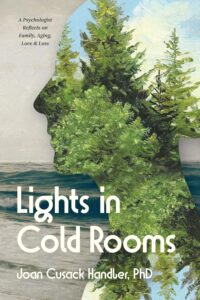 An honest account of depression from poet and psychologist Joan Cusack Handler.
Lights in Cold Rooms shares Joan Cusack Handler’s personal experiences with depression as a licensed psychologist with forty years of experience treating patients. For many, including Handler, quarantine precluded the preferred treatment of psychotherapy. Handler turned to her own pathology to teach herself and others how to navigate both isolation and depression. Feelings of anxiousness and impending mortality intensified as she faced the death of her older sister and grappled with the guilt that erupted when she learned that an in-person memorial service was impossible. Opening both her personal history and pathology to public view, Handler chronicles her confrontation with eighty years of family dynamics and explores the path she took to return to a place of hope.
BUY HERE
Category: On Writing
Subscribe
If you enjoyed this article, subscribe to receive more just like it.