Lost Trades, Lost Art, Lost History…and Lost Women By Sara Dahmen
A coppersmith? Tinsmith? What’s that?
For over a decade, people lean in, thinking they mis-heard one of my job descriptions. A what? You do…what?
And, for over a decade, I’ve wondered what it must have been like for women over 150 years ago who also became tinsmiths or coppersmiths. Building cookware and candle sconces with their hands, or providing bullet cartridges and ship lanterns, meant they were essential to any community where they plied their trade.
Yet, it was still a man’s world, filled with generationally guarded secrets. Women typically ended up as tinsmiths or coppersmiths under duress. If their spouse died early, or their brothers died young, females picked up the slack and sometimes became complete masters of the trade. We do have written historical proof in America going back centuries of these anomalies, but that’s only the women who managed to leave behind a written record.
I’ve inadvertently become obsessed with the women lost to time and history. As a traditional coppersmith myself, I feel intimately connected with the females hidden in the margins of ledger books, simply because I’m working to keep their legacy alive in the modern world.
A coppersmith? Tinsmith? What’s that? And how did you…?
Twenty-some years ago, had someone told me I’d spend most of my adulthood doing what I despised, I would have laughed, loudly, with my head thrown back. Decimals? Fractions? Chemistry? No way. I’m terrible at those things. I’d never do them for fun, on purpose.
Ha! Only under duress.
I’m a firm believer of writing what one knows intimately. It’s important to me to write about places I’ve physically visited (if possible) and write the details of what I’ve not only read about, but experienced firsthand. It’s why participating in historical reenactment camps was so pivotal. Because of those experiences, I can properly explain in my historical fiction about the weight of petticoats on our hips, the squeeze of stockings around our knees, and how corsets, when properly fitting, are more comfortable than today’s modern bras. (Shocking, right? But so true!)
It all started over 12 years ago, when I was researching a book and cookware. My questions were simple, I thought. What did women cook on in the 1800s? Why did they use it? And how was it built and maintained? From that research, when I decided to write about a woman tinsmith in the 1860s, it was doubly important to go to a traditional tinsmith’s shop and watch him work. I’m lucky in that Bob Bartelme, one of the nation’s greatest historical tin and coppersmiths lives about 18 minutes from my home, and he was willing to not only show me how machines and techniques but to take me on as an apprentice.
I didn’t realize it in the early weeks, but going to Bob’s metal shop several times a week, toddlers in tow, was essentially a true apprenticeship in the manner of Johnny Tremain. My children grew to call him and his wife Grandma and Grandpa, we showed up for holidays and family reunions, and I spent years upon years learning the ins and outs of the trade.
This of course meant I could write about it from an extremely intimate level in my novel, Tinsmith 1865, the first of the six books in the Flats Junction series. It also meant I could build House Copper & Cookware – the only female-owned and operated copper cookware manufacturing company in America. In fact, I believe I am literally the only woman in the country who builds copper cookware from scratch, using tools and methods from the 1700 and 1800s.
It’s a heavy burden to carry, sometimes. I meet with and speak to incredible makers, almost all of whom are men and in their 70s or 80s, and I worry their amazing knowledge will be lost to time, just like so much of history is when no one is really keeping track.
And that’s the connecting thread between my unexpected journey into metalsmithing and my work as a historical fiction novelist. All of my novels work hard to uncover the mundane, the beautiful, and the important place women in history have carved out for themselves, giving society and community the continued bedrock that has manifested even today. All of that, even when they have been deleted from the history books.
It is my firm belief that women are the true builders. We sustain not only life itself, but we create invisible ties across friendships and families to weave together society’s safety nets. Women can both sustain a community or be its downfall. This is an echo across thousands of years of history, found even in archeological digs. Often times, I think we’re too busy keeping people alive and villages afloat to write about our successes, leaving others to write about history, who quickly leave out the mundane and everyday workload it takes to make the world go ‘round.
That’s why, when I uncovered some of the historical aspects for my latest novel, Threads in the Tapestry, I was both thrilled and appalled. It shocked me that the two most powerful women of the Renaissance, who were the richest people of the time, had been shunted to the side of history books. We all know about the Medici family, or King Henry the 8th.
But who was the richest person circulating in Europe at that time? If you don’t answer, “Graçia Mendes”, my point stands. On the other side of the world, a young girl was captured as a Christian slave right before she would have been eligible to marry. Carried off to the Ottoman Empire, she essentially transforms the entire hierarchy of the Sultanate based on her Slavic roots. To this day, we don’t even know the name Hürrem was given at birth. I hope that the call-back to the past, of women lost to history along with their trades and their desires, brings more people to ask the question: what has history lost?
I tackle this erasure in Threads in the Tapestry, though I think Hürrem says it best: As a woman, our origins are inconsequential. Women are not part of the tomes and scrolls my beloved Süleyman collects. Our histories will be lost to myth and time, unknowable and unnecessary, because if our real tales were part of the written word, it would change history itself.
—
Sara is an award winning, bestselling author and multi-award-winning screenwriter, entrepreneur and Emmy-winning producer. Her historical fiction Flats Junction series (Promontory Press, Inc.) has been critically recognized and is currently in development for television. Her fantasy project, West of the Moon, has been optioned for both TV and video gaming by Titan1Studios, and her nonfiction book, Copper, Iron, and Clay: A Smith’s Journey (William Morrow/Harper Collins) is the first of its kind since 1894. She is the co-founder of House Copper Studios, based between Milwaukee and Los Angeles.
Sara is also known as the only female coppersmith in all of America who builds and restores copper cookware with her company, House Copper & Cookware. She consults artisans across the world; most recently working with Netherton Foundry in the United Kingdom and Colonial Williamsburg. Sara’s work has been featured in Forbes, Martha Stewart, Food & Wine, House Beautiful, Veranda, on PBS, the TODAY Show and many more. She is also a TEDx presenter and podcast host at All About Writing.
Threads in the Tapestry purchase link: https://www.amazon.com/dp/B0HLS47PZF?plpRedirect=mhFallback&ref=clp_hp_h_pc
Threads in the Tapestry
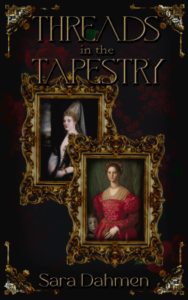 In the time of King Henry the Eighth and the Inquisition, at the height of the Renaissance and the great holy wars between East and West, a Christian, a Muslim and a Jew worked together to save thousands from death.
Agata always dreamed of getting married. Growing up in a small Slavic village meant she might not have a great house, or a fine tower to live in, but she’d have children and happiness, and could make her mark on the world. Those dreams are twisted away after she is kidnapped and enslaved, but Agata is still determined to weave that happiness. As she navigates an unfamiliar culture and country, she finds herself in a greater position than she had ever dared to hope for, giving her power to change the world.
Across the continent, Graçia is a widow too soon, and fends off far too many marriage proposals for herself and her daughter. Every monarch in Europe wants a piece of the largest fortune in the world, but Graçia is determined to use her enormous wealth to make a difference, continuing the clandestine underground movement her husband began. She, too, wants to make a mark on the world, and has the means to do it.
And when the richest woman in the world and the greatest Sultana of the Ottoman court finally meet, they hatch their grandest plan yet. How many people could they save? What could they build? What mark could they make on the world…if the world would let them?
Media Links:
Author website www.saradahmen.com
Author coppersmithing: www.housecopper.com
Author film production: https://housecopperstudios.com
Facebook: https://www.facebook.com/authorsaradahmen/
Copper YouTube: https://www.youtube.com/channel/UCYb9YkWCgp–7FWWexebNFA
All About Writing Podcast: https://open.spotify.com/show/7mQ71k6bTQhDaQgjSyG0RF
Instagram: https://www.instagram.com/sara_dahmen/
Threads: https://www.threads.com/@sara_dahmen
Substack: https://open.spotify.com/show/7mQ71k6bTQhDaQgjSyG0RF
Category: On Writing
Subscribe
If you enjoyed this article, subscribe to receive more just like it.