Speak Up to Breathe Freely
By Kate Woodworth
It’s 1988, and I’m in the back seat of the car, my mother at the wheel, one of my sisters beside her. I’ve just been picked up at Boston’s Logan Airport after flying in from Salt Lake City, where I’ve been living for about ten years. We talk this and that until my mother glances in the mirror and says, “Any news on your book?”
“Yes,” I say. “It’s going to be published in May.” A major New York publisher. Hardcover, with paperback to follow. I’ve been paid for writing fiction!
For me, it was all a dream come true. The novel, Racing into the Dark, had already won first prize in a state-wide literary competition. I was thirty-five years old, mother to three young children, and working full-time…and I was going to be a published author.
“Oh, look how ashamed you are,” my mother said following a second mirror glance. “How embarrassed.”
Neither reaction had occurred to me. I’d been proud, but my joy was shattered. I realized I was bad.
A year or so later, on the verge of my only book event near enough for her to attend, my mother refused to go. “I’m sorry you were ever born,” she told me.
That hurt. A lot. But, by then, I understood. Racing into the Dark is about the heartache of loving someone with a mental illness. In my mind, it was also about the sacrifices made by family members to help someone we love and that inevitable (but unforeseen) moment when we must choose between saving a loved one and saving ourselves. But from my mother’s perspective, I’d torn down the walls around our family and exposed our dirty secrets to the world. For her, every copy sold was a knife I’d plunged into the family, and she was—as she’d been socialized to believe—entirely responsible for the behavior of her husband and children. Any perceived transgression on our part was a flashing neon sign of her shortcomings. Mental illness wasn’t viewed as disease. It was a blaring announcement of her deficiencies that, in turn, spotlighted my egregious failure to protect the family by keeping our secrets.
Racing into the Dark got highly complimentary reviews. The first printing sold out in a matter of weeks. German language rights sold, as did a movie option. But I did little to promote the book and shied from its success. I tried to forget the whole debacle. No one in my family mentioned the book in my presence. I felt cemented into my role as the black sheep of the family.
But.
In the years since Racing into the Dark was first published, readers who’d been raised in a family of secrets and shame thanked me. Until they’d read Racing into the Dark, they told me, they had felt unseen, unheard, and alone. Their voices stuck with me. In 2025, after a number of friends confided in me about challenges in their families of origin—secrets that they still, after a half century or more—keep hidden, I realized that the stigma persists. People still suffer in silence, but a novel—read in the privacy of their own home—could at least let them know that they aren’t alone. Telling my truth could make life just a little easier for others.
Also worth mentioning: Years of therapy had allowed me to catch glimmers of the idea that my I had a right to speak my own truths, and my mother eventually wrote to tell me that she loved me but dreaded people she knew reading my book.
And so, when readers began asking what else I’d written in the wake of the success of Little Great Island—my 2025 novel about the power of community in the face of climate change—I decided to republish Racing into the Dark.
My parents are gone now, but I cringe each time I break the news to members of the extended family that the book is coming back. A part of me dreads April 3, 2026—publication day—but I’m not giving in to shame. Telling the truth can be hard. It can be painful. But I will remind myself that my goal, as a writer and as a reader, has always been to learn from the shared experiences and insights of people I may never meet.
I also know, this time around, that we writers can be a family unto ourselves. We know the courage and commitment needed to write a book, to revise it ad infinitum, and to release it into the world. We are here for one another when we tell our truth about how it feels to visit a spouse in prison, lose a child to suicide, keep vigil while a loved one dies, watch a parent’s addiction relapse for the umpteenth time, watch a friend become bewitched by a cult, or any of the other paths our loved ones walk.
We don’t have to keep secrets. We don’t have to tell them either. But, should we choose to speak, we may find, as Suleika Jaouad—a cancer patient and a New York Times bestselling author—points out, “When one person speaks honestly about their life, it doesn’t just free them; it rearranges the air around them,” giving “everyone else permission to breathe a little deeper.”
—
Kate Woodworth is the award-winning author of the literary climate fiction novel Little Great Island and of Racing into the Dark, about which Publishers Weekly wrote, “hits the mark repeatedly with emotional truths and fluid prose” and which Booklist called “A compelling exploration of mental illness…Emotionally gripping”. A retired medical writer, she lives in the Boston area.
RACING INTO THE DARK
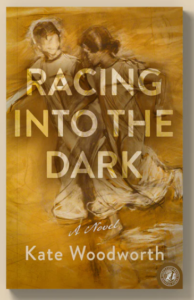 How Far Would You Go to Save the Sister You Love?
Sisters Beth and Ellen have always been close. The youngest of three daughters, Ellen is emotional and unpredictable—often dismissed by her family as dramatic or attention-seeking.
But as she grows older, the line between Ellen’s imagination and reality begins to blur. When she becomes a mother, her behavior can no longer be ignored, forcing the family to confront a troubling truth.
Despite the demands of her own growing family, Beth repeatedly steps in to rescue her sister, risking the stability of the life she has built. As Ellen’s struggles deepen and the consequences ripple through the entire family, Beth must confront an agonizing question: how much of herself can she sacrifice to save the sister she loves?
BUY HERE
Category: On Writing
Subscribe
If you enjoyed this article, subscribe to receive more just like it.