Telling the Bees: How a Social Media Post, an Ancient Tradition, and Magical Realism Inspired My New Novel, Bees in June
By Elizabeth Parman
A few years ago I was scrolling social media when a post from a friend caught my eye. Bees Attend Keeper’s Funeral read the newspaper clipping from the June 4, 1956 Danville Bee. The article went on to explain that a beekeeper from the Berkshire mountains, John Zepka, was buried in a cemetery with thousands of his bees in attendance. Immediately intrigued, I started googling and found a concept called telling the bees that inspired my new book, Bees in June.
When a beekeeper dies, it is imperative that someone share the news with the keeper’s bees. If they do not inform the bees of the death, the bees will leave the hives, fail to produce honey, or even die themselves. Additionally, a black cloth or ribbon is attached to each hive so that the bees may mourn properly. Some cultures have expanded on this notion, and inform bees of any major event in a family’s life, such as a birth or wedding.
Then I started wondering. What would happen if the bees answered? If a human talked to them about their lives, how would the bees respond? Would they offer helpful advice or let the humans learn those life lessons that are always so hard but also so valuable? Would they judge the humans for their foibles, or would they understand that people, unlike themselves, are far from perfect?
I had been toying for some time with an idea for a novel about a young woman who shared a special bond with her uncle, a wise man who has a keen understanding about the natural world. I had the basics of the plot, but knew I needed an underpinning, something that made the story deeper and more substantial. What if that wise uncle was a beekeeper? The idea seemed right, and I began planning. My wise uncle Dixon was now a beekeeper who would talk to his bees. I then realized the young woman, the main character whom I named Rennie, could talk to them, too. She was somewhat of an oddball, a bookworm with no real friends. I decided to give her thousands of friends, the bees, for her to confide in.
A character’s agency is a major part of any good story. Things can, and should, happen to a character, but that character must also have the power to make things happen. The bees were becoming the best part of my story, but I hadn’t given them any agency. What if they didn’t have to wait for a human to talk to them for them to respond to the action of the story? What if I gave the bees the ability to make things happen?
The bees were magical, of course, because bees are already magical, so that wasn’t much of a stretch. Humans often miss what is right in front of them, so I made the bees glow when they needed to be seen, offering light in the darkest moments. As I planned the role of the bees in my story, I began to put additional demands on them. They needed to be more than tiny super heroes saving the day. The would be friends for my lonely main character, a Greek chorus to comment on the story, nosy neighbors to keep a curious eye on the local happenings, and overly involved but well-meaning maiden aunts. They would also have a hive mind that served as a noble contrast to the often selfish actions of the humans surrounding them.
The bees needed their own point of view, and their short but vital chapters are my favorite parts of Bees in June. I especially enjoyed writing them as omniscient, something I could never do in my third person close point of view writing style. Whether an event happened in 1769 or 1969 was of no consequence, as these bees are not bound by a human timeline. They felt vaguely Elizabethan to me, and when I wrote their chapters, I always had a British accent for them in my head. When it came time to cast the bees’ voices for the audiobook, I got voted down on the British accent, but did get to select two wonderful narrators to read the bee chapters. And yes, casting voices for bees is as fun as it sounds!
I chose to set Bees in June in the summer of 1969, against the backdrop of the first moon landing. The whole world was wondering if the impossible—a man walking on the moon and then safely returning to earth—could happen, just as my main character, Rennie, wonders if what she thinks is impossible—a happy and peaceful life—is as unlikely as that moon mission. She shares her most heartfelt fears and dreams with the bees, and they do what best friends always do, listen intently and help out when things are at their lowest. There’s magical realism, of course, because bees are magical in real life, as well as optimism and heartbreak. Throughout the story, the light from the bees illuminates the path for my characters as they navigate through their lives, finding hope in even the darkest corners.
—
Elizabeth Bass Parman grew up entranced by family stories, such as the time her grandmother woke to find Eleanor Roosevelt making breakfast in her kitchen. She worked for many years as a reading specialist for a non-profit and spends her summers in a cottage by a Canadian lake. She has two grown daughters and lives outside her native Nashville. Connect with Elizabeth online at elizabethbassparman.com.
BEES IN JUNE
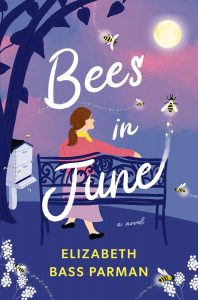 Uncle Dixon always told Rennie to tell the bees everything, but somewhere along the way, Rennie forgot. Now, with her life at its lowest, she begins to see the bees in a new light. Will she believe again in the magic of the hives, and will she listen as the bees try to guide her home?
It’s 1969, and the town of Spark Tennessee, is just as excited about the moon landing as the rest of the country. Rennie Hendricks is grieving and trying to heal from the unimaginable loss of her infant son. She had hoped a child would repair the cracks in her marriage to her husband, Tiny, but the tragedy has only served to illuminate his abusive character. Trying to relieve some of the financial stress that inflames Tiny’s anger, Rennie accepts a position cooking at the local diner. Hidden away in a kitchen making delicious food, she rediscovers the joy she finds in cooking for others, and as she spends more time with her new boss, she realizes there are more options for women than she thought possible.
One of the benefits of her new job is that she can bring meals to her beloved Uncle Dixon, the man who practically raised her along with her late Aunt Eugenia, a woman unkindly labeled as a witch by most of the town. What those people didn’t understand is that Eugenia was a healer and connected to power they couldn’t grasp.
Rennie thinks her elderly uncle is confused when he talks about communicating with his bees, but then she starts to see them glow, leading her toward safety time and time again. Could it be that these bees, discovered long ago by her Aunt Eugenia, are magical and trying to tell her something? And what about the new neighbor, Ambrose Beckett, who seems to understand the bees too. Is he being truthful about why he has moved to Spark, or is there more to him than meets the eye?
Hope-filled and infused with magical realism, Bees in June captures Rennie’s journey back to her true self, creating a rewarding life that the bees showed her was possible if she only believed in herself and the magic that surrounds her.
BUY HERE
Category: On Writing
Subscribe
If you enjoyed this article, subscribe to receive more just like it.