The Myth of the Maligned Woman
By Louisa Morgan
As a girl, I devoured many books based on the Arthurian legends—A Connecticut Yankee in King Arthur’s Court, The Crystal Cave, The Once and Future King, and so on. Recently, someone mentioned Morgan le Fay to me, and my memories of all those wonderful tales resurfaced. As a historical novelist, I naturally turned to research, and found literally centuries’ worth of treasures!
The first mentions of the name Arthur were found in fragmentary sources in England from about the sixth century, a circumstance which amazes me. It appeared in written texts in various forms beginning in the eighth century, and from that time, it has never disappeared.
I also learned about the decades-long arguments among historians concerning the factual existence of a king called Arthur. Some think the concept of a King Arthur might have been a composite of several rulers in the early centuries of England. Others believe there never was such a person except in oral storytelling traditions. My favorite, and the one I leaned on to write this novel, is the English historian John Morris (The Age of Arthur, 1973) who cites a number of fascinating and obscure bits of recorded history to assert that there was, in his opinion, an Arthur, a king who ruled briefly but well, and whose name was the tiny seed out of which a wealth of mythical branches grew.
The earliest iterations of the legends spring from the oral traditions, and were then adapted by the Norman poets. Those writers added their own details and characters and plots. Ultimately, the twelfth-century writer Geoffrey of Monmouth, in his pseudohistorical The History of the Kings of Britain, cemented the Arthurian stories in the popular consciousness, and the fascination with them has never subsided. Indeed, the legend of King Arthur is so firmly entrenched that a reader can be drawn into arguments about reliability and veracity, as if his historicity is without question.
The supporting characters of the Arthurian legends are fictional, but there are many of them, and over the centuries, they have taken on a life of their own. It was in the Arthurian romances of writers like Chrétien that women began to figure significantly. They were most often portrayed as malignant figures, witches, sorceresses, unfaithful wives, wicked queens. (As I studied this, I was reminded of the now-discredited belief that Mary Magdalene was a prostitute. That’s a digression that will keep you busy for hours!)
Morris writes, “Each retelling of the tale clothed Arthur in the ideas of its own day,” and any perusal of the many, many interpretations reveals exactly that, and helps us to understand how the legends evolved and grew. Malory, Chrétien, Tennyson, Twain, Stewart, and countless others have visited their own world views on the Arthurian stories, and now, I have done the same.
I was fascinated by the stories of Morgan le Fay I uncovered. The name is undoubtedly founded on the French version, Morgan le fée, which translates to “Morgan the fairy.” I used the Celtic and Breton and Welsh roots for most of the character names in the novel, which is how Morgan became Morgana. For me, Morgana is a monumental figure of feminine power, hardwon wisdom, dedication, and sacrifice. She is also, as powerful women have always been, maligned and feared.
It’s a familiar pattern. There are exceptions, such as the great Hildegard of Bingen, who was respected and admired in her life time. But Hildegard behaved. She kept herself to a nunnery. She didn’t step out into political affairs or even social ones. Those women who did—and those women who do—face the same resentment and fear and anger that Morgana does.
A wonderful example is Eleanor of Aquitaine, who was an epic figure in European history, a woman wise in politics, courageous in military matters, strategic in how she manipulated the culture she was born into. She struggled to live her life in the way she wanted, and the men of the time fought her every step of the way. The biographer of her first husband, Louis VII of France, hated her because her husband was so infatuated with her. That man was responsible for a steady stream of lies about Eleanor. In his history of the Second Crusade he criticized her “satanic beauty,” accusing her of using it to manipulate Louis, when the truth was that he was the one influencing the king.
Elizabeth I was another such female leader, who had to be wily and brave even to claim the throne that was her birthright. By the latter half of her reign, she was wildly popular with her people, but during her life she, too, faced vicious gossip, resistance even among those closest to her, and the constant risk of betrayal.
I can’t help but think that strong women in leadership positions today suffer the same suspicion and disrespect that these women of history did. Misogyny seems to lurk beneath the surface of our society like a sea monster, ready to surge to the surface in order to bring down any woman who dares to be ambitious.
These are the influences that led me to create Morgana, the faerie priestess whose life is devoted to protecting and preserving the true king, Arthur. For my Morgana, I’ve borrowed from some of the writers who have come before me, and adapted some of the others, all to fit a magical, mythical woman into the canon of the Arthurian myths.
There will be those who say, “But that’s not the way it was!” That will make me smile, but I will understand why they feel that way. We each have our own favorite interpretation of the nearly two-thousand-year-old world of Arthur. I hope my readers enjoy this one.
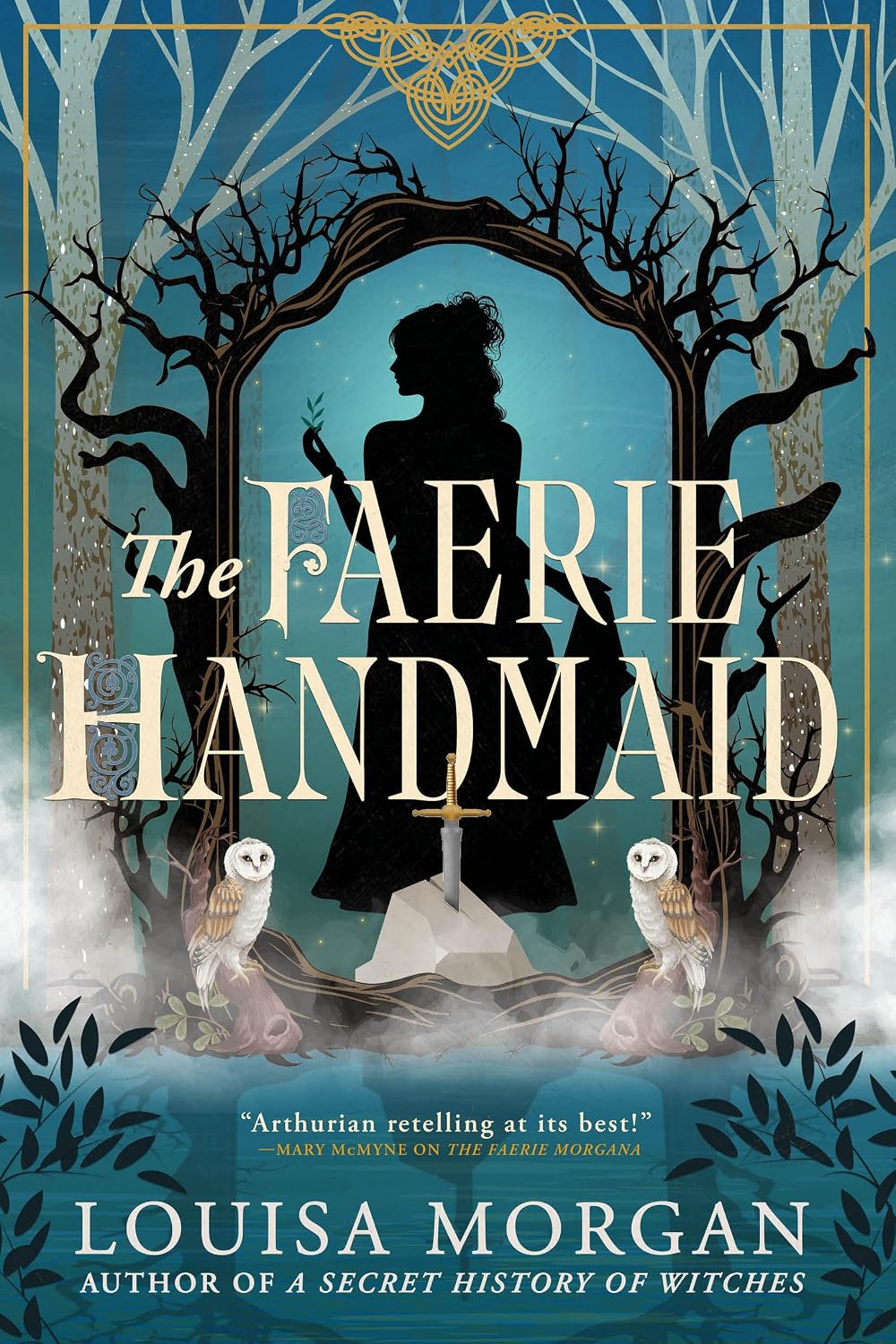
In this atmospheric and bewitching novel, Louisa Morgan reimagines the story of Morgan Le Fay, one of the most enigmatic and powerful women in Arthurian legend.
To the other priestesses of the Nine, a powerful council at the Lady’s Temple, Morgana is haughty and arrogant as she performs feats of magic no human should be capable of. Rumors start that she must be a fearsome fae.
To King Arthur, Morgana is a trusted and devoted advisor, but his court is wary of her and her prodigious talent at divination. But his wife sees Morgana as a rival and a malevolent witch.
To Braithe, Morgana’s faithful acolyte, she is simply the most powerful priestess Camelot has seen.
Morgana doesn’t know why she’s so different from everyone else, and she doesn’t much care. But when she aids Arthur to ascend the throne before his time, she sets off a series of events that will change everything Morgana believes about her power.
Find out more about Louisa on her website https://www.louisemarley.com/
The Faerie Morgana
 In this atmospheric and bewitching novel, Louisa Morgan reimagines the story of Morgan Le Fay, one of the most enigmatic and powerful women in Arthurian legend.
To the other priestesses of the Nine, a powerful council at the Lady’s Temple, Morgana is haughty and arrogant as she performs feats of magic no human should be capable of. Rumors start that she must be a fearsome fae.
To King Arthur, Morgana is a trusted and devoted advisor, but his court is wary of her and her prodigious talent at divination. But his wife sees Morgana as a rival and a malevolent witch.
To Braithe, Morgana’s faithful acolyte, she is simply the most powerful priestess Camelot has seen.
Morgana doesn’t know why she’s so different from everyone else, and she doesn’t much care. But when she aids Arthur to ascend the throne before his time, she sets off a series of events that will change everything Morgana believes about her power.
PREORDER HERE
Category: Contemporary Women Writers
Subscribe
If you enjoyed this article, subscribe to receive more just like it.