The Stories We Inherit by Kalyani Adusumilli, author of The Invisible Canvas
There are stories we grow up hearing, and then there are the ones we learn not to ask about.
I heard my parents’ arranged marriage story—how families met, decisions were made, and their lives set into motion with quiet certainty. But I never heard about my mother’s dreams, or what she may have had to set aside to enter a life already decided for her.
Stories, I’ve come to realize, are not only what we are told, but what we learn to read between the lines.
In many families, especially those shaped by survival and reinvention, silence is more than the absence of words. It preserves dignity, keeps harmony, and endures what cannot be easily acknowledged. You learn what can be expressed, what’s held back, and which questions are welcomed or redirected. Over time, what’s unsaid begins to carry more weight than what’s spoken.
This is especially true when it comes to emotional struggle. In many cultural contexts, especially immigrant ones, mental health is often understood through a lens of endurance rather than openness. Pain is managed privately, folded into daily life, not examined or articulated. Strength means carrying on, not being vulnerable.
I grew up with stories of the American dream in the South Asian community—stories of resilience, sacrifice, and starting over in unfamiliar places. They came in fragments, often without detail, as though telling them required a balancing act. What mattered was not always what happened, but how it was carried.
There is a kind of reverence in that. But there is also a cost.
Not everything surfaced. Emotions found no place to settle. The message—never stated but always clear—was that some things are better left unnamed.
For a long time, I accepted that as truth.
But life, as it often does, has a way of breaking through the boundaries of what we’ve learned to contain.
After my older sibling died unexpectedly, grief did not arrive loudly or immediately. It moved subtly, settling into ordinary moments, into the spaces between conversations, into the sudden awareness of what was no longer there, and especially into the absence of a generous love my children would never know. It reshaped my inner landscape in ways I didn’t yet have words for.
Around the same time, I began to notice how relationships, especially among the women in my life, shaped my self-perception and were shaped by forces before me. It revealed itself in the gap between what is felt and what is expressed, and in the ways love and misunderstanding can coexist across generations, often unresolved.
I began to realize that what remains unspoken does not disappear but finds its place in the spaces between what we say and what we cannot.
These questions followed me into fiction writing. I was drawn not to what was told, but to the pauses, contradictions, and the tension between lived experience and what goes unacknowledged.
Writing, for me, became a way of staying with those questions—returning to them from different angles and exploring what isn’t easily explained.
Fiction let me approach difficult truths gently—to ask questions without demanding answers, to sit with complexity without oversimplifying it. It provides both a protective and revealing distance, a way to look closer without feeling that something sacred is being broken.
The Invisible Canvas grew out of that space.
At its center is Jansi, a woman who has spent much of her life holding everything together—her family, her responsibilities, the expectations placed upon her—without ever fully naming what it has cost her. When the life she has so carefully maintained begins to fracture, she is forced to confront not only her present circumstances but also the layers of silence and inheritance that shape her sense of self. Through her journey, the novel moves between past and present, tracing the moments that formed her and the questions she can no longer set aside.
Through her, I found a way to explore the distance between who we’re taught to be and who we recognize ourselves as—and what it takes to bridge that space.
But more than anything, it is a reflection on what it means to find a voice—not in defiance of where we come from, but in conversation with it.
What we inherit does not vanish when questioned. It remains, woven into us, both visible and unseen. The challenge is not to reject it, but to know which parts belong to us—and which we’re ready to release.
In the end, what we choose to examine and give voice to shapes how we understand ourselves and move forward.
—
Kalyani Adusumilli is an attorney, author, and poet. Her debut novel, The Invisible Canvas, will be released on May 26, 2026. She is also the creator of The Happy Wildflower series, collections of reflective essays and poetry that celebrate authenticity and the quiet strength of living with intention.
Born in India and raised in the United States, Kalyani first pursued a career in epidemiology before earning her law degree and practicing as an attorney. Yet her lifelong passion for storytelling eventually led her to write full-time. Her work often explores identity, generational complexity, and the resilience of women navigating silence and stereotypes.Through her writing, Kalyani seeks to foster empathy, break cultural barriers, and offer readers a sense of connection and hope.
When she isn’t writing, she can be found lost in a book, traveling the world, or enjoying time with her husband and two children.
Find out more about her on her website https://www.kalyaniadusumilli.com/
THE INVISIBLE CANVAS
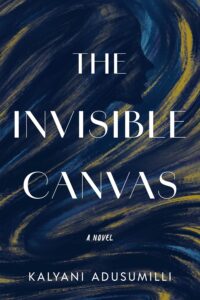 Even the most fractured among us can find their way back to the light.
Jansi has spent her life mastering the art of holding everything together. As a child uprooted from her home in India and dropped into a new world in the United States, she learned early that staying invisible was safer than asking for what she needed. Over the years, she built a life that looked steady from the outside—marriage, motherhood, and a career—but beneath the surface, old wounds continued to ripple through every part of her.
When an unexpected crisis forces her to stop running from herself, the carefully sealed seams of her life begin to tear open. In the aftermath of a reckoning that challenges everything she was taught to hide, she begins the difficult work of unraveling wounds she has carried for decades. Memories long buried rise to the surface, pulling her back through the formative landscapes of her childhood in India, the fragile years of adolescence, and the silent ache of adulthood lived in the shadows of expectation.
Weaving across continents and decades, The Invisible Canvas is a deeply resonant portrait of resilience, identity, and the unseen battles so many carry. It is both an intimate confession and a universal call to courage—an affirmation that even the most fractured among us can find their way back to the light.
Category: On Writing
Subscribe
If you enjoyed this article, subscribe to receive more just like it.