The Unlearning Project by M.D. Roblyer
 In her memoir-how-to book The Memoir Project, author Marion Roach Smith archly observes that “the #1 thing that baby boomers want to do in retirement is write a book—about themselves.” She’s sold a lot of copies being right about that. I joined that white-haired throng after retiring from a long career in higher education and, for the last 30 of it, writing successful textbooks in my subject area.
I knew that writing a publishable memoir meant I would be clawing my way up the learning curve of a writing style vastly different from the one I had spent decades mastering; I was up for that challenge. The book development process was a bear of another breed; no one seemed to have much wisdom about that. I could have saved years of reworking if someone had taken me aside and gifted me a quick course in Memoir Development 101. By now I feel I can teach it.
Three principles emerged from the six years I spent creating my memoir Strong Glass, all of them pieces in the mosaic of what became my story’s structure. Once these insights came together, I got the picture.
First, I learned the value of “read first, write later.” Absurd as it sounds as I reflect on it, I had read only a couple of memoirs in my lifetime, and they were celebrity stories. As a “memoir illiterate,” it seemed utterly logical to me that my story should progress chronologically, the way it was lived, so that’s the way I drafted it. It took a long time. Then I read a memoir that began with current day and dived back into the past, moving forward from there to show how the story arrived at the present. Then came other narratives whose chapters switched from now to then, now to then, making sense of each present event by reflecting on the past. By the time I’d read my fourth or fifth memoir, it began to sink in. Purpose drives sequence. Sigh. Rethink, restructure.
Next, I had to curb my long-time focus on factfinding, the obsession of all textbook authors. Most of what matters in textbook writing is comprehensive, up-to-date information, but a memoir demands something more—and different. Recently I read a published memoir on an addict’s path to recovery that read like an encyclopedia—all dates and places on the downward trajectory of his addiction, but absolutely no insights on how all that trauma was thinning out his self-esteem, how it was changing him as he stumbled along. That was “the good stuff,” the part I was dying to hear.
Yet when I first began my own memoir, I fell into the same pit. I wanted to tell a story about how my family shaped the flawed adult I grew into, so for the first two years of my memoir work, I was in constant family-research update mode. I craved facts about family history like a publisher covets a celebrity contract. In that quest, I logged untold hours on Ancestry and Newspapers.com and poured my findings into my manuscript without showing how my family history had predetermined my path and shaped my personality. Was all of that family history interesting to me? Definitely. But relevant to the theme—“the good stuff” in my own story? Not really. Grit teeth. Cut, cut, cut.
My last big blunder was rooted in the same lopsided view of storytelling as my factfinding mania. My criteria for including a vignette from my journey was whether I thought it was an interesting story. For example, I wrote page upon page of events from my high school and college days, laboring to make them as vivid and colorful as they were in my mind. How jarring it was to receive one reader’s comment, “What does this have to do with your family’s impact on you?” What indeed? Groan. Delete, delete.
Hemingway famously opined that, “There is nothing to writing. All you do is sit down at a typewriter and bleed.” Having poured some pints of my own plasma down the drain, I hope these three guidelines of memoir development I learned from writing Strong Glass may prove beneficial to the novice memoirist. They will make for a better memoir, but they also cut down on unnecessary bleeding. I recommend them.
—
Strong Glass: A Memoir of Escaping the Dark Mirror of Family History
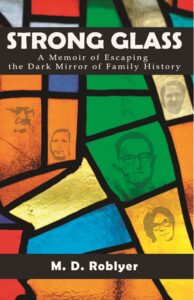 The fragile shell holding together Peggy’s successful yet troubled life shatters when her husband announces he is leaving. Suddenly aware she is repeating toxic behaviors she saw modeled long ago, Peggy turns to reckon with the dark mirror of the dysfunctional family she’d fled.
Strong Glass takes readers on her journey into memory as she pieces together her lineage and its legacy. Her 1950s childhood comes alive on the page, interwoven with travels through her parents’ formative years during the Great Depression and World War II. The intergenerational family business-specializing in stained glass creation and mirror restoration-in the rural western Maryland village of Cresaptown forms the backdrop.
Peggy learns that for many with an inherited history of trauma, gazing into the mirror of the past offers the healing grace of insight. This poignant narrative of damage and renewal begins with a single shock of illumination and ends in empathy, compassion, and absolution.
BUY HERE
—
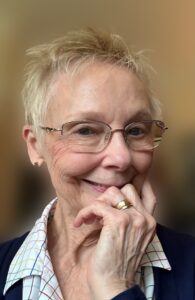
M. D. (Peggy) Roblyer [she/her], retired professor of educational technology, authored a dozen Pearson Education textbooks,
including Integrating Educational Technology into Teaching, which introduced a novel approach to the field in 1996 and became its
bestselling text; it remains so today in its ninth edition. Strong Glass: A Memoir of Escaping the Dark Mirror of Family History is her first nonacademic book; she is at work on another. Some of her nonfiction work has been published by Orange Blossom Books, Bewildering Stories, TrashLight Press, and Bright Flash Literary Review. Two of her stories are Chattanooga Writers’ Guild contest-winners and appear in the Chattanooga Writer’s Guild Fall 2025 and 2026 RidgeCut Anthologies. She lives in Chattanooga, Tennessee, with her husband and formerly feral cat Nikki Nicole.
Website: mdroblyer.com
Facebook: https://www.facebook.com/margaret.roblyer.98
Instagram: peggyroblyer
Category: Contemporary Women Writers, How To and Tips
Subscribe
If you enjoyed this article, subscribe to receive more just like it.