The World Needs More Loners: A Love Letter to My Sixteen-Year-Old Son
The World Needs More Loners: A Love Letter to My Sixteen-Year-Old Son
(Written in indelible ink because a Sharpie was all I could find in my bedside drawer at 3 a.m.).
I love that you are somehow able to wash your hair without getting it wet or using shampoo.
You sneak your laundry into my basket, sometimes one chalky tube sock at a time. Maybe you think I don’t notice these socks or the fact that you never do your own laundry. Maybe you think these rogue socks annoy me. But I will keep putting each one aside, waiting for its mate to appear in the next load. I will keep folding because these socks are a hand reaching through time. They are you, at four, asking, “Mom. Mom. Mom. Are you paying attention? Are you still here?”
I am still here.
I see you beneath the cruelties of teenage boys. Your eyes, puffy with anger, your fists clenched. You had this same outrage on day two of life when the NICU velcroed you into the MRI tube to take pictures of your brain bleed. You were 2 pounds 9 ounces of concentrated fury. Now, the measurements on our kitchen closet door say you are taller than me. Sometimes, late at night, I erase your latest pencil scratch. You will never be taller than me.
I couldn’t do anything when you were born at twenty-nine weeks, and I can’t do anything now except listen and bear witness to the pain of trying to find your way into adulthood.
You tell me that you hate school, that you feel like you could disappear. “I am a leaf, blowing down the hallways,” you say. “No one would notice if I wasn’t there. I’m a loner. Invisible. A loser.”
I listen and call my sister, the same one who talked me through life with twenty-nine-week-old twins. “Don’t fuck with the loneliness of this generation,” she warns. She is pulling on the experience of raising three teenage daughters and she is punching me in the gut. “Make him promise to tell you if he has thoughts of self-harm.”
That evening, you and I walk the dogs in our neighborhood. We look in warm windows at the glow of other families and newly decorated Christmas trees, and I make you promise.
You swear to me on your life, then come home and eat ice cream for dinner. You spend the next day texting me that your tummy hurts.
You complain. A lot.
You tell me about your WWII in Film and Literature class. About how you recently watched Alain Resnais’s documentary Night and Fog. “Mom, mom,” you repeat, making sure I’m paying attention. This is important. “There are kids in the class who asked if the Holocaust really happened.”
“Seriously?”
“For real.”
“It’s 2024. Jesus.” These days my despair for the future is a second skin, following me everywhere.
“But most of the class was on their phones when we watched,” you continue. “I sat in the back and all I could see when the movie was playing was electronic screens.”
For this, I have no words. All I can do is Thank God for you. The world needs more loners. More leaves. The world needs more of you.
Love, like life, goes on indefinitely. Until it doesn’t. There is no way to end a love letter, so I’ll just say it again.
I love you.
Mom
Megan Williams is the author of two memoirs: One Bad Mother: A Mother’s Search for Meaning in the Police Academy (2024) and The House That Jack Built, a memoir about Bar Harbor, Maine, that will be published by High Frequency Press. After graduating from Haverford College, Megan received her Ph.D. in English from Temple University and taught at Lafayette College and Santa Clara University. She has moved across the country—never landing in the middle—three times in twenty years. She now lives in Bellingham with her husband, who runs Blue Dog Bakery and keeps their teenage twins, rescued cat, horse, and mastiff full of treats.
ONE BAD MOTHER
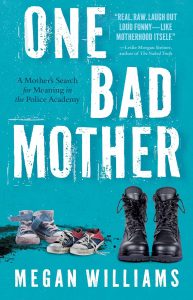 After her six-year-old daughter puts a hammer through a wall, Megan Williams decides to abandon a career as an academic and become a police officer.
It’s not lost on her that she may have applied to the Police Academy to escape the realities of mothering twins born via IVF at twenty-nine weeks. As the twins grow and test her endlessly, she feels she is failing. She needs a win.
During a grueling application process, Megan measures herself against the other candidates and confronts the normative notions of what it is to be a good mother. The paralyzing fear that she is a bad mother looms large in her head, as does the real possibility that she might not make the cut at the Academy. With its intertwined narratives of police recruitment and motherhood, the memoir provides an unflinching journalistic view of big-city law enforcement, set atop a personal journey during which Megan learns gratitude and makes peace with a motherhood far different from the dream sold to her by our culture.
BUY HERE
Category: On Writing
Subscribe
If you enjoyed this article, subscribe to receive more just like it.