Was It Worth It? A Journey of Leaving, Losing and Becoming by Maryam Rafiee
As a teenager, I dreamed of becoming a cycling champion, but there was no women’s team at the time. Cycling in public was also forbidden for women. I cycled through the streets of Tehran wearing loose jogging clothes and a cap, trying to look like a boy so I would not be stopped by the morality police.
I remember that feeling of cycling through the streets. I wanted to move through my own city without being told that I did not have the right to be there.
When I immigrated to Canada, I suddenly found myself in a place where I had no memories and no personal history. My connection to everything familiar was suddenly severed. I felt displaced—not because I did not have a home, but because home no longer existed in a single place. Cities, apartments, and buildings became places where life happened—where I worked, slept, and survived—but they did not necessarily become places where I belonged.
However, my search for a home had began long before I left Iran, when I first experienced the feeling of not belonging in my homeland. I learned early that restrictions on women shaped what we could do, where we could go, how we were expected to behave.
As a young woman, I began dreaming of a home beyond the borders I lived within. I believed there was a place somewhere where I could finally belong. But when I immigrated to Canada, I realized that such a place could not simply be found.
In my homeland, I grew distant from the person I wanted to be because restrictions limited my freedom. In Canada, I experienced a different kind of distance—not from restriction, but from absence: the familiar places, the routines, the language, the culture and the people who once made me feel that I belonged.
So I turned to storytelling to make sense of the situation. This was not simply nostalgia. It was not only grief. It was an act of resistance against forgetting.
I tell stories through my writings because memories are fragile and what is remembered survives. I have learned that without memory, I cannot understand who I am, where I come from and where I am going.
I write because I want people to understand why some people leave their homelands and then struggle to fit into new ones.
There are layers of complicated lives behind what people see. And I try to go through those layers and show what it means to be displaced. To not belong, even when you are safe. To not always feel free even when you live in democracy.
And I think this is where the stories in my book, Was It Worth It? come from.
I write about my mother, who planted hundreds of African violets and other plants in our small apartment in Tehran. Through those plants, she filled the void left by her children living on other continents.
I write about my father and his devotion to writing with his fountain pen, the sound of his pen scribbling on paper late into the night, because he believes typing is soulless.
I write about my childhood breakfasts filled with the smell of fresh sangak and barbari breads coming out of the tandoor.
I write about my grandmother’s charcoal samovar, which crossed an ocean, just as I did. Today, it has become the heart of our outdoor gatherings here in Canada, just as it once was for my grandmother and her friends, decades ago in Tehran.
I write about experiencing discrimination in Canada because of my race, my skin colour, and my accent—about what it means to carry one’s identity into a new country and sometimes be reminded that others see you as different.
I write about the pandemic in Canada, and the scenes that unexpectedly brought me back to my childhood in war-torn Tehran—the images and feelings I had believed I would never have to see again.
These may seem like small memories. But for me, they are pieces of home. And through these stories, I have slowly redefined what home means to me. Home is not a place that I can show on a map anymore. I assemble my home through small memories and ordinary acts.
I bake Iranian bread and although they never taste or smell like the breads I remember from Iran, the act of making something familiar gives me a sense of continuity. I cycle through the streets of Toronto freely, feeling the warmth of the sun on my bare arms. And, I remember that there was a time when I had to disguise myself to do exactly this. Now I can ride freely. And that reminds me of the freedom I have here and it gives me a sense of belonging.
So, with every memory and act, I am reminded that home is not the place where I stand but what I continue to carry.
A story cannot compensate for a life destroyed unjustly. It cannot revive a lost person or recreate a homeland I left behind. But it can preserve what forces of erasure try to disappear: our history, our identity, our belonging, and the evidence that we existed.
The Stories I tell today, are more than personal memories. They are archives of a life that refuses erasure.
—
Maryam Rafiee is a Canadian lawyer, writer, and human rights advocate. Through her legal work, advocacy, and writing, she explores themes of migration, memory, human rights, and the search for belonging. She is also the author of Dear Baba: A Story Through Letters which was praised by Kirkus Reviews as “Affecting… letters bearing witness to human rights abuses.” Her essays have appeared in The Globe and Mail, The New Quarterly, Humber Literary Review and Room Magazine. Maryam makes her home in Toronto, Canada
Was It Worth It?: A Journey of Leaving, Losing, and Becoming
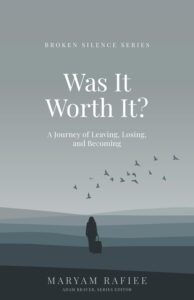 When intelligence agents storm Maryam Rafiee’s Tehran home and assault her for refusing to surrender her laptop, she faces a question that will haunt her for years: Was fighting back worth it? Days later, immigrating to Canada with bruises still fresh on her arms, she carries this question―and many others―into exile.
In this searing memoir, Rafiee chronicles her journey from a young woman defying Iran’s gender apartheid to a tireless advocate for her father’s freedom. Her interconnected stories span decades and continents: ration lines during the Iran-Iraq War, secret bicycle rides through Tehran, discrimination in a Burlington grocery store, 50,000 protesters chanting “Woman, Life, Freedom” in Toronto.
This is the story of a daughter who fights to free her imprisoned father from across an ocean, a woman who discovers that even democratic countries have their own forms of discrimination, and an immigrant who must learn to carry home within herself, as it transforms beyond recognition. Above all, it’s a meditation on the complicated arithmetic of freedom―where the cost is everything, but the alternative is unthinkable.
BUY HERE
Category: Contemporary Women Writers, On Writing
Subscribe
If you enjoyed this article, subscribe to receive more just like it.