What Happens When You Write About Spirituality in the Business World
By Jenna Nicholas
 It started with the stories people wouldn’t tell out loud.
In boardrooms and investors’ retreats, in the quiet corners after conferences, I kept hearing the same whispered confessions: “I don’t really feel like I can talk about this, but…” What followed were stories of dark nights of the soul — seasoned leaders wrestling with decisions that didn’t align with their values, struggling to connect success with purpose.
These conversations were taking place in hushed tones, across industries and continents, and I realized something essential: these stories needed a home. That realization became the seed of my book Enlightened Bottom Line: Exploring the Intersection of Spirituality, Business, and Investing.
I was raised by my mother and grandmother in an environment where spirituality and service were inseparable. My mother became a Baha’i in her early twenties, and I was exposed to the Baha’i teachings from a young age. There is a lot of emphasis in the Baha’i writings on independent investigation of truth, and curiosity is in my DNA! I was deeply drawn to the Bahá’í Faith’s teaching — that spiritual principles and practical action are two sides of the same coin, and this has shaped how I have approached every chapter of my life.
My journey has taken me from London to China, to Silicon Valley, where I did my undergrade studies at Stanford, as well as my MBA. I have worked across sectors — investing in healthcare, climate, and education — and helped build a coalition of over 170 foundations representing $50 billion to move capital from fossil fuels into impact solutions. Later, through cofounding Impact Experience, I worked to bridge the gap between investors and communities often left out of economic conversations. Through my work with LightPost Capital, I invest in and acquire companies in areas such as health, climate and AI infrastructure.
Through all of this, I saw what happens when spirituality moves from the margins to the center — when it becomes the heartbeat of decision-making rather than a footnote.
When sharing with people that I was working on a book on the intersection of spirituality, business and investing, some people would say to me – do you really think there actually is in an intersection? My answer came back to the idea that the material and the spiritual dimensions of reality are not opposites but partners, and this intersection felt too urgent to ignore. The book draws from the Bahá’í teachings that shaped my worldview, while also integrating insights from interviews with successful investors and business leaders from a broad range of different perspectives, including Buddhist, Jewish, Christian, and Indigenous traditions. My hope has been to honor that universality without flattening the beauty of difference.
In writing The Enlightened Bottom Line, I spoke with dozens of leaders — investors, CEOs, professors at Harvard and Stanford, the director of the European Investment Bank Institute. Regardless of geography or sector, four themes kept surfacing: Hope, Empathy, Abundance, and Legacy. These became the foundation of the HEAL framework that anchors the book.
One story, shared early in the process, stayed with me. Wayne Silby, a pioneer in the area of socially responsible investing, my mentor, friend and the writer of the foreword of my book, attended a Buddhist retreat in the late 1970s shortly after he started the Calvert Funds. At the time the Calvert Funds was a successful money market fund, and at the retreat the participants were asked to reflect on what it would say on their tombstones. Wayne’s reflection was that his would say, ‘the man that made 2% more than the next man.’ This was not the legacy that he wanted to leave. He went back to his team at Calvert and suggested that they become socially responsible. Calvert went on to become a pioneer in the area of socially responsible investing and currently has $45 billion in assets under management. This exercise to reflect on what it would say on our tombstones is an invitation for each of us to reflect on what truly matters.
The Enlightened Bottom Line is dedicated to my mum, grandmother, and the ancestors who continue to guide us to walk the spiritual path with practical feet. Their example reminds me that spiritual growth and pragmatic action are inseparable — not opposites, but reflections of the same pursuit.
More than anything, I hope The Enlightened Bottom Line gives readers permission — permission to bring their whole selves to work, to stop leaving their deepest values at the door.
To see money not as a mere instrument of extraction but as energy that can heal.
To ask, honestly and courageously: What do I want my legacy to be?
To believe that purpose and profit are not in competition, but profoundly intertwined — and the data increasingly shows that when businesses lead with purpose, they actually perform better.
We are living through a moment of profound disruption — political, environmental, and economic. It can feel disorienting, but this is precisely when spiritual principles matter most in business.
This book is not a prescription. It is an invitation — to reflect, to reconnect, to act with intention. To return to those quiet conversations that started it all, and to say out loud what so many have been whispering: that the path forward requires both the balance sheet and the soul.
—
Jenna Nicholas is an impact investor, entrepreneur, and president of LightPost Capital. She has led initiatives that shifted billions of dollars toward sustainable solutions and bridged the gap between capital and underserved communities through Impact Experience. Nicholas has worked at the World Bank Treasury and Calvert Special Equities, and her angel investments support innovative ventures in fintech, health care, and climate solutions. She has been recognized as a Forbes 30 Under 30 Social Entrepreneur, Council on Foreign Relations member, Stanford Social Innovation Fellow, and Echoing Green Fellow. She holds BA and MBA degrees from Stanford and studied at Oxford. Her work has been featured in the New York Times, Financial Times, and Forbes. Her new best-selling book is the Enlightened Bottom Line: Exploring the Intersection of Spirituality, Business, and Investing. Learn more at jenna-nicholas.com.
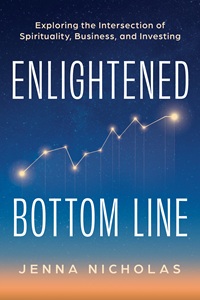 What if business and investing could be rooted in the deepest values of the human spirit?
In her groundbreaking book Enlightened Bottom Line, Jenna Nicholas explores the powerful intersection of spirituality, business, and investing—an intersection too often overlooked in a world driven by profit alone. Drawing on moving stories of entrepreneurs, investors, and leaders who are living out this integration, along with cutting-edge research, Nicholas reveals how spiritual wisdom can guide ethical choices in finance and business.
Unlike other books on business or investing, Enlightened Bottom Line is not just about strategies, numbers, or policies. It is about reimagining what wealth, success, and leadership can truly mean when guided by purpose, compassion, and integrity. It offers readers concrete frameworks and real-world examples to align their financial decisions with their deepest beliefs.
This book is for leaders, investors, entrepreneurs, changemakers, and anyone seeking to make their work and money matter—people who feel the tension between striving for success and yearning for meaning. Readers will walk away not only with tools and insights, but also with a renewed sense of hope: that business and investing can serve as vehicles for healing, justice, and spiritual growth.
At its heart, this is more than a book about money or management—it is an invitation to transform how we live, work, and lead.
Category: On Writing
Subscribe
If you enjoyed this article, subscribe to receive more just like it.