Writing Swiftynomics
By Misty L. Heggeness
It was the third or fourth call I had that week from reporters wanting to talk about the apparent mass exodus of mothers from the labor market. I was exhausted. I’d been sitting in my home office with my hair twisted up, no makeup, worn out sweatpants, and a keenly savvy 12-year-old child lying on the floor complaining about how bored she was with her 2D classroom and school work.
That afternoon, I had been listening to Taylor Swift’s new album, Evermore, tinkering with data on moms when I jumped on a call with Claire Cain Miller, a New York Times Upshot reporter. She wanted to do a story on mothers who had to stop working because of the pandemic shutdown, but she could not find any. She wanted to know what the data said.
Ordinarily, she could just jump onto the US Bureau of Labor Statistics (BLS) to understand how smoothly the economic engine was running when it came to employment, but BLS does not report out data on parents. She had come across my name because I had recently published a nerdy academic paper on the initial impact of the pandemic on mother’s labor supply – and I had been blogging and posting data on social media as the months dragged on.
Good luck finding mothers who left, I told her. While BLS’s data on labor force participation showed women’s rate decreasing, I was sleuthing around in public microdata and had discovered that the decrease was being driven by college age and retirement age women without minor children in the home.
Counterintuitive to what our traditional thinking might tell us about women and work. But in today’s modern society, mom’s earnings are an integral and critical source of household income and wellbeing. And, during the pandemic, many moms were able to work remotely or bring their children with them in cars as they delivered groceries or Uber Eats. Those mothers who worked as doctors or police often had access to emergency daycare providers or other adults (or older siblings) in the home who could supervise younger children.
This disconnect between what we thought was happening across the country with moms and what was happening on the ground (and in the data) was the driving force for writing Swiftynomics: How Women Mastermind and Redefine Our Economy.
Why focus on Taylor Swift, who is not even a mother? Whether you are a mother or not, everyone has one and so does Taylor. She also has a grandmother, Marjorie, whom she wrote a song about on the Evermore album.
While I was being crazy productive on the only research topic that I was angry enough to stay focused on with all the family distractions happening in my home, that of mothers’ ability to work while increased care burdens crashed into their homes, Taylor was busy being crazy productive in other ways. She produced two albums during the pandemic: Folklore and Evermore. She was doing what us mothers were doing – taking care of her most prized possessions while also being an active economic agent in a drastically changing world.
I knew of Taylor from her Lover era. I’d been mesmerized by the music video for “The Man.” So, it became obvious that I needed to start studying her career path in earnest and identify the kernels of wisdom and learned experiences that could help inform us on this new direction women were taking with respect to their education, career paths, and family decisions.
Like probably most authors, it took me two agents and multiple book proposals to find the sweet spot – and an editor who saw my vision. I think that circular motion of reinventing my book proposal multiple times is quintessential Taylor – and I wouldn’t have had it any other way.
Once I was under contract, the book writing process was one of iterative interactions and feedback from my editor and a push to write when I was not working or taking care of family. This meant my most precious Saturday mornings were often spent advancing my ideas and writing next to a hot cup of Joe.
The system worked well for me as writing gave me much joy, energy, and purpose. If I was to redo this process, however, I would try to find some relief from work and other tasks so that I could work on writing fulltime. Maybe that’s what retirement is for. Who knows, but I am here and ready for the next reinvented mastermind book idea that pops into my head.
And, in the meantime, I’ll be over here enjoying the book launch!
—
Swiftynomics: How Women Mastermind and Redefine Our Economy
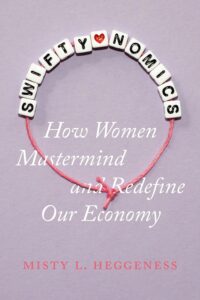 A feminist romp through pop culture that illuminates how women influence and shape the economy.
Taylor Swift isn’t just a pop megastar. She is a working woman whose astounding accomplishments defy patriarchal norms. And while not all women can be Beyoncé or Dolly Parton or Reese Witherspoon, the successes of these trailblazing stars help us understand the central role of women in today’s economy.
Swiftynomics assesses the complex economic lives of everyday American women through the stories of groundbreakers like Taylor Swift, Misty L. Heggeness digs into the data, revealing women’s hidden contributions and aspirations―the unexamined value they create by pursuing their own ambitions. She highlights the abundance of productive activity in their daily lives and acknowledges the barriers they still face.
Exploring critical reforms regarding caregiving and gendered labor, this book offers advice for women to thrive in an economy that was not built for them.
BUY HERE
Misty L. Heggeness is co-director of the Kansas Population Center, Associate Professor of Economics and Public Affairs at the University of Kansas, and former Principal Economist and Senior Advisor at the US Census Bureau. She is also creator of The Care Board, a dashboard of economic statistics built by and for caregivers that brings their economic contributions into the fold.
She has over a decade of experience leading high-profile research that informed decision-making within the U.S. federal government. Her research focuses on poverty & inequality, gender economics, and the high-skilled workforce, and has appeared in outlets such as The New York Times, TIME, The Wall Street Journal, NPR, The Economist, and Science.
Category: On Writing
Subscribe
If you enjoyed this article, subscribe to receive more just like it.