
The Covid Pandemic Held my Screenwriting Career Captive. Publishing set it Free. By Linda Margolin Royal
In 2008 I decided the time had come to record my father and learn about his life so my children would have a lasting memory for reference.
He was 80. His mind was clear and sharp. With a small video camera aimed at him, he began relaying a hair-raising tale of escape and rescue.
It was December, 1939 and the situation was dire. My father was 10. His father was serving in the Polish army on the Lithuanian border. He called for his wife, my grandmother, to leave by any means with my father.
The Gestapo had just approached my grandmother, he recalled – advising her that their apartment was to be taken over by the Germans. She was an exquisitely beautiful woman and fluent in high German. She could also spin a good yarn. She convinced the officer that she was from Berlin and could offer him US dollars if he would agree to drive her and her son to the border that night. Taken by her flirtations and charm, he agreed.
However, my father explained, the German only kept part of his promise and they were unceremoniously dumped in the forest in the dead of night, in freezing conditions. The two found other refugees wandering towards the border. A German patrol came upon the group, forced them to strip and they were about to be shot, when the drunk commander approached and ordered them not to waste expensive bullets on Jews.
Instead, they should load them into a rowboat at the edge of the nearby river and push it across to the other side and let the authorities deal with them on that end.
He said they then reunited with his father, my grandfather in Vilnius, Lithuania in January,1940. Stories began circulating late July about a Japanese diplomat named Chiune Sugihara and a Dutch consul, Jan Zwartendijk who were issuing visas to Dutch Curacao via Japan. My grandfather and father took the train to Kaunas and joined the line of hundreds of desperate hopefuls.
They were fortunate enough to secure these precious documents, pieces of paper that now represent life.
I stopped him there. “Sugihara? I asked. Who is that? Why have you never mentioned him before? Is that why you were in Japan for 10 months? I owe my life to this man?” A copywriter, I instantly began researching and, sure enough, this Japanese hero had saved not only my family, but 6,000 others from the Holocaust. Why had I and nobody I knew heard of him?
I became obsessed with an urge to perpetuate this hero’s memory. I had always wanted to write something significant. A movie. Here was my story. Most writers write from personal experience but nothing had happened to me that would force me to drop everything and start this process! But to hear that – to be told you are one of the fortunate few given life because of the actions of another who risked his own is a powerful thing. It’s indescribable. And this was my own family’s story, a story the world needed to know.
I was pumped.
I taught myself through reading and workshops to write a movie. I gathered a small team of passionate collaborators and I wrote and rewrote. That was about 8 years of a 10-year process. I secured a coveted government grant from Screen Australia.
But then Covid hit.
I was advised “Nobody is going to the movies. How about you write a book in the meantime.”
Journey number two commenced. I was in lockdown and so – shaken but not stirred, I sat quietly and wrote and wrote until I produced a 90,000-word manuscript. Someone then said, “Well – now you need a Literary Editor.”
“A what?” I said?
“Someone to edit it so it is presentable enough to approach publishers.”
I found one who announced, “This is a great story, but it reads like a well-structured screenplay!”
She said I had been taught to show, not tell; to rely on a camera and a director. “More description, more prose!” She ordered. I had to tell, not show.
Six more months and my editor decided it finally resembled a book.
After many months, curled up in foetal position, crying on my bed with rejection after rejection pouring in, one publisher finally had faith in me. Affirm Press (now part of Simon & Schuster).
The Star on the Grave was born.
The book world embraced this story. A bestseller in just three months, the top historical fiction in Australia for the first two months after release, the time had come to attract US attention so I could finally come full circle and develop the movie – which would now be an adaptation of the book; and attract a US studio.
First I needed to get known. I needed a US publisher. No mean feat.
Two years later and many more rejections, I’m still standing! I’m overjoyed to have had my book launch on US soil March, 2026 thanks to the wonderful Sibylline Press.
The story I have created, inspired by the true story of Sugihara, (and without giving away the premise), was designed to highlight the fact that just because you have been physically saved does not mean you have been emotionally rescued. The scars you carry, you carry with you for life and impact your mental wellbeing, your relationships and your parenting ability.
A troubled young woman, 21-year-old woman, Rachel, lives in Sydney. It is 1968. She is the only child of a troubled, distant man and has lost her mother at age 9. Her grandmother – Felka is her rock. An only child, she senses something absent in her life. A secret past is revealed and she is thrust into a journey of discovery and a desire for answers. This catapults her on a trip with her grandmother, to meet and thank the man to whom they owe their lives, and a journey to understanding and acceptance of her estranged father.
My real desire is that it be a story that represents not just descendants of the Holocaust but all individuals who have experienced trauma, loss, relocation and assimilation, and deals with the impact of wartime experience on the next generation, and the importance of family and connection to culture and faith.
My husband of 37 years has had to learn to make room for this other man in my life – Chiune Sugihara, as it is is now dominated by perpetuating his memory in book and on the screen.
—
Linda Margolin is the author of the Australian award-winning bestseller, The Star on the Grave – inspired by her family’s true story of rescue from the Holocaust. The prequel is with the publisher for consideration and a TV series is in development.
THE STAR ON THE GRAVE
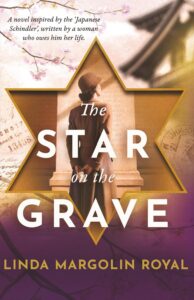 The incredible true story of the Japanese diplomat who defied his government to save thousands from the Nazis is now an award-winning historical novel
In 1940, as the Nazis sweep towards Lithuania, Japanese diplomat Chiune Sugihara defies his government and secretly issues visas to fleeing Jewish refugees. After the war Sugihara is dismissed and disappears into obscurity.
Nearly three decades later, in Australia, Rachel Margol is shocked when her engagement reveals a long-held family secret: she is Jewish. As she grapples with this deception and the dysfunction it has caused, unspoken tragedies from the past begin to come to light. When an opportunity arrives to visit Chiune Sugihara, the man who risked his life to save the Margols during World War II, Rachel becomes determined to meet him. But will a journey to Japan, and the secrets it uncovers, heal the family or fracture them for good?
The Star on the Grave is inspired by the true story of Chiune Sugihara, and the thousands of people who owe him their lives. Sugihara is often referred to as the Japanese Schindler. It is estimated that he saved 6,000 people – the author’s father and grandparents among them, and as many as 500,000 people are alive today because of him.
Winner 2025 Australian Jewish Writer Awards
This is the United States, Second Edition published by Sibylline Press
BUY HERE
Category: On Publishing, On Writing
Subscribe
If you enjoyed this article, subscribe to receive more just like it.



Wow, thank you for sharing your powerful journey.