
Following Curiosity to a Bigger Life
By Mimi Zieman
I’m convinced the best things in life happen when you don’t plan them. when you let go of rigid strategies and follow your curiosity, accepting uncertainty along the way.
That’s how I found myself, as a medical student, serving as the sole medical support on a remote Everest team in Tibet. It’s also how, thirty-six years later, I found myself publishing a memoir about that experience.
When people hear about our expedition, their first question is usually, “did you reach the summit?” They’re surprised to learn I wasn’t there to climb. I went because I treasured time in the mountains and wanted to immerse myself in the majesty of the Himalayas. Once invited, I couldn’t pass up the opportunity, even though I was filled with self-doubt about serving as the “doctor.” That role became my personal Everest. Part of my motivation for writing the book was to share that we’re all capable of far more than we imagine. It was important to me that readers with fears and self-doubt felt seen.
My path there was anything but strategic. It began with a poster in my college biology department advertising summer courses at a field station in the Colorado Rockies. One summer in the mountains — and discovering joy there — led to another. During my second summer, I watched a researcher’s slide show about acid rain in Tibet. Sitting in that darkened room, I thought, I want to go there. Within a year, at twenty-two, I backpacked alone in Nepal. Near the end of that trek, I met Everest climbers who later invited me on their next expedition, mostly because I hiked well at high altitude.
In today’s overstimulated world, I treasure memories from a time of true adventure, before Everest became commercialized and a bucket-list item. In 1988, there were no lines of people waiting to summit. During our four months away, we saw no other westerners. Invitations were extended only to elite climbers. My teammates would later enter mountaineering history books for establishing a new route on the mountain without supplemental oxygen or Sherpa support. We faced life-and-death struggles, and two of the four climbers wrote books about it.
I was not one of the elites. But I always wanted to write about the unique experience of being the only woman on the team, caring for severe injuries in the wilderness with limited experience and no safety net. There had never been a memoir by a woman serving as expedition doctor on Everest — though that didn’t make it any easier to find a literary agent.
Over time, I came to appreciate the significance of our long periods of isolation and the independence and resilience we gained. I longed for that quiet before internet and cell phones. Just before leaving for the expedition, I packed my tap shoes into a gray duffel bag. I didn’t know why, but one day during the trip I’d fuse two sources of joy – dance and mountains.
I built a career as an OB-GYN, married, raised three children. My early dream of becoming a writer was locked away.
The memoir began unexpectedly, as most meaningful things in my life have. I resigned from an all-consuming job in a moment of indignation and drove home with no plan. The next morning, I sat at my desk and began to write. I didn’t stop for a year. Three years later I had a decent draft.
Writing, like adventure, demands following curiosity to unexpected places and sitting with the discomfort of not knowing where it will lead. I had never planned to write about my family. Now I asked how had a New York City–raised girl ended up in Tibet at twenty-five? Why did I willingly place myself in a life-and-death survival situation when my father had been the sole survivor of his family from the Holocaust, and my maternal grandmother had fled Nazi Germany? Was there a connection between inherited trauma and chosen risk?
As I wrote about my insecurity as expedition doctor, I felt those same doubts at the desk. Could I write well enough? Who would care? The vulnerability of writing a memoir mirrored my fears about doctoring on Everest. My mantra became: anyone can write a book, I want to write a good book. I glued myself to the chair. Took craft class after craft class. Later, the surprise: Tap Dancing on Everest won Best Memoir by the American Writing Awards, and I was named Georgia Author of the Year for memoir.
Outside recognition feels good, especially when you feel unsure and vulnerable. But it also confirmed that there’s value in the circuitous path of following curiosity, instincts and passions. Nothing about it had been engineered. I’d been open to detours despite doubt. The best part was yet to come—connecting with readers at book events and hearing what parts of my story resonated with them and learning about their interesting life choices..
After submitting the manuscript to my agent, I thought I might never write again. Maybe I had only one story to tell. One month later, the Supreme Court overturned Roe v. Wade. For decades I had practiced medicine as an OB-GYN and advocated for reproductive rights. Within a week, I began drafting a play, The Post-Roe Monologues. Again, an unplanned convergence: medicine, advocacy, writing. Following my passions opened another door.
Albert Einstein said, “I have no special talents. I am only passionately curious.” We all know of his talent, but he chose to honor curiosity as fundamental. Curiosity led me to mountains. It led me to the page. It continues to expand my life in ways far better than I could have planned.
—
Mimi Zieman is a physician and author of the award-winning memoir Tap Dancing on Everest, about the risks we take to become our truest selves. Her play, The Post-Roe Monologues, has been performed in multiple cities and essays have appeared in USA Today, Newsweek, Salon, Ms. Magazine, and elsewhere. Her Substack newsletter, Medicine, Mountains & More empowers readers with medical news and inspires them with art and nature. Learn more at www.mimiziemanmd.com
—
TAP DANCING ON EVEREST
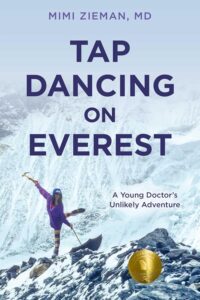 “Gorgeous…so full of joy, zest and fun, yet profound. Once started you cannot put it down.” —Sir Chris Bonington, author of Everest the Hard Way
“…lively, engaging, and funny…”—Meg Wolitzer, New York Times bestselling author of The Interestings
The plan was outrageous: A small expedition of four climbers would attempt a new route on the East Face of Mt. Everest, considered the most remote and dangerous side of the mountain, summitted only once before. They would climb without using supplemental oxygen, porter support, or chance for rescue. Mimi Zieman would accompany the climbers as the doctor—and only woman—although she was still in her third year of medical school.
Full of self-doubt, Zieman grappled with whether to go but couldn’t resist the call of the wilderness and mountains. On Everest, when three climbers disappeared during their summit attempt, she reached the knife edge of her limits and dug deeply to fight for the climbers’ lives and to find her voice.
Sparkling with suspense and vulnerability, Tap Dancing on Everest is a true survival story about the risks we take to become our most authentic selves. In this inspiring coming-of-age travel memoir that includes solo hiking through Nepal, Zieman weaves her childhood as the daughter of Jewish immigrants raised in 1970’s New York City, her father a Holocaust survivor, with adventure, medicine, and empowerment. She captures the curiosity and awe of a young woman as she faces down messages to stay small and safe and ventures into the unknown.
Category: On Writing
Subscribe
If you enjoyed this article, subscribe to receive more just like it.





On “Following Curiosity to a Bigger Life”
I was struck by the idea that curiosity can enlarge a life in ways we could never have planned. I began writing books at seventy, after a life spent in entirely different disciplines, and have come to think that the most interesting chapters are often the ones we could not have anticipated. Thank you for this thoughtful piece.
Alinda Lewris