How Schools Make Race: Teaching Latinx Racialization in America by Dr. Chávez-Moreno: EXCERPT
Excerpted with permission from How Schools Make Race: Teaching Latinx Racialization in America by Laura C. Chávez-Moreno, October 2024, published by Harvard Education Press.
On Friday, June 16, 2017, Amlie High School held its graduation ceremony. I had attended other high school graduations, including my own in Douglas, Arizona, a town bordering México, and five graduations as a public high school teacher of Spanish in Philadelphia. But this was my first in a midwestern city, and I wondered how different it would be. I arrived at the large sports arena where the ceremony was to take place, ten minutes before the 7:30 p.m. start time. After going through the metal detectors, I entered the stands, the usual “Pomp and Circumstance” march echoing and competing with people’s buzz of anticipation, and I was surprised that the lower sections looked packed. I had not expected so many to be early, indicating to me that I was late compared with the proud families. I sat close to where one of my study’s teacher participants had texted me that she would be sitting. Not finding her, I looked through the printed program pamphlet, now looking for acknowledgment of Amlie High’s bilingual education dual-language program, which I had been studying for more than a year. This commencement included the dual-language program’s first cohort of graduating seniors, who had started twelve years ago in Somos Bilingüe Elementary School. It was a notable accomplishment for the students, Amlie High, the Oakville Urban School District, and for Oakville’s Latinx community, who had fought to establish dual-language education as a means to improve Latinxs’ education.
Seeing that the pamphlet did not mention the program, I glanced over the 350 robed graduating seniors sitting in the middle of the arena. Everyone excitedly chatted until 7:37 p.m., when an announcement called us to rise for the US national anthem. Then
Amlie’s principal addressed the audience, with an American Sign Language interpreter nearby. The speech acknowledged the disparities of economic status and of opportunities within Amlie High’s student population. “Some of you have been homeless, some of you have competed in championships,” said the principal, adding the customary commencement comments, “If you work hard, believe in yourself, the world is yours.” Next, select student speakers went up to the podium individually. The fifth student to speak shared:
We are so lucky to have attended a diverse school. We have students who are different races, religions, . . . I even went to a quinceañera and bar mitzvah. . . . I learned a great deal from classes but also lots of my classmates who opened my eyes. For some of us, it means we will go to places, universities with less diversity. We have to seek diversity.
The mention of diversity struck me because all the speakers, including this student, were White. Amlie High’s racial makeup was approximately 41 percent White, 23
percent Black/African American, 21 percent Latinx/ Hispanic, 10 percent multiracial, 5 percent Asian American, <1 percent Native American, and <1 percent Pacific Islander. This racial composition made Amlie one of Oakville’s “less White high schools.” Yet not until 8:16 p.m. did a Black student break the trend. After her, another White student speaker came to the podium. She was the only one to note that Amlie’s dual-language graduates were a district first. Her remark prompted applause and cheering in scattered places throughout the crowd, including behind me, causing me to turn and see a Latinx family with young kids and a crying baby. Her remark also eased my disappointment that the ceremony had not formally recognized this community’s or the individual students’ bilingual education accomplishments. The ceremony ended without featuring any Latinx student or even the token inclusion of Spanish.
This surprised me. During the years I had spent at Oakville for the research study that is the catalyst for this book, many repeated the idea that Amlie’s diversity was its strength, making it stand out from Oakville’s other (better-achieving) high schools. While other schools also promote this narrative, it takes on special significance when we note that Oakville’s Latinx community made possible the racially diverse Spanish English dual-language program. While some people expect that bilingual education is a space for Latinxs—where they have a chance at meeting their needs and have a voice on par with their dominant peers—the ceremony upended the idea of the dual-language program providing opportunities and representation that uplift Latinxs even when outside of the program. The district’s educators, policymakers, and community members portrayed this program as for the educational attainment and benefit not only of Latinxs, but also of all students. The district used it to address the needs of Spanish dominant Latinxs who would otherwise be placed in subtractive English as a Second Language (ESL) courses. Oakville’s Latinx community, along with others, regarded the program as an intervention for ameliorating racial injustice, for providing Latinx students a linguistically and culturally relevant education. The district also used it to curtail White flight by attracting White families looking for bilingual education, a scarce resource in public schools.4 This made the absence of Latinx honorees at the graduation ceremony all the more apparent.
The absence might also lead some to question whether dual-language education can provide educational equity to students who are racialized as Others.5 This book tackles this equity issue by showing how these patterns and other practices convey ideas about race and Latinxs in schools. It uses Oakville’s secondary-level bilingual education program as an example to show how schools make race.
By “make race,” I mean how schools convey ideas about race, whether intentionally or not, and contribute to society’s ongoing redefinition of racial categories and hierarchies.6 Societies construct race through historical, legal, political, economic,
discursive, and/or other practices that discriminate and mark—and thereby make— racialized groups in relation to other groups. Scholars call this racialization—the process of socially forming racialized patterns, meanings, and the boundaries of racialized groups. This process also involves placing these groups in a hierarchy and distributing resources along racial lines.
Schools, as institutions in society, make race by contributing to racialization. Schools inform people’s ideas about race, sometimes by teachers providing explicit lessons on race or racism. But more often than not, and usually unintentionally, schools make race through their practices, policies, and discourses.
—
Dr. Chávez-Moreno is an award-winning researcher, qualitative social scientist, and assistant professor at UCLA in the Departments of Chicana/o and Central American Studies and Education. She is the author of How Schools Make Race: Teaching Latinx Racialization in America (Harvard Education Press, 2024), in which she uncovers the process through which schools implicitly and explicitly shape their students’ concept of race and the often unintentional consequences of this on educational equity. The book has already won several awards, include an American Association of Hispanics in Higher Education Book of the Year Award. You can watch her speak about these ideas further on PBS.
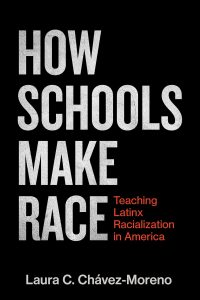
How Schools Make Race: Teaching Latinx Racialization in America
 Winner of a 2025 AAHHE Book of the Year Award
Winner of a 2025 Nautilus Silver Book Award
Winner of the 2025 National Indie Excellence Award in Latinx nonfiction
Winner of the 2025 IPPY Silver Award in Education II (Commentary/Theory)
Winner of the 2024 Foreword INDIES Silver Award for Education
A 2025 International Book Award Finalist in Education
An investigation into how schooling can enhance and hinder critical-racial consciousness through the making of the Latinx racialized group
In How Schools Make Race, Laura C. Chávez-Moreno uncovers the process through which schools implicitly and explicitly shape their students’ concept of race and the often unintentional consequences of this on educational equity. Chávez-Moreno sheds light on how the complex interactions among educational practices, policies, pedagogy, language, and societal ideas interplay to form, reinforce, and blur the boundaries of racialized groups, a dynamic which creates contradictions in classrooms and communities committed to antiracism.
In this provocative book, Chávez-Moreno urges readers to rethink race, to reconceptualize Latinx as a racialized group, and to pay attention to how schools construct Latinidad (a concept about Latinx experience and identity) in relation to Blackness, Indigeneity, Asianness, and Whiteness. The work explores, as an example, how Spanish-English bilingual education programs engage in race-making work. It also illuminates how schools can offer ambitious teachings to raise their students’ critical consciousness about race and racialization.
Ultimately, Chávez-Moreno’s groundbreaking work makes clear that understanding how our schools teach about racialized groups is crucial to understanding how our society thinks about race and offers solutions to racial inequities. The book invites educators and scholars to embrace ambitious teaching about the ambivalence of race so that teachers and students are prepared to interrogate racist ideas and act toward just outcomes.
BUY HERE
Category: On Writing
Subscribe
If you enjoyed this article, subscribe to receive more just like it.