My Writing Journey by Ellen Baker
I loved the feel of a pen gliding on paper as a kid. My mom, an English teacher, would bring me red and blue Papermate ballpoints from work. I was so driven to write that, at seven, after falling off my bike and breaking my right wrist, I scrawled out a messy story about it with my non-dominant left hand. My parents both loved stories and books; everybody was always reading in our house.
As a teenager, I wrote all the time, filling a stack of spiral notebooks: short stories when I should’ve been paying attention in class, poems and journal entries every night before bed, a novel chapter or two every week. By college, I’d finished my second novel. I mailed the typed manuscript off to Ballantine Books—I knew the over-the-transom route was frowned upon, but I was so sure they’d be the right publisher for me—and got a form rejection letter in the mail. This was 1995.
Over the next few years, I worked on a third manuscript while I got a B.A. in psychology and an M.A. in American Studies. By my mid-twenties, I was querying agents—and getting lots of rejections. I got married and started a new novel, which began as a family saga (my favorite), then evolved into the story of a young 1950s housewife trying to make the best of the unexpectedly dissatisfying experience of being newly married. (It was years before I’d allow myself to realize I was also unexpectedly dissatisfied with being married.)
At 27, I left my full-time museum curator job to become a part-time event coordinator at an independent bookstore so I’d have more time to write. It wasn’t only the time that turned out to be valuable: I learned the book business from the other side; I talked to readers and learned what they were looking for; I met lots of successful authors. Also, whenever I was shelving books, I would ask myself if my novel was good enough to be on the shelf beside Kevin Baker and Elizabeth Berg, and every day the answer was no, so I kept on working. I treated writing as my second part-time job, clocking my hours and trying to reach twenty every week.
When I finally thought my manuscript was ready, I began the querying process again. A few agents requested the first fifty pages—then a few requested the full manuscript. After months, on Memorial Day 2006—I was thirty years old and in the middle of making potato salad for a picnic, my hands gloppy with cooked potato—I got a call from a marvelous agent offering to represent me. It was incredible, life-changing news. More life-changing news arrived only two months later, when she called to say that she’d gotten me a two-book deal with a top editor at Random House.
My novel Keeping the House was published in July 2007. Now I can see that it did fairly well—but all I could seem to see back then was that it didn’t do as well as Random House had hoped. I started to really struggle. I’d been battling depression since I was fifteen, but now I fell into the deepest depression of my life. I got divorced and moved from Minnesota to Maine in an attempt to start a new life.
My second novel, I Gave My Heart to Know This, came out in 2011, and I began writing another. I thought I could do better than before; I hoped that, if I could, all my problems would be solved.
Fast forward ten years and I had finished—and rewritten eight times—a novel about a woman pilot in the 1910s. I was exploring what it might feel like to feel free. Free of conventions and rules that the 1950s housewife (and I) had lived by. But maybe I was writing this novel from the wrong place—from my head more than my heart. First my agent couldn’t find a publisher for it, then, for the last few versions, didn’t think it was worth trying. During this time, I also moved a couple dozen times and trained to become a mindset coach and Reiki healer.
By late 2020, I realized The Aviatrix was never going to have her moment. I was going to have to either give up or start fresh again. I decided to give myself one last chance, and, instead of trying to write what I thought would be the “right thing” intellectually, to return to working from my heart again, the way I had when I was young.
I wrote The Hidden Life of Cecily Larson over the next seven months, then sent it off to two trusted readers for feedback, then spent a few more months revising it. I had learned a lot over that decade of revising The Aviatrix, so the tools were there to work quickly, and the passion of that seven-year-old kid who just had to write no matter what was back. My agent and I had parted company, so I started querying again. Eleven months and seventy-four rejections later, I was thrilled to be offered representation by another marvelous agent and soon, a contract with Mariner Books/HarperCollins.
As Cecily met with success (including thrills like being featured in People and Woman’s World), I quickly came up with another novel idea and wrote a detailed proposal for a family saga centered around a Maine coast cottage and what happens when a husband disappears on the night of his birthday party in 2010, unraveling plans and upending the lives of everyone he loves. My publisher said yes, I wrote the novel over the winter of 2024-25, and Summerland Cove comes out June 2.
If at 30 I felt I had succeeded by becoming a published novelist, and at 45 thought I had failed for good, now, at 50, I’m starting to see that, in the business of writing, at least for most of us, neither success nor failure lasts—or even, in the end, is what matters.
What matters, I think, is persevering, finding joy, showing up as you truly are, the sensation of the pen on paper. The hope that you might provide someone some solace by creating a world to which they can escape—or even by making them feel seen and understood.
After spending years asking, “Why isn’t all this hard work getting me the peace and happiness I want?,” I’ve started asking different questions: What have been the beliefs that have caused me to stay stuck in certain patterns of struggle or dissatisfaction? The feeling that I could never do enough and that no matter what I accomplished I would find a way to feel I had failed? What part of me wanted me to stay stuck? And what is the best way that I can contribute now to a world that badly needs positive contributions?
That’s why, even as I continue working on a new novel about a different family and cottage in the same setting of Summerland Cove, I’ve also founded a space called The Next Chapter Studio for midlife women ready to stop proving and start living. My step-by-step Identity Rewrite Method makes it easy to uncover and rewrite the internal beliefs that have been limiting your own life story so you can get on the path toward the happy ending you want—just as I have.
Currently, in May/June 2026, I’m offering your first seven days inside the Studio at no cost so you can step inside and see if it’s the right space for you. Visit www.ellenbakerstudio.com/studio to explore.
—
—
SUMMERLAND COVE
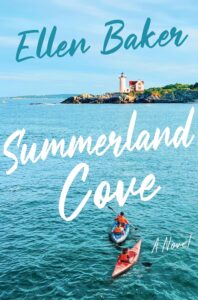 Apples Never Fall meets Maine in this captivating novel of family secrets, summer celebrations, and putting things back together again after they’ve all fallen apart— from the acclaimed author of The Hidden Life of Cecily Larson.
Lindy has the summer of a lifetime planned at her family’s beloved cottage in Summerland Cove, Maine, where she’s spent summers all her life and where she and her husband David met as teenagers. She’s slated big events three weekends in a row: David’s fiftieth birthday party, her parents’ fiftieth anniversary party, and her oldest daughter Hailey’s wedding. But when David doesn’t show up for his own party, everything about the life they’ve created together is thrown into question, as the shattered family sets out looking for him. Has he been in an accident? God forbid, been the victim of a crime? Or is it something more cliché—a midlife crisis, an affair? Surely, he’ll show up for his beloved daughter’s wedding—won’t he?
The agonizing days tick by and still no David. Lindy’s four nearly grown children are panicked. Lindy struggles to remain calm, even as long-buried details of the family’s past begin to surface, offering distressing clues. Meanwhile, her mother seems to be harboring secrets of her own, her father has grown alarmingly absent-minded, and Hailey wrestles with whether she should get married at all—even if her father does turn up.
A richly drawn novel of mothers, marriages, and one endearingly messy family, Summerland Cove beautifully evokes the crisp air and rocky beaches of coastal Maine, while poignantly revealing how complicated histories can shape the present in unexpected ways.
Category: Contemporary Women Writers, On Writing
Subscribe
If you enjoyed this article, subscribe to receive more just like it.