Understanding the Black Middle-Class—from Childhood Seeds to Sustained Sociological Inquiry By Angela Simms
 I grew up in a middle-class Black family in the 1980s and 90s. My dad, Everitt, and my mom, Joan, raised me and my brother, Joshua, in Prince William County, Virginia, a suburb in the DMV, as we locals say (the DC, Maryland, and Virginia Metropolitan Area). As such, my sociological intuition regarding race and class disparities developed organically as I navigated what was then a majority-White county and traversed the region to visit family who lived elsewhere in the DMV where the Black population was higher.
My uncle Garry and Aunt Shari lived in Prince George’s County, about a 45-minute drive from our house when traffic cooperated. As we cruised in our sky-blue Ford Taurus station wagon to visit my aunt and uncle, I entertained myself by peppering my parents with questions about the social world. When I was eight-years-old, I asked: “Why are there more Black people in Prince George’s?”
The budding sociologist in me was already noticing racial residential segregation patterns. Decades later, after years of graduate school, I asked a similar question.
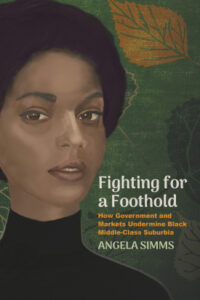
In 2016, when I commenced the research project that would become the book Fighting for a Foothold, it was a fortunate coincidence that Prince George’s is the ideal site for my examination of Black middle-class Americans’ ability to realize the same material returns to their middle-class status as their White counterparts.
I selected the county because it is a “best-case-scenario” for African Americans as they seek to overcome legacy and ongoing forms of White domination and anti-Black racism in government policies and market practices. Prince George’s has the highest concentration of affluent Black Americans in a single local jurisdiction (as measured by household income and college degree attainment).
Still, I brought my whole self to Prince George’s—and that included that I am a “home town girl.” I gleaned that the fact that I am a Black middle-class woman created a sense of ease with my respondents. They seemed confident that I was genuinely interested in “telling the whole story” about Black people, our joys and triumphs, not just our challenges.
Ethnographers often struggle to gain the trust of the people they seek to understand. But I experienced the opposite. To be sure, I had to demonstrate competence and sincerity, but I felt welcomed from the outset. At the end of my first week in the field, a council member beckoned me to the front of the hearing room to introduce myself; after all, it was rare for a person to attend mid-day hearings several days in a row.
Our shared racial and class background meant that as I talked to Prince George’s officials, agency staff, and residents, our interactions were more like conversations, than “work.” Yes, they were work-related, but those I engaged did not have to expend excessive emotional energy to explain things to me because they feared I could not or did not want to appreciate the expansiveness and complexities of their experiences.
For Black people, this concern is warranted; we are often studied with an eye toward what is deficient in our communities, rather than an eye toward depicting the social, economic, and political processes that shape us and that we seek to shape.
When speaking to council staff, they often mentioned things to me in ways that made me feel like an “insider,” indicating they expected that I “got it,” such as the discrimination Black people have faced, and continue to endure, as they pursue fair home mortgage terms. I use multiple forms of data to build my arguments—interviews, direct observation, and budget data; yet it is also true that many of the leads for what I focused on stemmed from informal conversations with Prince Georgians.
Beyond the ease that comes from shared class and racial identities, I think there were at least two other reasons for the warm reception I experienced: (1) I am a Black woman who had funding from a major university to conduct research and they were excited to see a Black person with the means to enact her own research agenda; and (2) given I had discretion about what to study and how to study it, they were thrilled that I chose to analyze and tell the story of an affluent Black county.
My experience as a researcher in Prince George’s, over 30 years after my trips there in my family’s sky-blue station wagon, reveal that stories told well are anchored by integrity-based communal processes and shared interests. The primary goal I share with Prince Georgians is to tell the truth about Black middle-class life in the United States in all its fullness!
Buy Fighting for a Foothold How Government and Markets Undermine Black Middle-Class Suburbia HERE
—
Angela Simms is Assistant Professor of Sociology and Urban Studies at Barnard College-Columbia University. Prior to academia, Angela served in the federal government for seven years as a Presidential Management Fellow and legislative analyst at the Office of Management and Budget during the George W. Bush and Barack Obama Administrations.
Category: Contemporary Women Writers, On Writing
Subscribe
If you enjoyed this article, subscribe to receive more just like it.