A Tea That Never Happened
By Linda Rosen
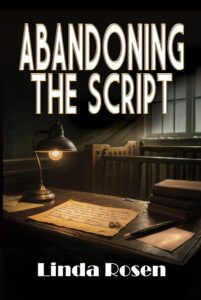
ABANDONING THE SCRIPT
 “Engaging and immersive, Rosen delivers a deeply moving plot with a heartfelt conclusion.” -Rochelle Weinstein, bestselling author of We Are Made of Stars
Lucy never wanted the life that’s been thrust upon her-the wedding band or the baby in the crib. A woman of ambition, she longs to pursue her dreams on stage, but her husband insists on locking her in a gilded cage under his control. And in 1922, alternatives are almost nonexistent and certainly not acceptable, forcing Lucy to make an impossible choice. Bound by convention but driven by a fierce desire for independence, she flees a life she can no longer endure. With heartbreak, she leaves a pair of cherished earrings along with a note for her daughter to read when she’s older.
Nearly thirty years later, in 1951, Lucy’s daughter, Anna Dodge, is given her deceased grandmother’s journal that’s been hidden away for years. Within its pages lies a long-buried secret, casting doubt on everything Anna believes about her family and herself. Among the clues is the story of the earrings, hinting at truths that defy what Anna has always known.
Devastated and determined to understand her past, Anna embarks on a journey to unmask the truth. As she does, she discovers the past isn’t just something to uncover-it’s something that could determine her future.
Meet Helen and Mama Brandt, two characters in Abandoning the Script, in a scene that never happened though Oh, how much Mama Brandt wishes it would
The Art Deco gates clang as the elevator operator draws them closed. “Five please,” Mama Brandt says to the gentleman in the double-breasted burgundy jacket with its shiny brass buttons and black collar, the uniform of all elevator operators in New York City’s fine apartment houses in 1936. She says the floor number calmly, though she’s sure he can hear her stomach grinding like the sound of the elevator as it climbs upward. Are her nerves from anticipation, joy, or is it intense fear? She’s not sure although she is certain of what she’s doing. It’s what she’s wished for, for many years. And prays Charles never finds out.
Standing in front of 5G, Mama Brandt adjusts the feather in her felt hat, then taps the brass knocker gently against the wooden door. Aware of her hesitancy, and not wanting to be despite her fears, she gives it another knock, stronger this time. A moment later, as if someone was anxiously waiting on the other side, the door opens.
“It’s so wonderful to see you again,” Helen says, a delighted smile on her face. “Come in, come in.” Mama Brandt steps into the spacious foyer with its crown moldings and solid oak floor as Helen babbles on. “Too many years have gone by from when we bumped into each other in the park,” she says. “Thank you so much for accepting my invite. Come, let’s go into the kitchen.” Leading Mama Brandt into the brightly lit room, she stops short and turns to her. “I’m sorry. Do you mind having tea in the kitchen, or would you prefer the dining room?”
“Oh, please. Kitchens are wonderful. So much cozier.” Mama Brandt looks around the sunny room with its linoleum counter tops and pink and green linoleum floor, then takes a seat at the table and removes her lace gloves. “You must know,” she says, “being with you warms my heart. Often, after running into you at Bethesda Fountain, I looked everywhere for you, when I was alone. I needed to see you again, to talk with you. But that was not to be. It has taken us, what, eight, nine years for that to happen, and at the grocer no less? It’s not a place I frequent.”
“Well, I am so glad you did. When I spotted you perusing the cereal aisle, I was afraid to approach you, that it would make you uncomfortable. I sensed that when we met in the park. Rosy was seven I think, so adorable with her bouncy curls. She must be close to sixteen now.” Helen leans across the table. “You know, after seeing you both that day, I looked up your address in the telephone book. But I was afraid to call or come by remembering what Charles had said about you not ever being in touch with me again.”
Mama Brandt nods. She understands that feeling all too well.
“Does he know you’re here?” Helen says, the words float across the table in a concerned whisper.
“Oh, my heavens! No! He can never find out. No one can, other than Crystal, if you decide to tell her. I would love to see her again. I have missed you both and am so sorry I was not strong enough to go against my son. I am still not and definitely not proud of that. I once told Lucy Charles is like his father, and I never went against my husband either. I was not brought up that way. In my day, women were expected to obey their husbands. I admire Lucy for having the gumption to go against Charles.”
“Are you saying you admire what she did? Wait,” she says standing up. “Let me get the tea. I’m anxious to hear your answer and feel we’re going to need a strong brew.”
Helen turns on the gas under the kettle, then spoons loose aromatic leaves into a china tea pot and waits for the water to boil.
“I see you make tea like your mother did,” Mama Brandt says. “I do, too. I like the choreography of brewing a pot from loose tea leaves. It’s soothing.” And today, I certainly can use soothing, she thinks.
With her back against the counter Helen, with a melancholy smile, looks at Mama Brandt sitting at her well-worn oak table. “That’s my mother’s table,” she says. “I took it from her house when she moved to the Bronx, after my father died. And,” she lifts the tea pot, “this is hers, too. Seeing you sitting there brings me back to all those times Lucy, Crystal and I sat around that table as kids in my mother’s kitchen.”
Lucy used to tell me about that. She was so much happier in your house than her own. Her mother…oh my gosh!” Mama Brandt stops mid-sentence, her jaw drops open. Sitting up straight, she stares at Helen. “Are you in touch with Lucy? Where is she? How is she?”
Helen shakes her head. “Sadly, no. I was hoping you were.”
Mama Brandt sits back, her head lowered. For a moment, both women are quiet. The tea kettle whistles, shaking the heavy silence. Helen pours the boiled water into the pot, watching it turn a toasty brown. Bringing the pot to the table, she says, “It’s just awful not having any idea where she is or how she is, if she’s still in California. If she’s still alive.”
“Oh, please. Let’s not think that way. It has been many years since Lucy sent Rosy a birthday card, not since we moved out of the Village. But I have to believe my Lucy, my long-lost daughter-in-law, is happy, doing what she loves, being the woman she is meant to be.
“It’s interesting you still call her your daughter-in-law. Wouldn’t Charles’ new wife be upset by that?”
“Oh, I would never want to hurt Florence. She is a wonderful wife to Charles, and a loving mother to Rosy. I think you would like her. She is the woman Charles needed and I am sorry we encouraged his marriage to Lucy all those years ago.
“I would say demanded is a better word.” Helen takes a sip of tea then wraps her other hand around the bone china cup and places her elbows on the table. “So let’s get back to that marriage, and why you say you admire Lucy. Do you approve of what she did?”
“That is difficult to answer.” Mama Brandt runs her index finger slowly around the rim of her flowered cup, following it going round and round. “I have thought it about it many times over the years.” She looks across at Helen. “I could never have left my child and, if you had asked me this question years ago, before Lucy left, I would have said I do not understand how any woman could leave her child. But that is not how I feel now. Although I do not agree with Lucy leaving her daughter, I understand why she had to. And I do admire her. Not for what she did but for who she is. Just as I admire you and Crystal and all the women who stand up for their rights, no matter what society claims is appropriate behavior. Not all women are cut out to be mothers. Or married, for that matter. A woman should be able to pursue her dream, whether it means being an actress like Lucy, a lawyer, doctor, or journalist like you, even if she has a husband and child.
“And that woman needs a husband who is willing to support his wife, even if it means her being out of the house. And he has to be willing to help out at home when needed. That’s hard to find in 1936.
“Your mother had that, and that was a long time ago. Your father was rare, though. I agree, most men never step into a kitchen or sit on the floor building blocks with their children, or diaper their own son or daughter.
“Diaper a baby?” Helen laughs. “Can you imagine? My father supported my mother’s volunteering. He even marched with her in 1915 demanding the vote for women, but I doubt he ever even touched one of my diapers. Oh no, that would be going too far.
“I suppose we can hope one day men will be equal partners with their wives.”
“It’s interesting how you put it, that men should be equal partners. First, we have to have women considered equal. Even having the vote, I think we have a long way to go for that, and that’s coming from me, a journalist, who is constantly by-passed by men, no matter my talent. Yet, my husband is fine with me having a career.”
“Unlike Charles. Which brings us back to Lucy.”
“And her reasons for leaving,” Helen says lifting the tea cup to her lips. She sips, then says, “Like you, I understand why she had to, but it pains me, after being the best of friends since we were little girls, that she never told me what she was planning. Or, other than one letter, ever wrote. I have my memories, which I hold dear, and the earrings. I wear them from time to time, to feel close to Lucy.
“Ah, the earrings. Lucy left hers with a note asking me to give them to Rosy on her sixteenth birthday. And to tell her the truth about her mother.
“Will you?” Helen asks, her eyes wide open.
“I hope I have the courage.”
“Hmmm,” Helen says, nodding, tea cup in midair as if it doesn’t know which way it should go. “I understand.” Placing it on the saucer, her eyes meet Mama Brandt’s. “I would like to help, in any way I can.”
“Thank you, but this is something I must do on my own. And face the consequences. Now, please, let’s enjoy this lovely tea.”
—
BUY ABANDONING THE SCRIPT HERE
Find out more about Linda on her website https://www.linda-rosen.com/
Category: On Writing
Subscribe
If you enjoyed this article, subscribe to receive more just like it.