Authors Interviewing Characters: Emily Franklin
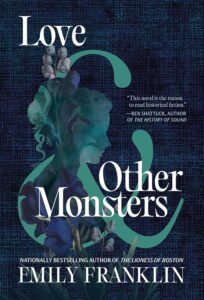 During the stormy, scandalous summer of 1816, daring eighteen-year-old Claire Clairmont, stepsister to Mary Shelley and lover of Lord Byron, changed the course of literature forever.
Those months of desire, betrayal, and creative passion gave the world the works of Frankenstein, the modern vampire, and the mythic image of these Romantic literary giants. In this intense and propulsive story of love, lust, art and betrayal, Claire tells her story, trying to solve the mystery of why she was all but erased from history.
Claire—herself a writer—is desperate to free herself from the uncomfortable role she plays in her sister’s marriage. Fueled by Jane Austen’s novels and believing love offers freedom, Claire begins an affair with celebrity Lord Byron and convinces Mary and Shelley to follow Byron to Switzerland.
With searing relevance to our here and now—of celebrity worship, climate disaster, and complicated femininity, Love & Other Monsters is the untold origin story of Frankenstein, a feminist reckoning of sisters, survival, and the creation of monsters—both those on the page and those who walk among us.
Emily Franklin interviews Claire Clairmont:
Claire Clairmont, carrying a basket of fresh herbs and wildflowers, holds in her hand a quill. Her fingers are stained with ink and mulberries. She looks around, clearly searching for something.
EF: Hello, Claire—
CC: Hello! I’m surprised you, a modern person, knows my name. Even though I am described as witty and wise and altogether more amiable than the famous people around me in the summer of 1816, no one remembers me. Such bizarre weather—freezing in July when the group of us took shelter at a mansion on the shores of Lake Geneva. Have you been?
[Claire crouches to look under my chair]
EF: Claire, are you looking for something?
CC: Yes. My journal. Have you seen it?
EF: No. I haven’t. Sorry.
CC: Well, anyway. Yes, Lake Geneva was beautiful and dramatic. Not unlike our host, the famous Lord Byron… [Claire blushes]. I used to… let’s say take tea with him. Byron had with him his rather complicated personal physician John Polidori. And of course, my stepsister, the brilliant Mary Wollstonecraft Shelley, was there with her fiery fiancé Percy Shelley.
EF: But you were really the center of the group, weren’t you?
CC: I suppose…though perhaps I was misunderstood. I was, after all, impressionable, clever, and… dangerously loyal. I did change the course of literature forever—not that any of the others would admit to that. [raises her voice] They tried to erase me, you know.
EF: I’m aware—that’s why I wrote a book about you.
CC: Well, that’s quite an endeavor. I, too, wrote a book. Not as famous as Mary’s novel, of course—
EF: You mean your stepsister Mary Shelley’s novel Frankenstein.
CC: Yes. That one. Perhaps you’ve heard of it? Haha. Everyone has heard of it. But did you see the preface? She tells the story of how she came to the idea, how Byron offered us all a challenge one evening during those storms. Yet—imagine this!—she says there were four people there that summer. Four! Perhaps my stepsister could not count, for I was the fifth.
[looks around again for her journal] My sister was brilliant, and I’m glad she had so much success in the literary realm. Still, a person does wonder what might have been—
EF: You mean if your work hadn’t been lost or, may I suggest, destroyed?
CC: [whispers] Perhaps we ought not make such claims. I wouldn’t want to upset anyone.
EF: And by anyone you mean Mary Shelley?
CC: Or… Dr. Polidori. Or even… the poet, Percy Shelley. He had quite a temper, did he not?
EF: And you’re worried his ghost will hear us?
CC: As I say in your novel, All love stories are ghost stories waiting to happen. [sighs] Not that I mean that about Shelley. Definitely not.
EF: Would you like to say more about that?
CC: Definitely not.
EF: Do you think you were, in some ways, your sister’s Creature?
CC: Ah, here we go with Frankenstein. And my influence on that work and the work of Lord Byron and Percy Shelley. I have a keen eye for editing, one might say. As for Frankenstein, all I might say about that is Mary and I had a complex sibling relationship that might have played a part on the page as well as in my day to day.
EF: It seems to me that Mary in some ways created you—asked you to be certain ways—and then didn’t like when you had a life of your own.
[Claire wipes away a tear.]
EF: I’m sorry, Claire! I’m not trying to upset you.
CC: I’m not upset. I’m relieved. To be known…
EF: Claire, you were funny and smart and yet history seems to have made sure your name has disappeared…
CC: That is not a question, Emily. That is a statement. And a controversial one at that. And yet… I will say that I left behind journals from before 1816 and journals from after 1816…
EF: So where is the journal from 1816, then?
CC: Exactly! I am forever searching for it. That’s the question that needs to be asked. So, thank you. Now, enough of this talking, I must go forage for wild garlic. Food was scarce that summer and I learned from the wonderful cook Elsa how to forage and keep everyone fed. I miss her. See? All love stories become ghost stories. The question is: who will tell the stories for the forgotten ghosts?
EF: Ah, maybe those of us who write historical fiction.
CC: Just make sure you put your name on your work—and do not leave your stories or journals unattended.
BUY HERE
—
Emily Franklin is the bestselling author of twenty-five books including The Lioness of Boston, historical fiction based on the life of trailblazer Isabella Stewart Gardner, now in its eleventh printing and recently featured as a clue on Jeopardy! Her work has been published in The New York Times, The Boston Globe, The Kenyon Review, and The Journal of the American Medical Association, among many other places, as well as featured and read aloud on National Public Radio, named notable by the Association of Jewish Libraries, and longlisted for the London Sunday Times Short Story Award. She grew up half in the UK and half in Boston where she lives with her spouse and four children. Her novel Love & Other Monsters (Godine, April 2026) is historical fiction told from the perspective of Claire Clairmont, Mary Shelley’s forgotten stepsister who was integral to the creation of Frankenstein.
Category: On Writing
Subscribe
If you enjoyed this article, subscribe to receive more just like it.