BACK TO SCHOOL REFLECTIONS: HOW GOING TO SCHOOL SAVED MY LIFE By Gina Barreca
If you’re the daughter of an unhappy mother, school can save your life.
Most children don’t think of their parents as depressed, anxious, or lonely because we don’t yet have words for those nuanced emotions. We might know that “Mom is sad” or sense that it’s a good time to stay quiet because the air crackles with the taut electricity of stress.
If your mother kept you close to her when she was feeling bad, you might have spent your earliest years trying to figure out how to make her feel better either by cheering her up or by keeping her company in her shadowy place.
You might have learned to become a storyteller because of the needs your mother had for diversion, or solace, or reassurance.
You, as a writer, have already figured out that this was the case for me.
While I wanted to be everything my mother needed me to be, I also wanted to be someplace, anyplace, else.
School was my Someplace Else.
Having seen my older brother do homework at the kitchen table, copying notes from textbooks, looking as serious as a monk, I couldn’t wait to go to kindergarten. I wanted to make friends, have adventures, and show off that I could read a little.
More than anything, if I’m being honest, I wanted school supplies: colored pencils, construction paper, my own spiral notebook. I wanted to write my name between the lines. I wanted to write my name ON the book.
That desire keeps me going.
Oh, sure, I can cite other inspirations for following a creative path: I found writing to be an act of salvation in all types of arenas, not only in terms of family dynamics but as a way to navigate relationships throughout my life. I fell in love with language and language occasionally seemed to return the affection, allowing me to develop intimacy with novels, nonfiction, essays, poetry, short stories, and fortune-cookies.
Writing was real, even if the topic was make-up and imaginary. It was a way to keep track of life, to admit to yourself what you were thinking even in the secret, hushed tones of a diary, so that you could keep track. It was an inky version of children in fairy tales who left breadcrumbs behind them, or knife-marks on trees, to know where they’d been and trace their way back if there was ever a need.
School, too, was real. It was real in a public way that was different from home: adults kept track of you not because they wanted to know how you felt but because you were meant to be achieving goals and reaching standards.
Those standards had little to do with what you felt as a person, and instead everything to do with how you performed.
The relief I experienced being evaluated in terms of what I could do instead of how I could react to someone else’s emotions was, I have come to realize, one of the greatest gifts my big, red brick public school gave me.
Teachers weren’t always fair, and lots of experiences could be labeled as nothing else apart from “miserable,” but the transactional arrangements of school were usually pretty clear. You showed up, you did what you could with the assignments, you could ask for help, you learned how to do some things well, and, if like me, you failed some classes despite trying your hardest, you could usually find a person who could help you figure out a way through.
School was far less complicated than home. You knew, on a quarterly basis, if you were satisfactory or unsatisfactory. I clutched those seasonal assessments to keep my sense of self intact. I had actual, written proof I was okay.
That somebody had written it made it real. Books were the realist thing in the world. The school library, as well as the local library, became sanctuaries. I read insatiably, promiscuously, defiantly.
All those words I took in had to go somewhere.
Writing became a habit by the time I was thirteen and, to my surprise, became a way to make money when I was in my late twenties. Writing it down was the opposite of covering it up.
School, then college, then graduate school, tailored my academic work, but I continued to write for myself and trade publications even as I wrote for scholarly journals. The academic focus landed me a tenure-track professorship and contracts with distinguished academic presses; the trade work landed me book contracts with big-five publishers and columns that went around the world.
As a working-class kid, though, I’ve always kept my day job. I encourage my own creative writing students to follow their dreams as long as those dreams include dental. They know I’m not kidding, either: the ones who keep in touch have lovely smiles.
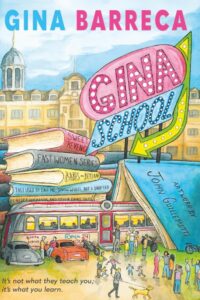
My most recent book is titled GINA SCHOOL. I wrote it for the girls who scribble in notebooks hoping to keep themselves grounded in emotional storms, for the women who are mapping their own way through new territories and might like to know there are lighthouses and landmarks seasoned voyagers can help them find, and for writers like me, who have seen certain horizons but continue to put pen to paper, or letters on a screen, to save ourselves and all those we can—or, at the very least, to offer greeting and recognition.
# # #
Gina Barreca is a Board of Trustees Distinguished Professor of English at the University of Connecticut and the recipient of UConn’s highest award for excellence in teaching. Her work explores humor, culture, and women’s lives, and her writing has appeared in outlets including The New York Times, The Chronicle of Higher Education, and Harvard Business Review, among others. Gina Barreca is the author of multiple books, including the bestselling They Used to Call Me Snow White, But I Drifted, a widely cited exploration of women’s strategic use of humor. Gina’s most recent book is Gina School (Woodhall Press, 2026). A regular contributor to Psychology Today with over 8 million views, Gina teaches us that “Humor doesn’t erase the hard stuff, it can help us face it—and sometimes it’s the bridge that gets us to each other.” www.ginabarreca.com
Gina School
 With eight million (and counting) readers of her Psychology Today blog-column, People magazine called Dr. Gina Barreca “smart and funny.” Bestselling novelist Wally Lamb says, “Barreca’s prose, in equal measures, is hilarious and humane.” “Feminist humor maven [Gina Barreca offers] her characteristic wit and wisdom,” writes Ms. Magazine. “Barreca learned to do what any sassy smarty-pants would: challenge stale ideas and press buttons,” raves the Chicago Tribune. “Barreca writes with intelligence and wit,” applauds the L.A. Times. Everyone’s favorite professor and advisor Gina Barreca is “wicked, witty, and wonderful,” (Library Journal), who “gets it just right (Booklist) and “… is an unfailingly winning narrator,” providing her readers with “humor along with serious insight” (Publishers Weekly).
GINA SCHOOL offers open, early, and rolling admissions, perpetual latecomers, mature students, speed readers, book groups, gloriously erudite librarians, anxious applicants in need of reassurance, writers in need of prompts, and gift givers. Extravagantly illustrated, provocative, reassuring and witty, GINA SCHOOL— a gorgeously delicate yet voluptuous volume — is virtually impossible to resist as an emotional support book, a motivating tome, and a daily inspiration source. GINA SCHOOL reassures readers that they are not alone, they are not nuts, and that laughing together is as close as you can get to another person without hugging them. You never have to graduate from GINA SCHOOL and will return with delight, given that it pairs just as well with coffee and cake, cheese and fruit, espresso and champagne—and, if you wish, a cap and gown.
BUY HERE
Category: On Writing
Subscribe
If you enjoyed this article, subscribe to receive more just like it.