The Ultimate Traitor: Background Story by Kathryn Gauci
 I was drawn to writing a story about France’s worst serial killer of the 20th– Century, Dr Marcel Petiot, after watching a documentary about him. Writing novels set in WWII France, I was amazed that I had not heard of him before and the more I uncovered, the more astounding his story was.
The German Occupation of France was a period of chaos and uncertainty, not only for the French, but for those refugees who had fled other countries under the tyranny of Fascism, and it is only when the cheering of liberation fades away, that one can really see what took place. In an atmosphere of fear and unpredictability, where thousands were executed or deported, it is easy to see how a shadowy underworld of criminals and collaborators operated.
In war, when civil liberties have fractured, it is not only the Black Market that flourishes, so do the men and women who seek to make their fortunes in nefarious ways not possible in times of peace. In such an environment, the lure of money looms large and human beings, once deemed pillars of society, can change at the drop of a hat. While we like to think many change for the betterment of their fellow man, that is not always the reality.
It was in this environment that Marcel Andre Felix Petiot, (1897-1948) flourished. Whilst the characters in my novel and fictional, the story I have created, revolves around Doctor Petiot himself, the actual streets in Paris where he lived and worked: 66 Rue de Caumartin in the 9th arrondissement, and the street in which most of the murders took place, 21 Rue le Seur in the 16th arrondissement. I also used his modus operandi. The years of Occupation were ripe for him to take advantage of desperate people wanting to flee France.
There have been many books written about L’Affair Petiot, including a memoir by Chief Inspector Massu himself, the French police officer whose meticulous work uncovered a crime scene that horrified investigators and worked on the case until he was replaced after the Liberation of France. Massu served as a real-life model for Georges Simenon’s famous fictional character, Inspector Maigret.
Petiot’s unusual and criminal behaviour began in Auxerre, well before the war, but it was during the Occupation that he was able to use murder for material gains. Using the code name, “Doctor Eugène”, his modus operandi was to lure victims, mainly Jews and other desperate people, including those in Paris’s underworld wanted by the police, to escape France with the promise of a safe passage to South America through his bogus network called Fly-Tox. By all accounts he was an extremely clever and charming man and made use of his profession as a doctor; a profession viewed as trustworthy, in exchange for money before murdering them.
Petiot, along with his wife, Georgette, and son, Gerhardt, lived and worked in Rue de Caumartin, and as his wealth grew, he bought the property in Rue le Seur with the intention of turning it into a private clinic, although that did not turn out to be its primary use. It was there that he murdered his victims by injecting them with cyanide and the poison, digitalis which he cultivated in his garden. He justified the injection by saying that the authorities in South America required proof of vaccination for the prevention of disease before allowing entry.
After murdering his victims, he cut up their bodies, disposed of the vital organs in his sink which connected to the sewers (to avoid any bad odour), and disposed of the rest of the body parts in quicklime supplied by his brother, Maurice who was the only person to see the bodies and he discovered them accidentally when Petiot was being held by the Gestapo. Petiot later started to incinerate the remains, particularly after being released by the Gestapo and that is when the foul smell and smoke alerted the neighbours.
The three main accomplices helping him in this nonexistent Fly-Tox Network were Raoul Fourrier, a barber who worked at 25 Rue de Mathurins, and Edmond Pintard, a cabaret artist, and his childhood friend, René-Gustave Nézondet. Lured by a substantial payment, Fourrier and Pintard helped Petiot find the victims and acted as a go-between.
At his trial, evidence was given that Petiot performed abortions, usually through his association with prostitutes and the underworld, and over-prescribed drugs to make victims dependent on him. Anyone who questioned what he was doing would be murdered. In an era of fear, few would report anyone missing to the police even though some had suspicions something was amiss, because the French police were forced to work under the watchful eye of the Germans.
Madame Guschinov, whose husband, Joachim, the furrier in Rue de Caumartin, was one of the first to disappear, did give evidence at the trial that she recognised her husband’s clothes. The bistro, Le Crocodile, at the corner of Rue de Seur and Avenue de la Grande Armée, existed and managed to do a roaring trade at the time the bodies were discovered from journalists and a host of curious visitors. 21 Rue le Seur became as notorious as 10 Rillington Place. It was eventually demolished in 1952.
Petiot’s trial captured the imagination of the international press. He was arrogant and taunted the prosecutors, claiming he was a Resistance hero and that the victims were Germans and collaborators, and showed no remorse. Of twenty-seven victims found in the Rue de Seur, he admitted to killing nineteen, part of a total of sixty-nine in which there was evidence of foul play. He was convicted of twenty-six counts of murder and sentenced to death by guillotine. Due to the vast amount of suitcases filled with clothes and other personal items such as jewellery found at house in Rue de Seur, (and also stored in Auxerre), along with an array of objets d’art and treasures in the house, along with the money he accumulated, it is estimated that he could have murdered well over a hundred people.
I also wanted to feature SOE and MI9 in this story, because this was a period of uncertainty for them too. There were rivalries between the various organisations but there were also times when they were forced to help each other. Weaving Petiot’s story with fictional characters was something that I enjoyed immensely. I tried to put myself in their shoes at the time. How would the victims feel and those who knew him. It was a fascinating story to write.
—
Kathryn Gauci is a critically acclaimed international, bestselling, author who produces strong, colourful, characters and riveting storylines. She is the recipient of numerous major international awards for her works of historical fiction.
Find out more about her on her website https://www.kathryngauci.com/
—
The Ultimate Traitor: Based on True Events in WWII Paris (The French Collection)
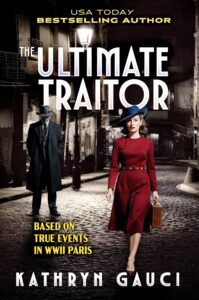 From USA TODAY bestselling author Kathryn Gauci comes an unforgettable and heart-wrenching story inspired by one of France’s worst serial killers – Dr Marcel Petiot.
Paris, 1944: “There had been a heavy snowfall during the night, enveloping Paris in a veil of white. Overnight, the city of light was transformed into a city of darkness. Her warm breath rose in clouds as Madame Josèphe-Rose hurried along the street, avoiding the dark, shadowy figures huddling inside their coats, their faces protected from the cold with hats and scarves. As she entered Place Vendôme, the plaintive music of a lone accordionist expressed the poignancy of Paris under Occupation.”
In a city where the enemy lurks in every doorway, who questions the work of a charming doctor, trusted by all who know him, going about his business in the prestigious 9th arrondissement? But Dr Petiot is using his practice to silently seek out his victims – the vulnerable and desperate who are lured in with the promise of medical help or safe passage over the Pyrenees. Freedom from Nazi oppression is too good to resist.
France, 1942: When the Gestapo executes her father for slipping bread to deportees, seamstress Bernadette Clement flees her village with her young daughter to a Resistance safe house in the elegant Rue de Caumartin in Paris, home of Madame Josèphe-Rose de Banville, whose own brother works for the Gestapo. It is here that Bernadette meets Solange, a young Jewish woman who escaped the Vel d’Hiv roundup and went into hiding.
Then Solange disappears without a trace.
London, 1943: Vera Atkins of SOE’s F Section is sending a new agent, Charlotte Hale, to Paris to find out why Allied agents and civilian escapees keep vanishing. Working undercover as a jeweller’s assistant in Place Vendôme, she traces the disappearances to the same doorway that haunts Bernadette’s dreams. The hunt is on.
Drawing on the true story and using the killer’s actual modus operandi, the author weaves a gripping and heartbreaking tale that you won’t be able to put down.
BUY HERE
Category: On Writing
Subscribe
If you enjoyed this article, subscribe to receive more just like it.