Finding the Golden Nugget: the Inspiration Behind The Girl Who Told the Truth
Catherine Hokin
Historical fiction writers have a lot of tools in their author kit bag.
No matter what time period we are writing about, we need an aptitude for research and a knowledge of when and how to use it. A reader has to be able to trust that we have done our job thoroughly, or they will walk away. They’ll also walk away if they need a PhD to work out what on earth the characters are talking about.
We also need to be able to juggle complex timelines and weigh up the merits of different sources and plot what can sometimes be two or three timelines. I’m sure none of that is a surprise, but did you know that a key item in our bag is a shovel?
One of the arts of writing historical fiction is accepting the limits the genre imposes, in other words, not playing fast and loose with the facts. I write novels set during World War Two and the Cold War, in the period after the fall of the Berlin Wall. The key players, dates and events – in other words, the what and frequently the who – are fixed in time. So my challenge is to go digging deep into the sources, pushing my way through the propaganda, to find the how and the why. The ‘I can see what they did, but why on earth would they do it,’ moment, which is the seam of gold where the stories lie. It’s my favourite part of the writing process, and it’s where The Girl Who Told the Truth began.
The Girl Who Told the Truth is set in London and Berlin between 1934 and 1948, against a backdrop of the rise and fall of the fascist movement in England (led by Oswald Mosley and his Blackshirts) and the last days of the Third Reich. It is my thirteenth novel with Bookouture, and it has been a particularly interesting one to write because a larger number of the characters than I normally include are real people. And one of my main characters – Margarete – was inspired by one.
There are ethics in play when it comes to writing about real people. It’s essential to be true to the known facts and chronology of their life and not to invent history. It is equally essential to read the widest variety of sources about them available and to make the figure as three-dimensional as they would have been in real life. Nobody is purely a villain; everyone has a private face which is as important to explore as their public one, and the contrasts are where the human, as opposed to the historical figure, lives.
For some of the characters in The Girl Who Told the Truth, that was a relatively straight-forward process. Oswald Mosley and his wife Diana Mitford have been well-documented (including in their own words), as have Hitler’s inner circle. The inspiration for Margarete was, however, a far more curious tale. A true golden nugget in the shape of a woman called Else Krüger.
I first came across her via historian Mark Felton’s YouTube video. I knew from the moment I started watching that she was a writer’s dream. Else came from a wealthy, Nazi-supporting, German family and first came to England to work as an au pair in her teens. During the war, she was employed as a secretary to Martin Bormann, who was Hitler’s private secretary and head of the Nazi Party Chancellery.
She is known to have escaped from the Berlin bunker after Hitler’s death, allegedly carrying a copy of his final testament and a bag of diamonds. She was arrested in Hamburg the following year, and taken to the Nuremberg trials as a witness to Bormann’s disappearance. While there, she became close enough to her army interrogator to marry him and she then settled in England, where she passed herself off as a Danish war bride.
It’s an amazing story, but that’s where it ends – unlike the other secretaries and survivors of the bunker, Else never wrote a memoir or discussed her experiences, and the truth about the documents and the diamonds died with her. My Margarete is, of course, fictional, and I have made it very clear in the book’s notes where the facts stop, and the fiction starts, but what a gift of a story and what a great mining expedition that turned out to be!
Perhaps one day, one of the awards given for historical fiction will be in the shape of a little golden shovel. I hope so, it would be fitting, and there are a lot of writers out there who know exactly how to wield it. I’m working away on my next book now. I’m deep in the Spanish Civil War, and Germany’s involvement there and I’ve spotted something so good, my shovel is already out and it’s impossible to ignore the Disney soundtrack currently playing on a loop in my head: “Hi-ho, hi-ho, it’s off to work we go…”
—
AUTHOR BIO
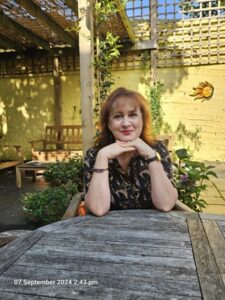 Catherine writes historical fiction set primarily in Berlin, covering the period from the 1930s up to the fall of the Berlin Wall and dealing with the long shadows left by war. The Girl Who Told the Truth will be her thirteenth novel with Bookouture and there are more to come. Her books have been published by Grand Central Publishing in the USA and translated into a number of languages including French, Italian and, most recently, German. becoming a full-time writer.
She is from the North of England but now lives in Glasgow with her American husband. She loves to travel and spends as much time as she can in Berlin, where her son also lives. If she’s not at her desk, you’ll find her at the cinema or just follow the sound of very loud music.
Details of all her books can be found on her Amazon page at bit.ly/486KkDh or at her website, detailed below.
Social Media Links
https://www.catherinehokin.com/
https://www.facebook.com/cathokin
https://www.instagram.com/cathokinauthor/
https://bookouture.com/subscribe/catherine-hokin/ Sign up here and get a free WW2 short story, The Last Casualty
The Girl Who Told The Truth
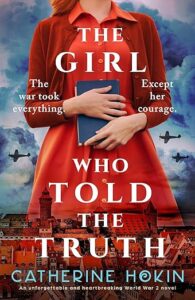 Blood surges through Annie’s veins as she stares into the cold eyes of the Nazi who hurt her mother. She knows she must finally make it right…
Germany, 1946. Annie draws a deep breath, trying to stop her hands shaking as she takes notes at the Nuremberg Trials. She isn’t just here to expose the horrors the Nazis committed, she also has a personal stake. And as soon as she lays eyes on Margarete, the Nazi who destroyed her family, a flame burns bright in her to deliver justice for her mother too.
Only Annie knows how dangerous Margarete truly is. Not only was she one of the last people inside Hitler’s bunker, she left there with a mission to continue his work. A mission that almost led to the murder of Annie’s mother. Now Annie must make a choice. Revealing Margarete’s true identity will also mean exposing her father’s secret relationship with the German woman.
In telling the world the truth, can Annie show the world who Margarete really is? Or will speaking out betray her father and destroy her family forever?
An achingly emotional page-turner about risking everything to protect those you love. Perfect for fans of Kristin Hannah, Roberta Kagan and Ellie Midwood.
Buying Link: bit.ly/489SV9k
Category: On Writing
Subscribe
If you enjoyed this article, subscribe to receive more just like it.