From Blank Page to Mr. Knoll
By Nanette L. Avery
 If writing What Killed Mr. Knoll changed anything in me, it wasn’t dramatic. It clarified something. We’re quick to describe communities as attentive and supportive, but those claims don’t always hold up under pressure. This book doesn’t accuse; it observes, looking at what slips through the cracks and what that reveals about the systems we rely on, especially when those systems fail to protect children. I wrote it to confront the ways we notice and how often we miss what matters most.
Mr. Knoll’s arrival was not unexpected. He appeared every now and again, unannounced, in his usual charming way. And then after a brief encounter, he’d keep his distance, not because he was shy, but because he wasn’t thought about. Mr. Knoll wasn’t the kind of man you wanted around, but then, one day, it hit me: he was my story.
Every story begins with a disruption. Some are clear, while others barely change the course of a day. What Killed Mr. Knoll started with a question that lingered: how does darkness slip into life so quietly that no one notices until it’s already there? The story stayed with me for years. In time, I realized I wasn’t just remembering it; I felt responsible for telling it honestly.
I grew up in the Virgin Islands, where daily life followed its own set of rules and shaped my sense of place, familiar and distinct from the world I later met stateside. The distant rumble of the Vietnam War filled the evening news, and then, one day, Navy ships in the harbor: a reminder that history touches even the most tranquil shores.
I remember eating sour tamarinds, picking gineps from branches on the way to Magens Bay, and feeding hibiscus flowers to iguanas basking in the sun. Saturday mornings, we shopped at Market Square, which had once been the busiest slave market in the Caribbean, surrounded by the lively chatter of calypso voices rising above the stalls. It was only natural for nostalgia to find its way into my book, just enough to add authenticity without ever turning saccharine. It leaves behind a quiet sense that something is always hiding just out of sight.
The novel began with one question: What hides beneath the life we claim to know? This thread continues as the story explores themes of lost innocence and the harm caused by an adult predator, revealing the quiet decay beneath a seemingly stable world. The teens in the story could be anyone, and each one deserves safety and understanding. Even the most beautiful places can feel uneasy when you remember what happened there. Mr. Knoll, with his unassuming presence and enigmatic disposition, embodied that intrigue for me.
I realized the island had to be more than just a backdrop; it needed to be a force in the story, with its beauty, closeness, and isolation. On an island, nothing stays private for long. News travels fast, but silence can be just as powerful as gossip. The sea is part of this rhythm too, always moving and always there. This tension felt right for the story.
To build Mr. Knoll’s world, I wanted readers to feel as if they were witnessing real lives unfold. The characters couldn’t be too mysterious or too perfect. They are part of a story where harm can be quiet, danger can look familiar, and the line between help and harm is hard to see.
Adolescence, with its search for belonging and uncertain identity, felt like the right setting. Writing What Killed Mr. Knoll let me explore these ideas and draw readers into a story where clarity is scarce. I tried to build unease through betrayals and broken trust. The teens face death and adult problems, showing how they move from innocence to a more grown-up, sometimes disillusioned view of the world.
My novel is not a puzzle to solve. Instead, it looks at the forces that shape us: trust, secrecy, silence, and the small betrayals that build up over time. I wanted to show how a community’s attention, a theme from earlier, can shift between vigilance and unawareness, and how lives change because of what we notice or ignore.
Nothing in these pages comes from one real event or person, but the feelings are ones many people will recognize. Looking back, I realize there were always adults like Mr. Knoll, trusted, always present, rarely questioned. And all of us have been young, trying to understand an adult world that doesn’t always keep us safe.
I didn’t try to explain everything. I wanted to ask tougher questions and look at the quiet places where harm grows not just from what people do, but from what they ignore.
If the story stays with you, I hope it’s not because it gives answers, but because it unsettles you. I hope it makes you look closer at what seems ordinary. For me, that’s where the real mystery lies.
—
Having spent formative years in the Virgin Islands, Nanette L. Avery brings a vibrant sense of place and quiet observation to every story. From the acclaimed Orphan in America to the haunting depths of The Colony, Avery’s work traverses memory, history, and emotional fault lines with wit, grace, and unexpected turns. She lives outside Nashville, Tennessee, watches subtitled films like they’re love letters from another life, and believes the most powerful lines are the ones that almost don’t say everything.
https://www.instagram.com/@averywordcatcher
WHAT KILLED MR. KNOLL
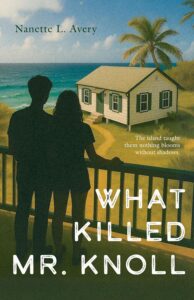 On a sun-drenched Caribbean island, a group of teenagers share cigarettes, secrets, and the illusion that nothing can touch them. For Nari, Marcus, Lonen, Reye, and their tight-knit circle, The Path is their sanctuary—a ritual escape before the school bell rings.
But the trust they place in their charming teacher, Mr. Knoll, is slowly and deliberately exploited. Under the guise of mentorship, he draws them in—his attention flattering, his encouragement intoxicating, his control insidious. The study sessions blur. The boundaries bend. And by the time unease takes root, the damage has already begun.
As the Vietnam War simmers just beyond the horizon and the island’s adults avert their eyes, the students stay close, their trust deepening even as the truth threatens to unravel everything. What begins as admiration ends in reckoning.
Lyrical and haunting, What Killed Mr. Knoll is not a whodunit, but a story of complicity, betrayal, and the quiet devastation caused by those who hide harm behind charm.
BUY HERE
Category: On Writing
Subscribe
If you enjoyed this article, subscribe to receive more just like it.