HOW SIMI GOT HER GROOM BACK by Sonali Dev: Excerpt
HOW SIMI GOT HER GROOM BACK by Sonali Dev
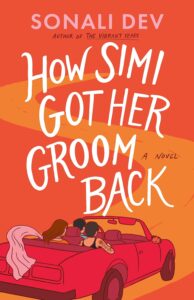 Two sisters face the real consequences of a fake marriage scheme in an emotional yet hilarious novel about immigration, healing, and family from USA Today bestselling author Sonali Dev.
Two sisters. One fake marriage. Zero chance of keeping the truth hidden.
The Naik sisters escaped their traumatic past in Mumbai to come to the States, but their journeys have been vastly different. Simi is working toward a bright future as a pediatric nurse in a small town in Kentucky when Rupi shows up at her door in distress, on the run, and as always, dragging trouble in her wake.
With Rupi’s safety in jeopardy, the sisters hatch a desperate plan to keep her in the country: Rupi must get married―and fast―even if it means Simi recruiting the man she’s been secretly dating as her sister’s groom. A perfect plan? Not quite. But there aren’t many alternatives.
As the big day inches closer, Simi and Rupi face a storm of wedding shenanigans and romantic surprises, not to mention sisterly jealousies. As the stakes and tensions rise, will their secrets tear them apart or will they find a way to risk everything for love?
EXCERPT
Chapter 2 – RUPI
My clients often cry when I’m done with them. Not because of the pain they feel when I give them what they ask for, but because what I give them is always far, far better than anything they imagined. The lady with silver curls and dark, kohl-lined eyes lets out another sob as she slips me a twenty-dollar tip. It’s her first time.
A first tattoo is like opening the floodgates to owning your body, claiming your skin, letting yourself flirt with being edgy. The fact that there isn’t much space left on my body where my ink hasn’t made its mark says all anyone needs to know about me. The client is already talking about the next tattoo she wants. The watercolor I gave her today is a Medusa—the universal symbol of surviving sexual assault. The woman is sixty-seven. Something about the fact that she is only now getting her Medusa makes me want to scream with rage. Rage is how I’ve always processed sadness.
“Do you have an Instagram page? I’d love to take a picture and tag you,” she says. “You’re such a great artist. I want everyone to know about you.”
“No.” I want to laugh. Social media is the surest way to get caught when you’re hiding. “I don’t do pictures.” I don’t make eye contact and keep my gaze just over the woman’s shoulder, my expression blank.
It works. Her face does the thing I’m hoping for. It registers a hint of sympathy, followed by a flight response. She’s identified me as someone who’s a little “off.” She backs away and leaves.
This is why I love Americans. They respect your space. Or they run from discomfort. Whichever it is, I’ll take it. In India, where I grew up, people stop you in the street to point out anything that marks you as different. If you have a scar, they look straight at it and ask how you got it. If they think you’re overweight, they offer unsolicited diet tips.
When we were young, my little sister had a severe stammer. Every single person she ever met pointed it out. They either outright imitated it to her face, or they expressed sympathy and provided advice. Simi hated confrontation, so it had fallen on me to tell every single one of those assholes to go to hell and mind their own business.
That’s my special skill. I have a full arsenal of weapons to get people to go away. And yet I can’t seem to stop being hunted. Perpetually and relentlessly, I’ve been hunted all my life. That might sound dramatic, but it’s true. Unlike my sister, I don’t hide from the truth. Only from people.
If you really want to be left alone, stop getting into trouble to seek attention. Those were my mother’s go-to lines for me. Our very own bonding words. Parents give us several gifts, but the ones that burrow deepest and stick longest are when they tell us exactly why we’re not enough.
As soon as the client leaves, I yank off my mask, then the glasses I don’t need and the Chicago Bears cap that makes my scalp sweat. I run my fingers through my short-cropped hair, airing out the sweaty strands and making them stand up in spikes. My arm cramps, and I stretch it out. Medusa took a good six hours of head-down labor.
I push a window open and stick my face out, letting Chicago’s famed wind cool me down. I’ve spent one winter here, and it’s the only time in my life that my body felt as cold on the outside as it did on the inside.
Squeezing my eyes shut, I memorize the Medusa I sent out into the world today, her many snake heads alert and ready to strike at any threat. Feminine anger in all its inexhaustible, indomitable, multitudinous glory. Distrustful and alert, with as many fighting heads and watchful eyes as there are threats. In other words, she’s every woman I’ve ever known.
I watch the hordes of tourists and locals walking along Michigan Avenue, with the powder-blue lake beyond shimmering all the way to the horizon. Bikes whiz by and dodge pedestrians on paths that crisscross the park. A man with a thick mustache stares up at the building. It’s a common sight: tourists and locals alike marveling at the Romanesque-style building constructed in 1887 to be a carriage factory. His gaze stops when it finds mine. My heartbeat slows.
He doesn’t know me.
It’s just some tourist.
This closet-size room I’ve been living in for six months is in Chicago’s Fine Arts Building. It’s often on the list of “hidden gems” that locals share with visiting friends.
The man keeps staring.
I pull away from the window, my heart fluttering against the cage of my ribs. This isn’t a residential building. I only live here, in the tattoo studio, because I’m sleeping with my boss . . . Another theme that’s become pretty consistent in my life.
When I came to America two years ago, I believed with my whole heart that I was going to break my old patterns. I was going to finally take my mother’s advice after her death and stop getting into trouble. I’d made a list of all the things I was going to do differently. The only thing that should have been on that list was learning how to turn invisible.
The only proof that Rupi Naik still exists in this world are the tattoos I’ve inked into clients, and that’s how I want it.
When I left Los Angeles six months ago, it had been almost two years since I held an inking gun. I hadn’t touched one since I fled Mumbai. Then I ran into Mathew on the brown line in Chicago. I was slipping in and out of sleep (the only way I ever sleep), and my flannel shirt had popped a button, exposing the tangled mermaids on my belly. I caught him staring with his startlingly green eyes. When I slipped past him and got off the train, he followed me. My hand was on my penknife, but when he complimented my tattoos, I surprised myself by telling him I’d done them myself. Then he surprised me by offering me a job if I taught him how to ombre a color like that. He threw in a place to stay, because obviously I looked like I didn’t have one.
It had been three days since I’d eaten, and I really didn’t want to add food theft to my crime repertoire, so I accepted. After spending six months traveling from city to city on buses, trains, and foot, I needed to rest for just a moment.
This wasn’t the first time I found something good after running away. A silver lining, a golden egg, a pot of treasure at the end of a rainbow. So what if the relief is short lived? The gray clouds always return, the goose is impossible to keep alive, and the rainbow inevitably moves as soon as the gold comes into view. That small respite has still always made running away worth the trouble.
When I was a girl, running and hiding meant protecting my sister and myself, but I also got a little addicted to watching the lumbering, drunk asshole we were hiding from lose. Giving those who wanted to hurt us the slip was even better than the high of watching the ink do exactly what I wanted under human skin and turning it into an inadvertent and unsuspecting canvas.
It’s time to give it up again, to run once more.
I pull away from the window and wait in the shadows to see if the man staring up at the building moves on. It takes him a while, but he finally looks away and starts walking. He digs a phone out of his pocket and pulls it to his ear.
I jump into action, my body moving at the speed of my flight response.
I grab my backpack, a hand-me-down from my last boss, Ron Komar.
I’m wearing the only pair of jeans I own and one of the two black Underground Tattoo T-shirts Mathew gave me when I first started here. I cast a glance around the room that’s been my home for six months. The place where I got to do what I love. My work is the only thing that I’ve loved with my whole heart that’s loved me back without demanding a price.
I’ve learned as much from Mathew as he’s learned from me. About inking, at least. The sex was absolutely ordinary. Even fifty-year-old Ron Komar had better moves. Now the asshole is back to haunt me. Why don’t the dead ever stay dead?
I pull on my shoes. “Running shoes,” our mother used to call sneakers. A laugh bursts from me. Thanks for the laugh, Ma!
I hook the backpack on my shoulder, and as if on cue, the landline rings. It’s the number listed on the internet. If I’m going to run, I should at least know why I’m running. I answer.
“If you’re on the run, why would you stand at the window like a call girl in Amsterdam?”
I haven’t spoken to her since I came to this country, but I recognize the voice only too well. Tina Komar sounds exactly like she did when she teamed up with her husband to entice me into coming to LA: bright and friendly and high as a kite.
“Return the stuff you stole, or I’m going to have to turn you in to the cops,” she says.
“If you were going to turn me in, you would have done it already. But to hire a private investigator to find me is pretty desperate.” I thank my lucky stars for taking the documents when I stole her jewelry.
“Just return the stuff you stole from me, damn it!”
The glee I feel at her frustration is a moment of light in the darkness, and I soak it up. “I don’t know what you’re talking about.”
“I’m pretty sure you do.”
I go to the cash register and punch in the keys to open the drawer. “Accusing me of stealing and lying is hardly going to get you what you want.” I take out every bit of cash. There isn’t much. Mathew cleans it out every day. He’s obviously been expecting me to run off from the moment I got here. I’ve never hidden the fact that this is just a pit stop along whatever wretched journey I’m on. I roll up the money and shove it deep into my bra, trying not to think about the fact that it’s barely two hundred dollars, including the tip I just got.
“It doesn’t have to be this way.” Tina changes her tone, attempting some grotesque version of niceness. “We were friends once. One of the pieces you took was my dead mother’s bracelet. You can keep that if you want. Just return the file. You have no use for it.”
“I can’t imagine why you couldn’t make it as an actress. You’re not half bad.” She’s actually terrible. “Maybe you can give Hollywood another shot. I hear there are more roles for older women these days. Unless you plan to keep Ron’s operation going?”
“You’re forcing me to go to the cops.”
Despite myself, I groan in frustration. “Stop treating me like I’m stupid, Tina.” I consider leaving Mathew a note, but I’m not living the kind of life where I get to say my goodbyes. What’s the point anyway? He was only interested in learning my technique, and he’s already gone as far as he can with that. Talent can’t be taught.
I put on my mask, cap, and glasses. Time to get out of here. “I think bringing someone to this country under false pretexts and then forcing them to work without pay after taking away their passport might be a bigger crime than whatever lie you’re planning to pin on me.”
This time her pause is longer. “I wouldn’t have to lie. Do you think we don’t have cameras in the house?” There’s another pause. I’ll bet she’s wondering if she should offer up my passport, but that would mean admitting to having it. “You are stupider than I thought if you believe Ron could do what he was doing if he was afraid of the cops.” Finally she hits her target. Cold sweat breaks across my skin. Of course they’ve always had the cops in their pockets. “If you’re arrested for theft, you’ll be deported.”
I’m going to be deported even if I’m not arrested for theft, thanks to her and Ron. “I didn’t steal anything. You owed me a year and a half of wages.”
“Ron took care of you,” she has the gall to say. I want to laugh, but I’m too sick to my stomach to manage it. “I can charge you with trafficking, you know that.”
“Is that what we’re calling entrapping and sleeping with a married man now?” she throws back.
“And what are we calling a wife aiding her creep husband in cheating a woman into moving to a foreign country so he can take advantage of her?”
“It could be argued that you lured us into bringing you to America and then supporting you at the cost of our reputation and marriage?” “Did I also lure him into taking away my passport and holding me to ransom for it?”
“Stop lying.” She sounds tired now. “My mother’s bracelet is my only memory of her. To lose that when I’m grieving my husband. Don’t you have a heart?”
This time I do laugh. Ron told me exactly where each piece of jewelry had come from and what transgression he was apologizing to his wife for with each one. Ron turned into a storyteller after two Lagavulins. I knew exactly how loving that marriage was. Not that “a loving marriage” isn’t the most oxymoronish of oxymorons.
“If you want something from me, then threatening me is hardly the way to get it.” Not that I can give back the jewelry. I’ve pawned off all of it, which is probably how the private investigator tracked me. The only thing I have left are those papers. That file is my only leverage.
She sighs a deeply defeated sigh. “Fine. I’m asking nicely. What do you want?”
The last two years of my life back. “For you to leave me alone. Stop sticking private investigators on me, and stop threatening me. I don’t owe you shit, but you owe me wages and my passport. Let’s talk when you’re ready to hand that over.” Another sigh. “Fine. Tell me where to meet you. We’ll do an exchange.”
Right. She’s already told me that the cops are in her pocket and she has me on camera taking her stuff. I send up another thanks for finding the title deed for the restaurant. “I’m not getting anywhere near you. That’s never happening. But send me my money and my passport, and we can talk.”
This time she laughs. There’s no negotiation without trust.
“That’s not going to happen until I get that file back first. Aren’t you tired? How long can you keep running?”
Oh, the woman has no idea. I’ve trained for running and hiding since the day I was born.
“Haven’t you learned this past year that you will never catch me? Give me what’s mine, or leave me alone. Otherwise I’ll destroy the thing you’re looking for.”
I can hear the anger in her pause. “Don’t underestimate me, Rupi. I know you’re not stupid enough to do that. If that’s gone, you have nothing left to protect you. You’ll never get to stop running. I know you have nowhere to go.”
In that, she’s wrong. I do have somewhere to go. I’ve been avoiding it, but it’s time. Time someone protected me for a change. Time some- one paid me back for everything I’ve done for them. I’ve had enough of being the only one who pays and pays.
“You’re right,” I say. “Which is exactly why you will never know where to find me.”
BUY HERE
—
 Sonali Dev’s first literary work was a play about mistaken identities performed at her neighborhood Diwali extravaganza in Mumbai. She was eight years old. Despite this early success, Sonali spent the next few decades getting degrees in architecture and writing, migrating across the globe, and starting a family while writing for magazines and websites. With the advent of her first gray hair her mad love for telling stories returned full force, and she now combines it with her insights into Indian culture to conjure up stories that make a mad tangle with her life as supermom, domestic goddess, and world traveler. She lives in Chicagoland with her husband, two visiting adult children, and the world’s most perfect dog.
Sonali Dev and her novels have been featured in The New York Times, The Washington Post, The Chicago Tribune, NPR, Marie Claire, Bustle, Shondaland, BookRiot, She Reads, Kirkus Reviews, Booklist, Publishers Weekly, Library Journal, and more. She has won the American Library Association’s award for best romance, the RT Reviewer Choice Award for best contemporary romance, multiple RT Seals of Excellence, is a RITA® finalist, and has been listed for the Dublin Literary award. Shelf Awareness calls her “Not only one of the best but one of the bravest romance novelists working today.” To learn more, please visit https://sonalidev.com.
Category: On Writing
Subscribe
If you enjoyed this article, subscribe to receive more just like it.