Nineteen: A Memoir of Reckoning and Recovery by Leslie Johansen Nack: Excerpt
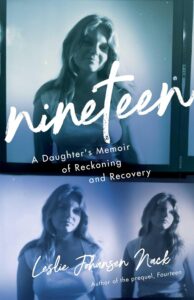 For fans of Stephanie Thornton-Plymale’s American Daughter and Cea Sunrise Person’s North of Normal comes Leslie Johansen Nack’s emotional follow-up memoir about her battle with addiction following a traumatic childhood—and her inspiring journey toward healing and happiness.
In the mid-1970s, Leslie Nack’s family returned from sailing to French Polynesia and began the integration process into American life again, which included being tossed back and forth between an alcoholic, mentally ill mother and an abusive, overbearing father.
To find love and acceptance, Leslie chases a myth that throws her into the path of nefarious older men, where she eventually falls into drug and alcohol addiction. Her father dies in his plane in the jungles of Mexico when Leslie is nineteen, but his abuse lingers in her psyche. She spirals, her only solace her next fix—until, somehow, she finds the grace, despite her abjectly dysfunctional family background, to believe in her worth. This newfound self-love changes everything for her, and finally she is able to find her way to sobriety and recovery.
Raw and intense but ultimately hopeful, this sequel to the popular memoir Fourteen tells the rest of Nack’s turbulent—and incredible—story.
Poem to My Younger Self by Leslie Johansen Nack
I met my younger self today – and boy have I changed
She ordered a gin and tonic and snuck a toot from her cocaine bullet
I ordered a sparkling water with a slice of lime
She fidgeted and scanned the room for men and talked too fast
I sat quietly and looked at the view feeling grateful for my life.
She dressed sexy and checked to see who was watching her
I dressed in a pair of jeans and sweater with walking shoes and didn’t notice anybody else.
She felt less than, needed to be cute and sexy
I felt content at who I’d become through all the hard work I did on myself
She was running from the pain inside
I felt peace and knew I had done my work and given my best to this life of mine
EXCERPT
It was October 22, 1975, and we were three days from San Diego in the cold, North Pacific Ocean when I looked behind me as a wall of water three stories high rose. Bending my head back to find the top of the wave, I let out an involuntary scream. The wind blew in angry gusts as the top of the wave blew off and slammed down on my head with a thud. I shivered, tasted the salt, and wiped my eyes. My hair was drenched and clinging to my face. I yelled, “Dad!” into the crashing spray. I could barely hear my own voice.
I steered as best I could down the face of the next wave, spearing the bottom of the trough with our ten-foot bowsprit, when the boat seemed to fall off a cliff, and we free-fell several feet. The cracking sound as we hit the concrete floor of water reverberated through the ship. I could feel the vibration in the wheel, through the deck on my rear end, and on my feet, which were planted between the wheel’s spokes.
For days we had been taking on water from the separating planks below deck, and the water was constantly above the floorboards. The electric pump had quit, and our captain—my father—had started us on manual pumping shifts. We were also taking on water from above through a hole in the main cabin, where an air vent had been ripped off and lost in previous days. Water was everywhere, and it looked like we would sink.
The hatch opened, and Dad appeared dressed in his foul-weather gear. “What the hell was that noise?” he yelled as he made his way to me.
“I don’t know!” I shouted. “The wave just disappeared, and we fell!” I could almost see my words being carried away on the wind before they reached his ears.
Frantic and shivering, I looked up into Dad’s eyes. He was calm. “I can’t do this. I’m scared. Take the helm,” I begged.
“You can do it! It’s going to be fine,” he said, patting my leg. “Use the strength in your legs to keep the wheel from turning. Steer her down the wave at a forty-five-degree angle.”
I held on with both hands, my arms and legs quivering slightly at the strain. I didn’t let the wheel turn. We reached the bottom of the wave, and Patricia began to climb the next mountain. He coached me for thirty minutes, eyeing the storm in every direction. When my watch was over, I was exhausted but proud. I hadn’t crumbled. I hadn’t given up and turned into a crying ball.
Dad was affectionately nicknamed the Voice of America by the crew, and I had to admit he was a great teacher and captain, always calm in an emergency. Besides him, two other inexperienced crew members were aboard the boat: Roland from Switzerland, Gibus from France, and our third crewmember, a woman who had sailed from Hawaii to Tahiti months earlier, Annie from San Diego.
I was the fourteen-year-old middle daughter of the Voice of America and the de facto first mate on board, although Dad would never admit it out loud to anyone. This was my second ocean crossing with him in the past year. He had taught me everything I knew— how to navigate with a sextant, plot our course, and sail expertly so that I could handle the entire boat. Sometimes I was proud to be his daughter, especially when he was the wise mentor or incomprehensibly generous with less fortunate people. But more often, the converse was true. He shamed and humiliated me frequently and was sexually, mentally, and emotionally abusive. His abuse started when I was nine, but there are times when I’m sure it began earlier and I can’t remember.
Never a traditional dad, like the ones who mow the lawn and take out the trash, he was an adventurer. Born in Oslo in 1935, he emigrated to Ontario, Canada, in 1957 with only $50 in his pocket, unable to speak English. That’s where he met my mother, and our family began. He made a success of himself without much help from anyone, becoming the single parent most of the time, raising my two sisters and me to be “Europeans.” He had different ideas about how girls should be raised. We were commanded to sleep naked, not wear bras, not shave our legs or armpits, and never to complain, because we were luckier than most in the world.
Living with our mom wasn’t an option very often. She drank too much, was mentally unstable, and had been in and out of mental health hospitals since I was six.
Growing up unconventionally, I loved my father desperately, as any little girl loves her hero father, but I also hated him fiercely. I would have done almost anything to escape him. He was the best and the worst father in the world. The line between protector and predator forever blurred.
The storm built every hour, but now I was off watch and ready to sleep. I waded through the ankle-deep water in the cabin and crawled into my wet bunk, trying to think positively about our current fate, hoping the ocean loved me enough to spare us, hoping the storm ended soon, and hoping we wouldn’t die at sea. Everything below deck was wet, and the layers of clothes on my body, my long johns, jeans, sweater, hoodie, and ski jacket, were all damp. I pulled the wet blanket over myself, shook, and shivered, feeling salt crystals on my arms as I wrapped them around myself. I swished my bare feet back and forth, trying to find warmth.
As I lay frozen cold, Dad climbed into the bunk with me. He kissed my cheek, whispering, “You did a great job on the wheel.” It was pitch black, and my eyes flew open wide. I faced away from him as he pulled the covers over himself and snuggled in. Visions of past encounters with him in the dark, in a bed, flashed through my head.
Almost immediately, his rhythmic breathing and snoring filled the space.
My mind wandered as images of gigantic waves and howling wind flew by, then me at the helm trying to fight my way down the face of a massive wave so Patricia didn’t pitchpole. Next, I saw Dad’s face with that proud expression, and I knew I had succeeded at the newest challenge he’d given me. His admiration and pride were the only treasures I longed for in my heart. All of this played in my head like a movie as Dad lay sleeping beside me.
The force 8 storm ended the following day, and three long and wet days later, Patricia was safely tied to the Customs and Immigration dock in San Diego. We were survivors of the most desperate kind: survivors of the sea.
I longed to kiss the dry ground, but we were immediately quarantined until each crew member cleared immigration. I’m sure we deserved quarantine. I hadn’t had a shower in over five days, and I couldn’t remember the last time I had brushed my hair or teeth.
The officers boarded Patricia and went below to see if we were stashing anything illegal. The smell of moldy bedding, cushions, and clothing had them pinching their noses as they waded through the bilgewater. The disgust on their faces at the state of the boat embarrassed me. At that moment, I felt protective of Patricia and self-conscious about how bad she looked.
Patricia was an older lady, a 1940s sixty-foot bugeye ketch originally built in the Chesapeake Bay to fish oysters but retrofitted to sail around the world. In her original 1800s design, the two wooden masts leaned back to lift heavy nets of oysters from the bay, but to California sailors, they were a curiosity. Her maintenance had been neglected. The paint was peeling from the hull, and the varnish cracked on the deck. She looked beaten up and was now gravely injured and taking on water. I’m sure she looked homeless, but I assert she was never more loved. She had earned our respect and, in our hearts, would always be known as “The Valiant and Brave Mighty Bugeyed Ketch.”
Of course, that’s not how I had felt about her when we boarded her in Papeete, Tahiti, forty-two days earlier. I didn’t want any part of her, but Dad had insisted she was seaworthy. I knew he mostly needed to make the dollar-a-mile to deliver her the four thousand miles to San Diego.
I had ended up in Tahiti with my dad and two sisters after sailing there on our own forty-five-foot sailboat, Aegir; our stay on the island came to a crashing halt when my younger sister was hit by a car. Mom was visiting at the time and took Karen with her back to Canada to heal. My older sister, Monica, opted to join Karen in Canada with our mom, having been seasick for almost the past year. While waiting for Karen to heal, Dad accepted the job of delivering Patricia to San Diego for a man who was too old to continue his trip.
Now, in San Diego, Immigration informed us we were free to go. We moved the boat to Driscoll’s Boat Works on Shelter Island and docked in front of a slew of hauled-out ships in the yard. We said our emotional farewells as the crew disembarked and headed in separate directions, leaving only Dad and me aboard Patricia.
With dreams of a soft, dry bed, a hot shower, and a hamburger, I asked, “Where are we going to stay?”
“Here,” Dad said, the sun reflecting off his bald head. “We’re staying on the boat. The owner comes down tomorrow to inspect her.”
“Dad! We can’t stay on this boat. She’s a drowned rat, ready to sink!”
He stared at me without saying a word, squinting his eyes in warning.
“Do we have to continue the pumping shifts—just the two of us? And do we have to sleep on those wet bunks?”
“Leslie, I am warning you. Hold your tongue, or I will hold it for you.”
I stomped off the boat and off the dock to stand on solid ground, staring him down, incredulous, hands on my hips.
Dad’s gruff voice followed me. “But I will take you to dinner at Boll Weevil and buy you a hamburger even though you don’t deserve it with that attitude.”
I twirled around slowly, smiling. “Can I have french fries and a chocolate shake, too?” A hint of a smile appeared at the corner of his mouth.
I dropped to my knees and kissed the ground beneath my feet. But it wasn’t long before fear and dread set in. Soon, I’d be alone with him on the boat.
—
Leslie Johansen Nack is the author of two award-winning books: her debut memoir, Fourteen, and her historical novel, The Blue Butterfly. Her forthcoming sequel, Nineteen: A Daughter’s Memoir of Reckoning and Recovery, concludes her raw and deeply personal story that chronicles her path to sobriety and a renewed sense of hope. Nack graduated from UCLA with a degree in English literature, and she overcame past traumas to raise two children in a healthy, loving home. She is a member of The Authors’ Guild, The Historical Novel Society, and the Pacific Northwest Writers Association. She lives outside Seattle with her husband of thirty-five years. You can find more about Leslie and her work at www.lesliejohansennack.com.
Category: Contemporary Women Writers
Subscribe
If you enjoyed this article, subscribe to receive more just like it.