No One Wants Another Middle-Aged Woman’s Memoir
By Shannon Nering
No one wants to read another middle-aged woman’s memoir about her weird and terrible life. That realization hit me like a bag of books to the chest during my second year shopping my manuscript at the Kauai Writers Conference.
I didn’t come empty-handed. I had a polished third—or maybe fourth—draft in my bag. It read beautifully, I was told. Agents said it was “strong,” “well written,” “thoughtful.” And yet the feedback kept circling the same vague drain: not quite it, not enough, hard to place.
The truth was uncomfortable but clear. How many Instagram followers do you have? asked a well-known publisher. I wasn’t famous enough. Nor was I culturally shiny. Nor already mythologized. Sorry—who are you again?
At the same time, memoirs by women in their forties, fifties, and sixties were selling. Just not by women like me. These were women who had already “won” the game: movie stars on comeback tours, reality stars living a perfectly engineered mess, women whose faces, bodies, and bank accounts had already been culturally validated.
Demi Moore writes about aging and reinvention and the world leans in. Erika Jayne writes about chaos and excess and it reads as spectacle. The rest of us? We’re expected to bleed quietly—and preferably look pretty while doing it.
That’s when I realized something sobering: the world is flooded with memoirs about depressed women, drunk women, addicted women, burned-out women. Many well written. Many honest. And many of them disappear—not because the lives weren’t worthy, but because pain alone no longer earns attention.
That was my epiphany. So, I got creative.
The Lie We Were Sold
I’m a Gen X woman. I grew up in the 1970s and 80s marinating in a very specific promise: women could have and do it all. We weren’t just watching ads with women cooking and cleaning—we were watching them bring home the bacon, fry it up in a pan, “and never, ever, let you forget who I am. ‘Cause I’m a wooooooooman, Enjoli.”
She was hot. She was competent. And she was sexy in a pencil skirt, glasses off, flipping her hair down from a tight bun. Vavoom.
Our TV shows echoed the same fantasy: working women with great apartments, sharp wit, full lives, perfect hair. I was raised on this. It’s why I ended up working in TV—as a producer and director. It was the one language I truly understood.
The problem with that promise wasn’t ambition. It was exhaustion. Trying to live inside that ideal—career girl, supermom, emotionally available partner, spiritually evolved woman—was never sustainable. And yet we internalized it. When we burned out, we assumed the failure was personal, not structural; and that’s the messy truth a lot of midlife memoirs circle, but don’t quite land.
How Structure Made Truth Matter
Once I accepted that honesty wasn’t the problem, I stopped asking whether my story was good enough and began asking the braver question: what could I do that was different enough to make women look up and question their own story?
Because I’m not here to entertain, or soothe, or placate. I’m here to wake people up.
I want women to question everything: their lives, their exhaustion, their choices—and especially the systems that sold them an impossible dream and then blamed them for collapsing under it.
That’s when my TV brain kicked in. I stopped treating the book like a diary and started treating it like a TV series. I built four narrative through-lines that every chapter would carry:
- A multiple-choice question—the kind women already live inside but rarely articulate.
- The story of my first truly mind-blowing ayahuasca ceremony—the rupture, not the romance.
- The move to Kauai—the memoir spine I originally thought was the book.
- A throwback from my earlier life—the psychological backstory that explains why the present matters.
That structure gave the truth traction. It also meant killing my darlings. The original Kauai manuscript—the one I thought was the book—had to be cut in half. I lost real gold. Anyone who’s written seriously knows that pain. But that was the moment I finally understood the difference between self-expression and storytelling. Truth doesn’t just need courage. It needs architecture.
The Industry Shift We Hardly Noticed
A close friend of mine—who wrote a bestselling memoir in 2013 with a lottery-win advance—told me something quietly shocking a few months ago: she does not think her book would be traditionally published today.
It’s a proven bestseller, a cultural touchstone. It has enviably enduring relevance. And still, she believes the industry has shifted so dramatically that it might not make it through the gate now.
The publishing world is sticky, saturated, risk-averse, obsessed with platform and optics. And increasingly unwilling to invest in stories unless the author already embodies a certain kind of cultural success that the average writer can hardly imagine.
Which means we writers have to get smarter about how we tell the truth.
What I Learned
The messiest truth of writing my memoir wasn’t the content. It was realizing that honesty is only half the job. The other half is craft—structure, perspective, and knowing when your personal story becomes a mirror instead of a monologue. Without structure, honesty just spills.
Midlife isn’t interesting because it’s messy. It’s interesting because it shows us the gap between the story we were sold and the life we actually lived. When that experience is shaped with intention—into a structure that invites inquiry—that’s when a memoir matters.
—
Shannon Nering is a former TV producer turned modern medicine woman. After two decades in the fast-paced world of TV, she traded red carpets for red clay, moving her family to the jungles of Kauai in search of healing, purpose, and maybe a little magic. Her debut memoir, The Mother Vine, is a funny, raw, and soul-baring journey through motherhood, marriage, ayahuasca, and the messiness of midlife transformation.
When she’s not running her wellness platform Glo Well, or helping her two grown boys launch their lives, you’ll find her with her husband and two playful pups, barefoot in the orchard sipping lemon water, or whispering secrets to her avocado trees. Shannon writes for the woman who’s done pretending everything’s fine — and is ready to feel wildly, unapologetically alive.
The Mother Vine: How I Healed my Heart with Ayahuasca
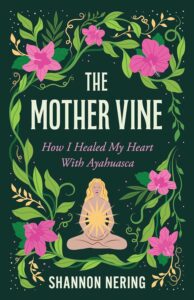 For fans of Eat Pray Love and Untamed, a soulful memoir of motherhood, mysticism, and plant medicine that chronicles one woman’s journey of healing and transformation in the lush wilds of Kauai.
What if your greatest teachers weren’t shamans in the jungle but the people you eat breakfast with every morning?
The Mother Vine is a raw, often funny, and deeply human story of one woman’s awakening through plant medicine—and the winding road that leads her there. After walking away from a high-powered TV career and a picture-perfect life in Canada, Shannon moves her family to the jungled slopes of Kauai in search of a more laid-back existence. But instead of fresh mangoes and good surf, she finds herself swept into a tide of unexpected revelations.
In the crucible of motherhood, Shannon’s two sons and husband become unlikely teachers, reflecting her forgotten pieces with unrelenting love and occasional ferocity. Their struggles crack her open in ways no self-help book ever could. When deep-seated heartache has her seeking transformation, an invitation to drink ayahuasca becomes a lifeline. Guided by ancient wisdom and insatiable curiosity, Shannon begins the journey of remembering who she truly was—and still is.
More than a memoir of healing, The Mother Vine is a love letter to the mess of motherhood, the mystery of the medicine path, and the sacred power of being fully alive. If you’ve ever longed for something deeper, this book is for you.
BUY HERE
Category: On Writing
Subscribe
If you enjoyed this article, subscribe to receive more just like it.