On Writing Free Range Girl by Meghan Cox Gurdon
 When I tell people that I’ve written a memoir about moving to rural Maine at the age of twelve to live with my father on a homestead that he was building with his own hands, I’m immediately asked:
But what about your mother?
At first the question surprised me, because as a child it didn’t cross my mind and even as an adult I scarcely pondered it. Indeed, it’s a mystery I didn’t begin to try to solve until I was deep into writing “Free Range Girl” (Morehouse), which comes out October 20th.
It’s a fascinating process to piece together one’s memories and put them in narrative order. I suppose all memoirists will have tasted the mingling of pleasure and trepidation that I did as I attempted to capture the past (which I understood imperfectly at the time, because that’s how humans are) and which is impossible entirely to re-create.
In life, we see things from our own perspective, but we don’t see what we don’t see, and we don’t know what we don’t know, and we certainly do not see others the way they see themselves – all of which calls for a certain amount of humility and generosity when we are tempted to judge the people in our lives then.
Revisiting girlhood was as exhilarating and clarifying as actual time travel might be. With some incidents, I found I could enter my own memories and walk around in them a little, as if I were really back in 1976. I could return to my father’s warm, red-floored kitchen with the two wood stoves, and I could see the old unreliable brass clock on the back shelf.
There were the sooty circles that our burning kerosene lamps had left in the wooden ceiling beam. In another feat of memory, I thought back to the Union Fair, an annual agricultural shindig that loomed large for country kids my age. In my mind, I re-entered the Freak Show. Once inside the tent – this was all in my head — to my amazement I realized that I could direct my gaze around so that I saw things I thought I’d forgotten.
Of course, not for nothing has memory been called the “false friend.” I can’t be absolutely certain that I remember all things with precision, nor would I swear to the authenticity of my timeline. I admit to tampering with dates. The memoirist must be allowed some leeway so as to tell a proper story. What reader cares if an event really took place in September rather than in October?
When I started writing, I didn’t know I’d be publishing it as a book (which I’m thrilled about). I wanted mostly to try to bottle the scent of the past, to retrieve elements of pre-screen childhood in the harum-scarum, unsupervised, tactile, back-to-the-land 1970’s, so as to preserve them. As I put down my remembrances, that question began to bob about just below the surface of my conscious thought:
But what about my mother?
I had been living with her. Now I was living with my father. What was that all about? It was too late to ask my parents: By the time I thought to ask, both of them were dead.
My initial queries therefore consisted of me trying to remember what they had told me, which was a short, benign explanation that as a child I had accepted entirely.
Now, as a mother myself, I was no longer satisfied. It was not a real answer. I found myself getting angry. My next step was to contact an old crony of my mother’s and my surviving aunt and uncle. They told me what they knew. I was not delighted with what I learned. And then – this was the surprise – I felt my heart shift and soften.
It came to me then: Had I been writing my memoir ten or fifteen years ago, there might have been bitterness in “Free Range Girl.” My mother parted with me at an age when I needed her, and even today the idea of her maternal surrender stings. But the fact of it no longer hurts. Having waited to write about the past, I gave myself time to mature — to get past the age of grievance-– and that has helped disperse any ill-feeling.
I am now almost twice as old as my mother was when she sent her only child away. I recognize now in a way that I hadn’t, before, that she herself was very young at the time. She had been nineteen when she married my father and twenty when I was born, so when I was on the cusp of adolescence she was only thirty-two!
She may not have recognized how much a daughter wants a mother at that age. She may, I now realize, have been trying to juggle the competing demands of her private life with her responsibilities as a mother, and felt she could best strike the balance by dispatching me to my father’s custody in a little house in the Maine woods.
I don’t know if I’m right about her calculus, but forgiveness feels a lot nicer than resentment. In the book, you will get my girlhood take on the matter, because “Free Range Girl” tells of the adventures of an only child who believed what she was told and who never got around to asking the question: What about my mother?
Ah, well. It is tempting to blame one’s parents for things they said and decisions that they made. It is a gift of the later-life memoir to be able to look back in tenderness. To see, to love, and to absolve – for goodness knows, those of us who are parents will want our children to see, love, and absolve us too.
—
Meghan Cox Gurdon is a columnist for the Wall Street Journal’s “Free Expression” newsletter and a weekly contributor to the WSJ books pages. At the Journal, she writes about biographies, histories, audiobooks, fiction, technology and social science, with a lively eye to the quirks of domestic life. She brings to her work a humane sensibility grounded in traditional respect for language and literature. Previously, over two decades as the Journal’s children’s book critic, she commented on cultural trends in books for young people while seeking to highlight works of lasting value.
Meghan’s forthcoming memoir “Free Range Girl,” publishing October 20th, tells of her experiences in the mid-1970s going “back to the land” in rural Maine with her father. An ardent and authoritative advocate of reading aloud – with five children, she’s had plenty of experience – Meghan is also the author of “The Enchanted Hour: The Miraculous Power of Reading Aloud in the Age of Distraction” (2019), an award-winning work of nonfiction soon to be available in seven languages.
Meghan and her husband, the English journalist Hugo Gurdon, live in Maine.
—
FREE RANGE GIRL
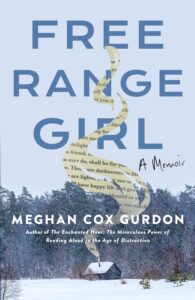 A poignant and affectionate memoir about a time when being young, free, and largely unsupervised was the norm, before the digital age ushered in a world of algorithms and overparenting.
Set in 1976, the bicentennial year, Free Range Girl chronicles the year 12-year-old Meghan spent on a homestead in rural Maine with her father, who built the house by hand. A proponent of the idealistic “back to the land” movement of the ’60s and ’70s, Meghan’s father hoped that renouncing modern conveniences would usher in a life of greater simplicity, authenticity, and independence. Many locals were skeptical of Meghan’s father and his cohort ―they were regarded as “From Away.” Nevertheless, without electricity or indoor plumbing, Meghan found herself enduring―and often enjoying―a penniless and largely unsupervised childhood, in which, among other things, she blew her eyebrows off trying to cook with gas, discovered a severed pig’s head in a wheelbarrow, learned to ride enormous horses with neither saddle nor helmet, and witnessed her father use a handgun to execute a misbehaving alarm clock. Meghan faces challenges beyond these ― family break‑ups, a serious accident that sends her to the hospital, and her attempts to bond with new school friends ― yet she thrives.
This is a powerful and luminous look back at a childhood that could likely never happen again, providing a striking counterpoint to the screen-saturated and tightly managed childhoods of today.
Praise for Meghan Cox Gurdon’s The Enchanted Hour:
“Parents and grandparents shouldn’t miss The Enchanted Hour.” ― James Patterson, international bestselling author
Praise for FREE RANGE GIRL
“Are you craving a better path to the good life than safety and comfort? Free Range Girl is the delightful story of Meghan Cox Gurdon’s countercultural off-the-grid childhood in rural Maine. This memoir is as inspirational as it is entertaining.”
—ARTHUR C. BROOKS, #1 New York Times bestselling author of The Meaning of Your Life
“Before there was helicopter parenting, before there was gentle parenting, there was the wild dangerous freedom of childhood in the 1970s. Meghan Gurdon’s memoir evokes that lost world with the honesty and freshness of the child she was––and the wry humor of an adult still surprised she survived to tell the tale.”
—DAVID FRUM, staff writer at The Atlantic and author of How We Got Here: The 70’s, the Decade That Brought You Modern Life—for Better or Worse
“A triumph of reconstructive memory…. The book not only captures collectively the vanished world of the past, but the individually vanished worlds [of] each of our own early lives that feel as if we might almost––but never can quite––grasp them again.”
—DANIELLE CRITTENDEN, author of Dispatches from Grief: A Mother’s Journey Through the Unthinkable
“What difference does a year make in the life of a child? Luckily, we have a writer as talented and engaging as Meghan Cox Gurdon to tell us…. Gurdon describes with humor and empathy the adventures, mishaps, surprises, and joys of that year. What a gift it is to have this intrepid, curious girl as our guide, and to experience alongside her the remarkable, bygone wonders of a free range childhood.”
—CHRISTINA ROSEN, author of The Extinction of Experience: Reclaiming Our Humanity in a Digital World“Free Range Girl brings back the tender, half-grasped reality of being young with bright, photographic clarity. It is also a refreshing departure from the familiar misery memoir. The focus isn’t trauma and dysfunction, but a child’s remarkable ability to find joy and meaning in the chaos of daily life.”
—CHRISTINA HOFF SOMMERS, author of One Nation Under Therapy
PREORDER HERE
Category: How To and Tips
Subscribe
If you enjoyed this article, subscribe to receive more just like it.