Researching THE OTHER MOCTEZUMA GIRLS
By Sofia Robleda
This novel was born, raised, and fed on research. The mere idea of it started circa 2019 or 2020, as I conducted my investigation for my debut novel Daughter of Fire. It was then that I came across the story of Tecuichpoch, the last empress of the Mexica (pronounced Meh-shee-ka, more commonly known today as the Aztecs).
Tecuichpoch was the most important daughter of Emperor Moctezuma Xocoyotzin. She was given as a ‘prize’ to Hernan Cortes when he arrived in Tenochtitlan in 2019. Tecuichpoch was then baptized with the Spanish name, Isabel Moctezuma, and not only survived the smallpox epidemic that decimated 90% of the population, a siege during the Spanish conquest, six marriages, and giving birth to seven children, but also managed to sue the Spanish Crown successfully enough that she ended up being the wealthiest landowner in New Spain. She left behind a will where she famously freed all her slaves. Her inheritance was highly contested by all her children and tore her family apart.
For years, I could not get her or her testament out of my mind. I clearly remember thinking of her as I gave birth to my son in 2021. I remember panicking about how I would ever manage to write a novel again, let alone a novel worthy of her, now that I could hardly string a thought together in my sleep-addled brain.
Somehow, we both persisted, because Tecuichpoch never left me, and at some point, I began the process of drafting her novel. Thankfully, I was able to build on many of the foundations I had established with my previous book, Daughter of Fire. However, unlike Daughter of Fire which relates more to the Maya in the 16th century in Guatemala, I was now focussing on a completely different civilization, the Mexica.
To build this new picture, I obviously read as many books as I could – not only on the Mexica, but also on the customs and ways of life in 16th century Mexico, both pre- and in the four decades post-colonization. I tried to find as much material as I could on Isabel Moctezuma, but there isn’t a single biography about her, only a few chapters in various non-fiction books and the odd research article, which I carefully collected into my little treasure chest – a folder named ‘Tecuichpoch Research’ in my computer.
I think I took something like 18 A4 pages of citations and references on all the additional evidence-based articles that I read, both in English and Spanish. I had thousands of questions – what did people wear? What textiles did they use? How did they carry water? How did they swear at each other? What plants and foods were actually there at the time? What goods were imported?
I had to look at many maps of the Valley of Mexico and Tenochtitlan at the time, consider the topography and geography of the place and how it was five hundred years ago. The fact that the Valley of Mexico was essentially a collection of five lakes was a huge challenge, as these have nearly been totally drained. I wanted to honor the loss of this incredible natural resource and write about so many things I think are important to our sense of identity as Mexicans, like our complicated family ties, the origins of our incredible cuisine, our mixed Indigenous, European and African lineage.
But there came a point when books and articles and maps and memory failed me, just as they eventually failed me with Daughter of Fire. I needed to immerse myself in the setting somehow, experience it with my own eyes and ears.
Museums came in handy. I was overjoyed when the National Gallery in London (where I live) put together an exhibition on Mexican artist, Jose Maria Velasco. I rushed to see his stunning landscape paintings of the Valley of Mexico. Even though he completed his works in the 19th century, most of the lakes remained, so it gave me a sense of perspective of the valley, the colors, geology, and local flora.
Similarly, when I took a trip back home to Mexico City in 2023, I visited several museums, including the Museo Nacional de Antropologia and the Museo del Templo Mayor in Mexico City, which are just incredible places and so informative on everything related to the Mexica ways of life and religion.
During my trip back home to Mexico City, I conducted a lot of ‘experiential’ research too. I took several workshops – one which took me canoeing around the remaining lake and chinampas in Xochimilco to learn about the 700-year-old system of agriculture the Mexica used – and another with a chef who is an expert in pre-Hispanic food. I made notes on whatever caught my attention, such as, ‘Paddles hitting the side of the canoe with dull clang. Fish snapping mosquitos from the surface. Paddle getting heavier with use.’ Or, ‘Smells like honeydew. Leaves and pinecones and bark strewn on the floor.’
These are sensory details that not many books can give you, which make the setting come alive.
I walked around the forest of Chapultepec in the heart of Mexico City, and I hiked the foot of the volcano of Iztaccihuatl with my sister and an expert mountain guide – whom I interviewed to get a sense of what it felt like to summit the volcano (which I could not do thanks to bad weather and atrocious levels of fitness). I wanted experience a temazcal ceremony first-hand, but I ran out of time. Nevertheless, I got a fabulous second-hand account from my sister, who has done quite a few of them.
Overall, the research was continuous, even at the very end I was double-checking Nahuatl spelling with my bilingual dictionary and begging my publisher to find a native speaker to proofread the manuscript. Even the audiobook got a helping hand from Nahuatl professor and author David Bowles who provided a pronunciation guide for the narrators.
All of this work was essential to me, however. This book is my love letter to my country, to my people who in this very moment are being scapegoated, harassed, rounded up, and tortured. I wanted to uplift and inspire them. I wanted to do right by them and by Tecuichpoch. I felt an enormous responsibility as the first Mexican woman to write a novel about this Mexican queen, and the first person ever to the write a book based on her life in the English language. I desperately hope to have done her some justice.
After five hundred years of being sidelined from history, she deserves it.
—
Sofia Robleda is a Mexican author who spent her childhood and adolescence in Mexico, Saudi Arabia and Singapore. She completed her undergraduate and doctorate degrees in psychology at the University of Queensland, in Australia. She currently lives with her husband and son in London. Her debut historical fiction novel, Daughter of Fire, was an Amazon First Reads and Editor’s Pick for July 2024 and a top 100 Kindle bestseller. It has been translated into Spanish. For more information visit https://sofiarobleda.com/ or follow her on Instagram (@sofiarobleda).
The Other Moctezuma Girls
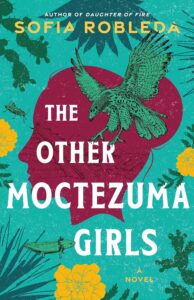 In sixteenth-century Mexico, a fearless young woman strives to uncover the secrets her mother kept as the last Aztec empress in a sweeping historical epic by the author of Daughter of Fire.
Tenochtitlan, 1551. Thirty years after the Spanish Conquest destroyed everything she loved, the last Aztec empress has passed and left behind a pristine yet tenuous legacy for her children. As her last will and testament is read out, her daughter Isabel suspects that another account of her mother’s life may exist, hidden away, chapter by chapter, in the Valley of Mexico. Following each clue, Isabel is determined to find out who her mother really was and to discover the secrets she buried in order to survive.
Joined by her siblings and a handsome young cook named Juan, Isabel embarks on a perilous journey to piece together the past―a journey that will force the party to brave the brutal viceroyal court, face fearsome legends in mystical chinampas, and trek through desert, fire, and snow. As Isabel’s feelings for Juan grow, she confronts everything she thought she knew about her Spanish father, her empress mother, and herself. Facing everything from the tunnels of ancient pyramids to the summit of an active volcano, Isabel will meet every challenge to fulfill an epic quest for the truth.
BUY HERE
Category: On Writing
Subscribe
If you enjoyed this article, subscribe to receive more just like it.