“Scattered Light”: How Fiction Can Help Us Heal Our Own Past Trauma
By Martha Engber
All of us experience trauma of one kind or another. A terrible accident. A scary upbringing. A life-threatening illness. How we process that trauma varies widely. But I hazard to guess that most of us never address our demons at all, primarily because our “bring yourself up by your bootstraps” culture encourages us to “get over it already,” and as we all know, the fastest way to do that is by sweeping our worries, fears and terrors under that proverbial rug.
That’s the case for Mary Donahue, the protagonist of my newest novel, “Scattered Light” (Nov. 25, Vine Leaves Press). This novel is the sequel to “Winter Light” in which 15-year-old Mary, a burnout in a large suburban Chicago high school during the blizzard winter of 1978-79, knows she’s sinking fast under the weight of poverty and family dysfunction. When she suffers the devastating loss of the person she loves most, she becomes vulnerable to a boy who offers her a ride home one night, then terrorizes her. A span of two hours in which Mary learns the bridge between life and death is almost nonexistent.
People who read the book are always so happy that tough girl Mary survives. But after saying, “poor Mary,” they usually want to know what happens to her later in life. Does she succeed in fighting her way out from under the dozens of extra obstacles placed on troubled teens that kids from stable homes don’t encounter.
The answer is yes. And no.
“Scattered Light” begins on an April day in 1999. Hard-driving Mary has found her way to this exact moment when she enters her favorite Chicago sandwich shop to celebrate both her birthday and a major achievement in her career as an attorney at a top law firm. She doesn’t expect anything unusual to happen, which is maybe why it does. Her good spirits temporarily lower her steely emotional shield for her to meet the man waiting in line in front of her and…
She falls in love, something she’s both desperately desired, yet fought against, because loving someone makes you vulnerable, the very thing she vowed to avoid as a result of that grim night in her youth.
The story leads Mary to fight harder than she’s ever fought before to — this time — save the person she loves most. In so doing, she’s driven straight into the arms of her personal monster: that past trauma she never dealt with.
While writing this novel, which I now think of as a “trauma thriller,” I drew on my personal experience of the unresolved stress of having a neurodiverse dad, who, though he loved me, also scared me; an experience I write about in my memoir, “Bliss Road.”
The more of Mary’s story I unspooled, the more pronounced became my objective of using her journey to demonstrate the reality that most of us suffer from unresolved trauma. A wonderful graphic titled “How to Manage Trauma” explains that 70% of adults — 223.4 million Americans! — suffer some form of trauma for the following reasons:
- grief and loss
- physical, emotional or sexual abuse
- childhood abuse or neglect
- war and other forms of violence
- witnessing violence
- medical interventions
- cultural, intergenerational and historical trauma
Through Mary’s journey, I wanted to show others what it looks like for a strong woman to struggle mightily with denial until the moment she no longer can. She fully sees what happened to her, and from that moment on, her healing begins. Because often it’s only when we’re given that layer of fiction — something is happening to someone else — that we can privately give ourselves permission to look inward and confront what happened to us.
I’ll leave you with what I wrote in the book’s acknowledgments, which I penned for all of us:
“Mary Donahue is no different than the rest of us in having suffered a trauma in her youth that she was encouraged to sweep under the rug by society, the era in which she grew up, the authority figures around her and the culture of her region and heritage. I’d like to acknowledge all of you who’ve been similarly wounded and dismissed. I hope you’ve been able to find the courage to seek help in healing. If you haven’t, I hope Mary’s story proves that you, too, deserve care and compassion.”
Free excerpt
SCATTERED LIGHT
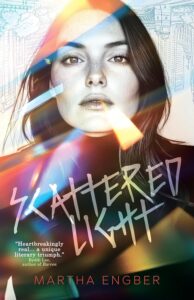 “Heartbreakingly real… a unique literary triumph.” Byddi Lee, author of Barren
When 36-year-old attorney Mary Donahue of Chicago meets the surprising man of her dreams, she discovers that to love is to risk learning who you really are and what happened to you.
SCATTERED LIGHT is the sequel to WINTER LIGHT, an IPPY Gold Medal winner in YA, in which teen Mary fights to save herself during the blizzard winter of 1978-79 from the poverty and addiction that plague her family. Only when the real storm hits does she learn how little distance exists between success and failure, life and death.
SCATTERED LIGHT begins in 1999. After years of insulating herself from further physical, emotional and financial harm, Mary falls in love with a humble, but world-famous Ugandan human rights lawyer who barely escaped Idi Amin’s butcherous regime.
When his life is endangered, Mary has no choice but to fight for him as she once did for her teen self. Almost losing him dredges up the trauma of her youth, a festering wound that can only be healed by an apparent enigma: to protect herself, she has to bare her soul.
Hair-raising, yet inspiring, SCATTERED LIGHT illuminates a basic truth, that to fully love others, you have to love yourself.
Purchase links
Vine Leaves Press (print)
Amazon (print/ebook)
Barnes & Noble (print/ebook)
bookshop.org (ebook)
Apple Books (ebook)
Bio
Martha Engber is the author of six books. SCATTERED LIGHT, the sequel to WINTER LIGHT, an IPPY Gold Medal Winner for YA, will be published Nov. 25, 2025. Her other fiction includes THE FALCON, THE WOLF AND THE HUMMINGBIRD, a historical novel, and THE WIND THIEF. Her nonfiction includes BLISS ROAD, a memoir about her neurodiverse family, and GROWING GREAT CHARACTERS, a resource for writers. A workshop facilitator and speaker, she’s had a full-length play produced in Hollywood and fiction published in a variety of literary journals. She and her screenwriting team have optioned a TV series to a studio. She encourages readers to connect via her website, MarthaEngber.com.
Author links
Martha Engber website/blog
BlueSky: @marthaengberauthor.bsky.social
Threads: https://www.threads.net/@marthaengber
Category: On Writing
Subscribe
If you enjoyed this article, subscribe to receive more just like it.