The Dream Purse: A Psychoanalytic Journey of Becoming through Psilocybin, Art, and Movement by Natalie R. Cohen, PsyD
I am a psychologist and psychoanalyst who also identifies as kind, tired, and a mover. Creating art has always been a vehicle for my inner life, offering relief from conflict and a nonverbal invitation to explore what wants to emerge. During my psychoanalytic training, I engaged in multiple psychedelic journeys, and each one taught me something no coursework or case conference ever could. What unfolded was an unusual kind of treatment— one that honored the interpersonal field between my analyst and me while opening into the shimmering, dream-realm of psychedelic medicine.
After every journey, I reached instinctively for art. Sometimes it was image, sometimes sensation, sometimes a memory arriving sideways or supine. My hands and body always seemed to know what to do next. I journaled, sketched, painted, built small objects, and choreographed and filmed dances—all artifacts of the psychedelic trance that had allowed the unsayable to take shape. The art became a kind of afterglow, a residue of the medicine I could hold, move with, and breathe into.
Art-making supports psychedelic-assisted treatment by giving form to an experience that is, by nature, beyond language. Psychedelic states often surface images, sensations, and emotional truths that do not arrive as linear sentences but as symbols, colors, gestures, and fragments of dream logic. Psychoanalysis gives meaning to the art-making, creating the bridge between the ineffable and the everyday, offering the psyche a way to express itself. Art becomes a vehicle not only for the unconscious but also for the stories that need room to expand beyond the couch. In psychoanalysis, the unconscious material builds inner containers for the work ahead.
I carried my artistic creations into my analytic sessions, sometimes shyly, sometimes urgently, placing them between my analyst and me like a map to my unconscious. Together, we traced the threads between the artwork, the visions, and the deeper currents of the transference. Together, we let the art, the body, and the medicine braid themselves into the treatment. The journeys did not sit outside the consultation room; they entered it and changed it. Slowly, the art integration unfolded and became the real heart of my transformation, often revealing its meaning half a year later.
I invite you to follow the nonlinearity of one of my psychedelic psilocybin journeys in which I spotlight how three forms of art informed and nourished the integration: 1. a dream object brought to life with a glue gun, followed by a Sharpie drawing of past trauma; 2. a dance I created titled Amplify, an embodied representation of the drawing; and 3. a creative writing piece which became the first chapter of my forthcoming memoir-in-essays, Welcome Home: Reclaiming My Body through Coffee, Drugs, Dance, and Psychoanalysis.
The preparation began long before the medicine touched my tongue. It started in the liminal terrain where dream, art, and psyche overlap—the place where symbols are shaped by the hands before they can be understood by the mind. Like many initiations, mine arrived in the form of an unexpected object: a small wooden purse that appeared first in a dream and then demanded to be realized.
In the dream, my psychoanalyst arrived at the dosing session wearing an adorned, bedazzled wooden purse with a long gold chain. He was perfectly on time, yet he had missed the entire journey because the co-facilitator had started the session early.
The purse captivated me as I was dreaming—its jewel-like surface, its wooden sturdiness, the sense that my unconscious would be held with care in a bejeweled container. What non ordinary material might be placed into that purse—or taken out? Whatever emerged would be carried by a thick gold chain, a precious tether linking the visible world to the unseen one. After I woke, the dream continued to fascinate me, and in analysis, we traced its meaning of containment, desire, and the beginnings of psychic reorganization. Little did I know, I would build the dream purse once the medicine wore off as part of my integration night.
On the day of the psilocybin journey, I swam a mile and a half, ate a light breakfast, and surrendered to whatever the mushrooms would bring. About an hour in, my ordinary sense of self dissolved into particles in the sky. I floated in a vast, formless space alongside two singing voices whose language I did not understand, but whose vibration carried what felt like the world’s pain, despair, and joy.
Autobiographical memories surfaced: my beagle-coonhound failing his obedience test and sprinting after a horse; the sting of lost chances and lost control. Throughout, my human guides offered steady care, grounding, and slices of pineapple that exploded in my mouth and seemed to stream hope and love directly into my system.
After the journey, I went home to my empty apartment as planned, to let the experience settle. Without my nine-year-old daughter’s voice, the silence felt both eerie and protective. I drew an orange blossom bath, made a large mug of rooibos tea, and by around 7 p.m., found myself ready to move toward art.
I remembered the dream purse. I needed the object in my hands. So, I made it, with a glue gun I found nestled in the back of my art supply drawer. For two hours, flow overtook me, and I built the purse my analyst had carried in my pre-journey dream.
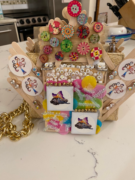
The Dream Purse
Next, I set my Sharpie thin, ultrathin, and thick markers beside me, the hum of the journey playlist filling the room. I began to draw. Just as time inside a psychedelic journey becomes distorted, I sketched until my rooibos tea had gone cold and nighttime slipped in, quietly announcing itself at the windows.
Only the sequence of the music and the length of its unfolding told me that hours had passed. I drew a vivid composition that covered the entire page. bordered by a zig-zag frame of repeating colors that created a sense of containment. The upper portion is filled with bright yellow and slanted green strokes that resemble grass, energy, or movement, interrupted by two striking shapes: a bold red form that looks like a torn flag, a wound, or even an internal organ, and a smaller, house-like shape on the upper left.
This pink form immediately stands out as one of the most charged symbols in the drawing. The tiny hexagonal structure—part home, part protective chamber—feels more alive than architectural. Inside this “house,” many tiny red eyes cluster together, alert and watchful. They do not face a single direction, but swirl and scatter. The house reads as a container of awareness—holding multiple ways of seeing, sensing, or remembering.
The pink interior has the softness of flesh, while the red eyes lend it an uncanny, pulsating quality. Resting atop a field of diagonal green lines, it floats like a sentinel of the emotional landscape—a psychic house where perception gathers during a non-ordinary state of consciousness. Altogether, the drawing feels like a psychedelic terrain—part organism, part dream—alive with symbolic meaning.
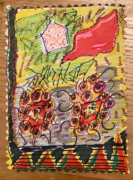
Sharpie Drawing
Only months later would the meaning of the drawing become clear. Meanwhile, I danced. I selected the music from the journey’s playlist to guide the choreography, and my body instinctively tuned itself to certain notes while recoiling from others. Two songs announced themselves immediately, expressing opposite states: joy and hope on one side, despair and grief on the other. Selecting the music was its own kind of surrender, letting the heart and body choose what the mind wasn’t yet ready to name. For six weeks,
I met weekly with a choreographer, shaping movements to match both the music and the story the medicine had revealed. Music and dance offered me an off-ramp from cognition, a sanctuary where words stepped aside for breath, rhythm, and motion. My choreographer could read a body the way some people read a score.
He understood how movement reveals what language hides, how the body organizes memory, how grief can sit in a shoulder blade or a rib. Week after week, he helped me translate the journey’s symbols into gesture, posture, breath, and sequence, creating a dance that felt less like a performance and more like a reclamation.
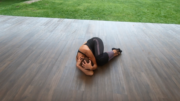
Amplify dance (shock)
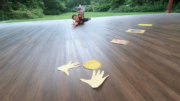
Once the choreography had seeped into my bones, I spent two months rehearsing the dance on an outdoor stage in upstate New York before having it filmed professionally. The integration dance, Amplify, begins with a buoyant rhythm, where my movement is light, skipping, and full of early-pregnancy hope.
But then the choreography shifts—my torso buckles, my hand flies to my mouth, and grief floods the body. I push the truth away in sharp, slicing gestures before finally collapsing to the floor. The piece charts creation, denial, and the gravity of loss. It relives a moment of disbelief and shock from fifteen years earlier: being told that my healthy, genetically normal baby boy had died in utero.
 For months I channeled my energy into the dance creation. But when the final echoes of the dance had faded, I could still feel something calling for expression. In analysis, the pull toward writing arrived quietly, insistently. Images from the dance began arranging themselves into sentences while I walked, swam, lay awake before dawn, or shared the work with my analyst.
Writing became the place where sensation, memory, and meaning could meet without being rushed. I wrote early in the morning, often at 4 a.m., before the house stirred, when the world felt porous. In that liminal hour, language arrived and I entered a flow state where the work felt guided rather than constructed. Movement had opened the door, and creative writing let me step fully inside. This final layer allowed me to weave the medicine journey, the dream purse, the drawing, and the choreography into one coherent story. Writing created temporal integration and narrative clarity.
Energized, I joined a psychoanalytic writing group and spent months immersed in the drafting and editing process. The 20-page personal essay I composed—also titled Amplify— eventually became the opening chapter of my memoir Welcome Home. In prose that ranges from lyrical to humorous, the piece traces an arc from my teenage LSD adventures in Bloomington, Indiana to my midlife psilocybin journey, showing how psychedelics, psychoanalysis, art, and dance braid together in one long project of coming home to my body.
It moves across emotional terrain that includes adolescent wonder, betrayal and culture shock, silenced longing, medical and reproductive trauma, and the shattering grief of my second-trimester miscarriage, concluding in a fierce, yet tender reclamation. Writing helped me to see and name the arc my body had already traveled. The process ultimately led me back to the moment that underpinned the entire triptych—the instant I was told that my baby had died in utero—and allowed that unbearable fact to be held, endured, transformed, and integrated into my life.
Psychoanalysis requires leaving space for what keeps growing, mutating, insisting on expression. A drawing, a dance, an essay—each becomes a vessel, a way of metabolizing grief, love, and transformation. Some experiences carry so much meaning they pierce the membrane of the everyday and remind us that healing is both art and labor, both mystery and method.
Psychoanalysis and art-making supported my psychedelic experience not by simplifying the material but by giving it channels—hands, breath, color, rhythm—through which it could move. Psychedelic journeys are not meant to be held in the mind alone; they need tangible places to take shape. Psychoanalysis offers us those places. It widens the container, steadies the nervous system, and lets the unconscious speak. In this way, psychoanalysis becomes the bridge between a patient’s non-ordinary state of consciousness and the life that follows, the practice that helps psychedelic experience become a homecoming.
—
Dr. Natalie R. Cohen is a psychologist, psychoanalyst, and psychedelic-assisted therapist in New York City whose work bridges trauma healing, embodiment, and creative expression. She holds postgraduate certifications in ketamine- and psilocybin-assisted therapy and MDMA training from MAPS. She lives with her partner, tween daughter, and their puppy. Radical Return is her first book.
Radical Return: Reclaiming My Body Through Coffee, Drugs, Dance, and Psychoanalysis
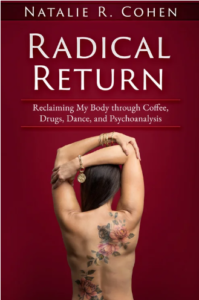 Radical Return fuses personal storytelling with professional insight to explore the transformative potential of psychedelics. A memoir-in-essays tracing Natalie’s experience healing from sexual violence, ancestral trauma, medical trauma, and institutional betrayal, this fearless reflection challenges the medicalized narrative of healing. Clinical psychologist Dr. Natalie R. Cohen recounts her recovery through guided journeys with ketamine, MDMA, psilocybin, and ayahuasca. But the real story unfolds after the medicine fades—through dance, ritual, tattooing, dreamwork, and psychoanalytic reckoning. Blending lived experience with clinical insight, Cohen centers a woman’s body as both witness and site of transformation.
Urgent, embodied, and culturally resonant, Radical Return offers a new blueprint for integration—one rooted not only in science, but in voice, movement, and a radical return to one’s whole self.
BUY HERE
Category: On Writing
Subscribe
If you enjoyed this article, subscribe to receive more just like it.