The Louvre Heist: When Life Imitates Art
By Mailan Doquang
There’s something uncanny about watching life echo art, more so when the reflection hits close to home. On 19 October 2025, just after 9:30 a.m., a brazen heist at the Louvre Museum in Paris proved that the line between fiction and reality is thinner than we like to think.
The thieves struck the resplendent Galerie d’Apollon, a large, gilded hall housing France’s Crown Jewels. Using a truck-mounted ladder, they entered through a second-floor window, smashed two high-security display cases, and escaped with eight priceless jewels of Napoleonic provenance. Ariel Weil, the mayor of central Paris, called it “a scenario out of a film or a television series.” Or, as it happens, one of my books.
The parallels to my novel Ceylon Sapphires, the second installment in my Rune Sarasin caper series, are striking. The book opens with Margot Steiner, Napoleon Bonaparte’s great-great-grandniece, admiring a portrait of her famous ancestor at the Louvre while wearing a rare Ceylon sapphire necklace commissioned by the emperor himself. But when a commotion erupts on the museum’s grand staircase, Mrs. Steiner discovers that her necklace has vanished and that the mysterious young woman who caused the commotion has disappeared into the crowd.
Enter Rune Sarasin, the series’ protagonist. She works for Charles Lemaire, a ruthless gemstone trafficker to whom she owes a dangerous debt. But when Lemaire orders her to steal the earrings from the same royal parure, Rune realizes that he’ll never willingly let her go. Her only chance at freedom lies in turning the tables on him, an act of rebellion that sets off a high-stakes cat-and-mouse chase across Europe.
Real treasures at the Louvre inspired the fictional gems in my novel, including two that were stolen in the recent heist: a Ceylon sapphire and diamond necklace that once belonged to Hortense de Beauharnais, Napoleon’s stepdaughter, and the matching sapphire and diamond earrings. The thieves also made off with a crown from the same parure, an emerald necklace and earrings belonging to Empress Marie-Louise, a pearl diadem and brooch from Empress Eugénie’s parure, and a diamond “reliquary” brooch. As in my novel, remarkably, no one was hurt during the robbery.
I heard from dozens of friends in the aftermath of the Louvre heist. We joked that my book had served as a how-to guide for the thieves—a striking case of life imitating art. But in this story, the reverse is also true.
Ceylon Sapphires was inspired by a real crime. In 2019, Napoleon’s great-great-great-grandnephew, Jean-Christophe Napoléon, was in Paris with his fiancée when a ring set with a forty-carat diamond, taken from the crown of France’s last empress, was stolen from their unlocked car, along with credit cards and a laptop. The imperial couple traced activity on their accounts and discovered that the thief had dined at a sushi restaurant and stayed at a nearby hotel. They alerted the police, who used CCTV to identify the culprit and arrest him at his home. In a rare happy ending, the couple recovered the ring.
I took two things from this incident. First, pretenders to the French throne still exist. Second, they are shockingly careless with their heirlooms.
As it turns out, so is the Louvre. Security didn’t notice when the thieves parked a maintenance vehicle on the rue de Rivoli, directly outside the museum’s Denon wing. They didn’t notice when the thieves raised a mechanical ladder to the second floor. In fact, it wasn’t until the alarms sounded—triggered by a broken window—that anyone realized something was wrong. By that point, it was too late. The thieves rushed into the Galerie d’Apollon, snatched the jewels, and escaped on scooters with their accomplices. The security guards in the room and nearby galleries immediately followed museum protocol, contacting police and prioritizing the safety of visitors and staff.
The Louvre heist is only the latest in a long history of theft and dispersal targeting France’s Crown Jewels. In addition to the 2019 theft of Jean-Christophe’s ring, the jewels have been stolen, sold, and scattered many times over the centuries. In 1792, in the wake of the French Revolution, the jewels were stolen after rioters stormed the Royal Treasury. Most were eventually recovered, including the Sancy Diamond, later found in Russia in the Vasily Rudanovsky collection, and the Royal French Blue, recut and renamed the Hope Diamond. In 1870, after Napoleon III’s defeat and the establishment of the Third Republic, the French government removed the most valuable gems from the royal crowns, selling many and placing others on display in Paris museums. Jewelry experts still lament the dismantling of the royal collection, calling its sale an act of historical vandalism.
The Louvre heist marks another sad chapter in the history of the French Crown Jewels, but diligent efforts by authorities offer hope, and lost treasures are sometimes found. These irreplaceable symbols of France may soon return to their rightful place, allowing the public to marvel once again at their timeless splendor.
—
Mailan Doquang is an academic turned novelist with a PhD in architectural history from the Institute of Fine Arts, NYU. Her debut novel, Blood Rubies, is a Globe 100 Best Book of 2024, an Amazon Editor’s Pick, and a Strand Pick of the Month. Mailan enjoys traveling, photography, and running. She is a Canadian transplant and longtime resident of New York City.
Website: mailandoquang.com
IG, X, Facebook: authormailan
CEYLON SAPPHIRES
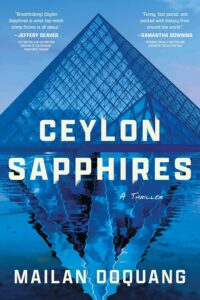 In this thrilling follow-up to Blood Rubies, plucky gem thief Rune Sarasin finds herself racing across Europe in pursuit of precious sapphires that might buy her freedom from a dangerous crime lord.
At a private showing in the Louvre, Napoleon Bonaparte’s great-great-grand niece Margot Steiner admires the painting of her famous ancestor while wearing a precious Ceylon sapphire necklace commissioned by the emperor himself. After getting caught in a commotion on the crowded staircase, however, Mrs. Steiner discovers that her necklace is gone and the suspicious young woman who started the commotion has melted away into the throng…
Rune Sarasin is new to Paris, but not new to stealing priceless jewels. She has spent the last few years plying her trade in the fast-paced city of Bangkok, but after unwittingly stealing from the ruthless smuggler Charles Lemaire, she now must hunt down the gems that he requests until she repays what she owes. But when Lemaire demands that she now steal sapphire earrings to match the necklace, Rune realizes that he will never willingly let her go.
Taking down a man with near unlimited resources is not a job for a young woman on her own, who now must hide in the shadows. With the help of an old friend and some new and unlikely alliances, Rune finds herself in a cat and mouse game around all of Europe, from Paris to Mallorca, to Marseille, to Amsterdam, and Berlin. Caught up in the world of smuggling, drug dealing, and shady businessmen, Rune fights to stay one step ahead of both the police and Lemaire.
BUY HERE
Category: On Writing
Subscribe
If you enjoyed this article, subscribe to receive more just like it.