The Origin Story: How a Career’s Worth of Frustration Became a Book
By Kimberly Lee, SPHR
I did not sit down one day and decide to write a book. That is not how this happened.
What happened was more like a slow accumulation. Twenty years of watching the same thing play out in organization after organization, across industries, across company sizes, in good economic times and bad. Talented people get identified. They get promoted. And then, largely, they get left alone to figure out how to lead.
I have spent my career in human resources, most of it in senior leadership roles navigating acquisitions, transformations, and the kind of organizational complexity that keeps HR executives up at night. I have watched companies build impressively sophisticated systems for identifying high-potential employees: rubrics, assessments, performance ratings, nine-box models. The rigor that goes into selecting someone for promotion is, in many organizations, genuinely thoughtful. We take pride in developing our people. We promote from within. We believe in them.
And then we hand them a new title and expect them to manage.
Some organizations offer training programs, onboarding bootcamps, leadership curricula. And those things have value. But there is a significant difference between informing someone about what management looks like and actually developing them as a leader. Training tells you what good looks like. Coaching helps you get there. The newly promoted manager walks out of their bootcamp and into a role where the daily reality of giving feedback, navigating conflict, and developing their people all hit at once. And the person who is supposed to coach them through it, their own manager, frequently never received that kind of coaching either.
That gap is systemic, well-intentioned, and almost invisible because it hides inside otherwise good processes. It is what I kept seeing. And for a long time, I kept seeing it without writing about it.
The writing started as something personal. I had recently experienced, firsthand, what happens when a high-performing, deeply collaborative team encounters the wrong kind of leadership. Watching talented, engaged people slowly shrink themselves, pulling back, doing just the basics, going quiet, was both painful and galvanizing. I had spent years building teams where people showed up fully, where they grew, where colleagues followed me to new organizations because the work we did together meant something. Seeing the opposite in action clarified everything I believed about why leadership culture is not a soft topic. It is the whole game.
So, I started writing. Not a book, just processing. Blog posts, articles, working things out on the page the way writers do when they need to think out loud. I am a sports fan and a former competitive swimmer, and I spent nearly a decade on the sidelines watching my son play football from pee-wee leagues all the way up. Coaching was everywhere I looked. It was the difference between a team that coheres and one that fractures; I had seen it in the water, in the stands, and in every conference room I had ever sat in. It kept finding its way into what I wrote.
A colleague in my network, Keith, read some of what I was putting out. He was direct about it: this should be a book.
There is something different about hearing that from a peer. Someone with no stake in the outcome, no editorial agenda, just a reader who found something useful and wanted more of it. It landed differently than encouragement from people who knew me well. Keith was reacting to the work itself. That mattered.
From there it was iterative, the right word for a process that was more organic than linear. I kept writing, kept refining, kept asking what I actually believed and whether I could say it clearly enough to be useful to someone in the middle of their first management role at eleven o’clock on a Tuesday night, wondering if they are doing any of this right.
That person became my reader. Not the senior executive with a coach and a thought partner and a full leadership team around them. The manager who was exceptional at their individual contributor job, got promoted because of it, and is now responsible for developing other people with very little infrastructure for developing themselves. Most leadership books are built around theory and aimed at people who are already at the top. I wanted to write something for anyone in a leadership role, at any level, that was practical, honest, and grounded in what actually happens inside organizations.
The book took shape around a central conviction: people genuinely want to succeed. They want to do well by their teams. What they often lack is not motivation but the specific skill of coaching. Knowing how to give feedback that lands, how to develop someone without doing the work for them, how to build a culture where people feel safe enough to grow. These are learnable skills. They do not require a certification or a formal program. They require attention, consistency, and a belief that your people are worth the investment.
I know this because I have lived it from both sides. I have been the leader whose team members came back years later, from different companies, different industries, to say that something I did changed how they thought about their own leadership. I have also been in the room when it went the other way. Both experiences are in this book, even when they are uncomfortable to put on the page.
What I hope readers take from it is not a formula. It is a shift in how they see their role—from someone who manages tasks to someone who develops people. That shift, compounded across teams and organizations, is what I call the ripple effect. It starts with one leader deciding to show up differently. It does not stay contained for long.
The blog posts became a book. The frustration became a framework. And somewhere in the writing, the thing I had been carrying for twenty years became something I could hand to someone else.
—
Kimberly Lee, SPHR, is an HR executive, leadership coach, and founder of Lotic Systems and MyTalentAdvantage. She has spent more than two decades leading HR transformation across global organizations. She is the author of Building a Coaching Culture: The Ripple Effect (Business Expert Press, 2026) and the creator of RippleIQ, an AI-powered coaching platform for leaders. Learn more at loticsystems.com and mytalentadvantage.com.
Building a Coaching Culture: The Ripple Effect
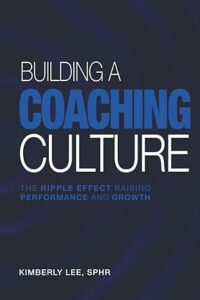 In a world defined by burnout, quiet quitting, and relentless change, traditional management is failing. But there is a better way.
Building a Coaching Culture: The Ripple Effect Raising Performance and Growth offers a human-centered alternative to leadership that not only boosts productivity but also transforms people. With decades of leadership experience, Kim Lee introduces “The Ripple Effect”—a research-backed framework that proves how a leader’s targeted acts of coaching create cascading waves of positive change.
This isn’t about management fads or getting a certification. It’s about a leader’s deepest work: seeing the unseen potential in others and helping them see it too. You’ll learn how to activate talent through powerful conversations, deliver feedback that fuels, not frightens, and lead with empathy to drive real results.
This essential guide equips leaders at every level, from first-time managers to CEOs, with the practical tools to navigate today’s dynamic landscape, including the integration of AI. Because when you invest in people, you create a powerful defense against costly turnover and build a culture of lasting success.
BUY HERE
Category: Contemporary Women Writers
Subscribe
If you enjoyed this article, subscribe to receive more just like it.