The Voice That’s True to Only You
By Jordan Rosenfeld
There’s a new voice growing louder and stronger every day, creeping into all of our lives like a toxic mold. It’s one you’ve probably encountered even if you don’t know it yet. It’s infiltrating everything around you, your apps, your commercials, your emails—especially your emails—from companies trying to sell you things and websites hoping to drive traffic. It’s trying to unseat your favorite artists, take over your entertainment, greedy in its need. It’s even infiltrating your friends and family. Its ebulliently cheerful, obsequiously positive and steeped in hyperbole. No, I haven’t gone down a conspiracy rabbit hole—it’s “artificial intelligence” (AI), a phrase too generous and inaccurate for what the large language models (LLMS) like ChatGPT et al, actually are. AI isn’t intelligent, my friends—it’s got more in common with autocorrect than it does with anything sentient—and it’s dumbing us down.
As a reader and writer all of my literate life I have always been hungry for the fresh turn of phrase, a bold voice that skitters off the page and lives inside my head for months or years. I comb sentences like quarries, mining for raw gems. I’ve been able to inhabit worlds and cultures and peoples not my own, empathy and awareness expanding like a full bellows. I only crave more of these experiences when they are human-made. Will there come a day when the models are so sophisticated we can’t tell them apart from human creation? Probably. Meanwhile, I’m going to seek out the real at every turn. I want to know that someone sat and poured pain and joy and shards of experience and history and culture onto the page, wrestled, grappled, scratched out paragraphs, spent early mornings or late nights in a flow state. I don’t want to absorb something that a prompt vomited out, no matter how quirky, clever, uniform, a perfect mimic. I want the voice of a character only that writer could put on the page.
Rebuking a Unified Voice
Voice is not just a technical term to sell books, either—it’s the raw material of what makes us human and unique. Haven’t we learned anything from Huxley’s Brave New World—with its soma-stupefied society; from L’Engle’s A Wrinkle in Time, where homogeneity is Meg’s first hint that evil lurks on the planet Camazotz where her father is trapped? Didn’t Toni Morrison and Gloria Anzaldua and Arundhati Roy and all the great writers of color lay bare the perils of letting a single voice or culture pretend they are the only stories of history?
When the chatbots first rolled out, I was hesitantly amused, curious what drudgery AI could erase in a split second—spreadsheets, translating legalese and so on. But I also grew up steeped in great sci-fi; I knew that humankind can’t be trusted with new technology for long. While I certainly can appreciate the time and effort saving qualities of having AI do laborious tasks, I soon realized that most LLMs have been trained on pirated data (In fact, I’m part of the huge class action lawsuit against Anthropic AI for illegally training on five of my books). As I read the laments of professors whose students are now turning brains off and ChatGPT on, the switch flipped for me. When emails began pouring in from obsequious sounding “fans” or dubious “book clubs,” “marketing professionals” and even, a couple of “famous authors,” telling me about my “masterful,” “life-changing” and “inspired” writing on an almost-daily basis, written in a voice so unnaturally emphatic that it should give even the most polished marketing writer the shivers, I realized I’m already sick of it.
Like the angry Carol (Rhea Seehorn) in Vince Gilligan’s new sci-fi show Plur1bus on AppleTV, I don’t want any part of this AI hive-voice that confidently strides into the world as if it knows everything—when in fact, it can’t know at all; it is not a brain, not a human mind, not a consciousness with lived experience, not a voice at all.
Complex, Messy and Human
As I teach in my new book, The Sound of Story: Developing Voice and Tone in Writing, while voice does indeed manifest at the sentence level—all that glorious, complex syntax and lexicon and grammar—it springs from character experience. Your characters speak and think and emote based on the specific lives they’ve lived, their family environments and secrets, their cultural richness or lack thereof, the time period in which they live and the historical forces exerting power upon them. All the things that probably made you (or your characters) feel weird and awkward and unseen as kids, the quirks and tics developed later in life, the weird and the specific, are what resonate as voice in life and literature.
AI is clearly here to stay until it burns itself (or us) out, but in the meantime, I hope you’ll remember that stories are better when produced from human complexity, not computer code. Keep reaching and tussling and playing with your own singular voice.
Check out Jordan’s course Sound of Story–Finding, Crafting and Playing with Voice
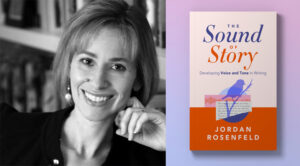 Ideal for any writer who wants to polish prose and write vibrant characters
Saturday, January 10, 2026 • 11am-12:15pm PST
https://craft.sibyllinepress.com/courses/sound-of-story-confab
THE SOUND OF STORY: Developing Voice and Tone in Writing
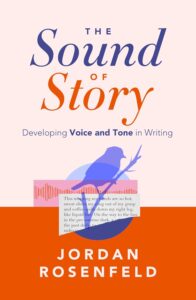
The Sound of Story: Developing Voice and Tone in Writing, Jordan Rosenfeld
Voice in writing can seem elusive and hard to define. It’s more than just style―it’s rhythm, energy, attitude, and the unique fingerprint of a narrator or character. Voice is shaped by culture and history as much as the mechanics of language.
In The Sound of Story, author and writing teacher Jordan Rosenfeld demystifies voice and its close companion, tone, offering writers the tools to develop and refine their own. Through contemporary examples, this book explores how syntax, point of view, and emotion (to name a few) shape voice on the page.
Whether you’re crafting fiction or nonfiction, this book will help you shape and refine voice to create compelling, authentic narratives. The Sound of Story empowers writers to wield voice and tone with purpose, increasing their chances of publication, yes, but delivering the optimum story for readers.
BUY HERE
Jordan Rosenfeld is author of the novels Fallout, Forged in Grace and Women in Red, and seven books on the craft of writing including the forthcoming Sound of Story: Voice and Tone in Writing, How to Write a Page-Turner, the bestselling Make a Scene, Writing the Intimate Character, A Writer’s Guide to Persistence, Writing Deep Scenes and Write Free. Jordan’s articles and essays have been published in hundreds of publications, such as The Atlantic, LitHub, The New York Times, The Rumpus, Salon, Scientific American, and many more. Jordan teaches online writing classes and at numerous writing conferences. She is a freelance manuscript editor and writing coach, and author of the popular Substack, Writing in the Pause. Learn more: jordanrosenfeld.net.
Jordan’s Website: www.jordanrosenfeld.net
Writing in the Pause, Jordan’s Substack: https://jordanwritelife.substack.com/
Category: How To and Tips
Subscribe
If you enjoyed this article, subscribe to receive more just like it.