What Makes a Hero?
By Magda Mizzi
Some years ago, I was asked to write a senior high school unit for a new syllabus at the school where I was teaching. I jumped at the chance. Immediately, I knew what I would focus on: the narrative of the hero, because who doesn’t like to learn about the heroes that have shaped the way we understand courage, leadership and strength. As I traced heroes from ancient Greece to the World Wars and into modern storytelling, a pattern became clear: most heroes throughout history were men, and the few female heroes who appeared often had to adopt traditionally masculine traits to succeed, as if courage, decisiveness and bold action, often equated with physical strength, were inherently male qualities and the primary measures of heroism.
Heroically, I ploughed on. I examined Homer’s Odyssey, Tennyson’s poem Ulysses, extracts from The Hobbit, and films such as Hacksaw Ridge. Over time, I noticed that while the qualities expected of heroes shifted slightly with each era, the focus remained narrow, and female heroes rarely had room to shine without taking on “male” characteristics.
Consider the modern Irish detective series The Fall. Its lead detective, Stella, is coldly rational, emotionally distant, and fiercely independent. She defies traditional female stereotypes, and her success comes from toughness, control, and a single-minded focus on work over connection—qualities often coded as male. She is not alone. In many contemporary stories, heroes may occasionally display traits associated with femininity, but these are rarely central to their success. Female heroes remain far less visible or celebrated, and the stories continue to suggest that the characteristics that truly define a hero are still those historically coded as male.
I admit I was slightly worried about how my students, a mix of boys and girls, would respond. Would they come away thinking heroism was still inherently male, or that female traits only mattered if they mirrored masculine ones? I wondered whether the girls in my class might feel underrepresented, while the boys could feel validated in a way that reinforced a narrow, traditional view of what it means to be heroic. Was I, in focusing on these stories, simply perpetuating the same stereotypes in the narratives I hoped to challenge?
The outcome was far more rewarding than I anticipated. The discussions sparked a lively exchange of ideas, with students sharing personal experiences, questioning traditional literature and then recognising heroism in its many forms while learning from each other’s perspectives. Qualities traditionally coded as “other”, such as patience, empathy and insight, were validated, and everyone, on both sides of the desk, saw that courage, intelligence and resilience are not gendered. It became clear that we all need a hero at some point in our lives, and that heroism can take many different shapes.
This realisation shaped how I approached writing my Fractured Reality series. I wanted a story that did not rely on a single hero or heroine. Survival in the series is not about who is loudest, strongest or boldest; it depends on people bringing different strengths together. This was not about silencing the masculine; it was about giving equal voice to all, showing that traits often labelled as feminine or “other” could be just as essential.
In the series, Michael may appear to save the day. Yet it is Madeline, whose intelligence, empathy, and courage are inseparable from her identity as a young woman of immigrant background, who ultimately ensures he survives, completing the circle of their story. Alone, neither could face the challenges of their world; together, their strengths—decisiveness, patience, empathy, strategic thinking and bold action—determine survival. Over time, Madeline becomes the bold one, taking risks that Michael cannot, while he must learn patience and restraint for both of them to have any chance at meaningful survival. Their partnership demonstrates that even heroes can learn from each other, and that heroism is collaborative, diverse and quietly powerful.
The story comes full circle, beginning and ending where Madeline and Michael first meet, drawing attention to the role of structure in shaping meaning. By returning to this point, the narrative foregrounds how choices and perspective accumulate over time, rather than resolving through a single decisive act. Qualities once overlooked—cultural knowledge, resilience, insight and quiet courage—are revealed as decisive through the way the story is built. By framing identity traits as assets rather than hindrances, the narrative resists a one size-fits-all model of heroism.
Teaching and writing have shown me that the stories we tell shape how young people, and all readers, understand heroism. If most narratives present only a narrow vision of who can be heroic, it limits imagination and expectation. By making Madeline’s traits essential to survival, the story presents a broader model of heroism, one not defined by gender, culture or conformity to a traditional mould.
In Fractured Reality, survival requires more than a single hero. It demands seeing strength in difference, recognising the value of collaboration, and honouring quiet courage that often goes unnoticed. Stories like this remind readers that the world, even a fictional one, thrives when all voices matter and all forms of bravery are recognised. For writers and educators alike, it is a call to expand the narrative and celebrate heroism in all its forms.
—
Magda Mizzi spins tales of shattered worlds and fierce survivors. A lifelong fan of post apocalyptic fiction, she sets her stories in the haunting beauty of Western Sydney’s riverbanks and the rugged Blue Mountains—landscapes she grew up exploring. When she’s not teaching English or encouraging young writers, she’s crafting her next dystopian twist or bingeing The Last of Us. She lives with her husband, kids, and two dogs who’d probably sleep through the apocalypse. Readers can connect with Magda Mizzi on Facebook, Instagram, TikTok, and Goodreads. To learn more, visit MagdaMizzi.com
The Promises Of Yesterday: A Post Apocalyptic Novel (Fractured Reality Book 3)
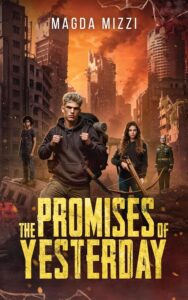 Some promises bind us. Others break us. Only one can save him.
Madeline is fighting to hold Binoomeal together. But when a long-buried family secret surfaces, her world begins to crack—and she’s pregnant, alone, and running out of time.
Far from home, Michael walks a dangerous path of vengeance and rescue. Each step drags him deeper into the shadows of his past… and closer to a future he may not survive.
The virus wasn’t an accident. The General’s final plan is unfolding. And the truth could destroy everything.
As old promises clash with new realities, Madeline must summon the strength to protect what remains. Because this time, it’s her turn to save him.
BUY HERE
Category: On Writing
Subscribe
If you enjoyed this article, subscribe to receive more just like it.