Writing Historical Fiction as an Homage to My Ancestors By Peggy Joque Williams
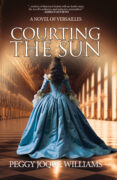 When asked about my two books, Courting the Sun: A Novel of Versailles (2024) and Braving the Dawn: A Novel of New France (January 2026), I take delight in saying they are an homage to my French-Canadian ancestors.
In a 2024 piece I wrote for Women Writers, Women’s Books, “From Super Collaborator to Solo Historical Novelist,” I mentioned that the idea for the books came from my love of genealogy and research I had done into a group of immigrant women called the Filles du Roi (Daughters of the King). Twenty-three of my 7th and 8th great-grandmothers were among the Filles du Roi. They traveled to Canada, married, and settled in the villages of Québec, Ville-Marie (Montreal), and others up and down the St. Lawrence River, including on Île d’Orléans.
I had mixed feelings about writing the first book, Courting the Sun. It is the story of fictional Sylvienne d’Aubert’s rise to become a favorite in the court of King Louis XIV. The story begins in Amiens, the birthplace of one of my French ancestors. However, once Sylvienne leaves Amiens, I decided to let my imagination run wild creating her adventures.
She has a grand time at court, partying, dancing, meeting young men—until it isn’t so grand anymore. She eventually realizes she is a pawn of the king, she gets into trouble, and by the end of the book is in danger of losing her head. The king offers her the choice of going into a convent or going to New France, both of which are anathema to her. She chooses New France.
I extensively researched France, Paris, and court life during that time period. However, Courting the Sun reflects very little of the real lives of my French ancestors. None of them spent any time at court to my knowledge. It is simply a fun story loosely inspired by their existence.
Braving the Dawn is quite different. As soon as she steps onto the ship in that story, Sylvienne’s experiences reflect the very real lives of my many-times great-grandmothers. I researched the crossing and strove to make Sylvienne’s time on the ship as authentic as possible, down to being sick and losing weight throughout the voyage, so that when they get to Québec, the dress she saved for the arrival hangs on her.
While the thread of Sylvienne’s relationship to the king is infused throughout Braving the Dawn, it is entirely fictional. But the welcome she experienced by the Ursaline nuns, the interviewing of prospective marriageable men at the convent, attending Mass at Notre Dame de Québec, spending time in the hospital run by the Augustinian nuns were all experiences common to my ancestors.
Some of the male characters in Braving the Dawn were inspired by men in my family tree. One of the key characters, Armand, is a captain of the local militia. Several of my many-times great-grandfathers were members of the Carignan-Salières regiment sent by the king to quell the Iroquois, who regularly attacked both colonists and indigenous people. When the situation with the Iroquois improved and the regiment called home to France, soldiers were given the option to stay and bonuses if they settled in Canada and married.
Another key character, Jacques Farley, is a half-French, half-Irish coureur des bois, a fur-trader who works illegally. I modeled him after my 5th great-grandfather, Jacques-Philippe Farley, a voyageur (legal fur trader) who traveled regularly by canoe between Montreal and Michilimackinac, Michigan, although nearly a century later.
Another element of Braving the Dawn was the inclusion of Native characters. I wanted to honor my 2nd great-grandmother, Angelique Beaudoin, who was Ojibwe. I worked to be as accurate as possible about the role of the Native people in the cultural and economic structure of New France. I learned there were a number of First Peoples nations—the Wendat, Cree, Ojibwe, and others—who got along with the French colonists, primarily because they were business partners. Intermarriage between the Natives and the French was accepted, though it was mostly one-way: French men marrying Indigenous women who were expected to move into the colonial villages, convert to Catholicism, and take on French customs.
The nuns who welcomed the Filles du Roi also educated young French and Native girls. Their original purpose was to convert the Native girls. Some embraced the new religion, others resisted, maintaining their own cultural and spiritual beliefs and practices. I represent both in my novel.
Some of my ancestors had amazing accomplishments, and in my research travels I found plaques in their honor in Montreal, Québec City, and on Île d’Orléans. Others have done horrible things I prefer not to mention. I have several forebears who were murdered, and one who was kidnapped by the Iroquois during a raid and never heard from again. But most of my predecessors lived ordinary, everyday lives much as I do. They strove to create good homes, raise their children, form communities with their neighbors.
Sylvienne may have a fictional background in France unlike my foremothers, but in Canada she represents them well. And there are plenty of characters in both books whose lives mirror the ordinary lives of the women and men who came before me—people just trying to get along and live a good life. I honor and thank all of them for the lives they lived—and the life they handed down to me.
—
Award-winning author Peggy Joque Williams writes historical fiction inspired by her love of genealogy and historical research. She has also co-authored two contemporary mystery novels: On the Road to Death’s Door and On the Road to Where the Bells Toll. Her first solo historical mystery, Death Doth Protest Too Much, is due out in March 2027. Peggy lives in Madison, Wisconsin.
Braving the Dawn: A Novel of New France
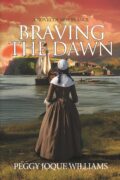 Banished from France by King Louis XIV, once royal favorite Sylvienne d’Aubert must make the dangerous ocean crossing with a group of young women eager to secure husbands in the French colony of Quebec as Filles du Roi (Daughters of the King). Sylvienne, however, scarred by an abusive, arranged marriage in France, vows never to wed again. She is determined to one day return to her beloved homeland and to her lover, Etienne.
Clinging to hope that her true love still lives, she must first survive hardships and challenges unique to the Canadian frontier and rebuild her life in a young colony that is at once welcoming and dangerous. She finds friendship in unexpected places and allies among the Native people while developing a resilience she didn’t know she possessed.
But the king’s reach is long, and Sylvienne’s past haunts her at every turn in this saga of new beginnings, survival, and determination of the heart.
BUY HERE
Category: On Writing
Subscribe
If you enjoyed this article, subscribe to receive more just like it.