
From Coffee to Debut Novel: I Have So Many Questions by Denise Smith Cline
Almost every family has an odd story or tradition. We may not know how surprising it is until an outsider hears about it. My aunt did a handstand against the dining room wall in her best Sunday dress after every Thanksgiving dinner, after which her husband played “White Christmas” on the piano. Nothing about this annual show struck me as odd until I told the story to a stranger and saw the shock on her face.
The story behind my debut novel, The Resettlement of Vesta Blonik is like that. On a regular morning over coffee, a friend casually mentioned his aunt moved to North Carolina from Minnesota to marry his uncle, only to find out when she arrived that the man was in a mental institution, and that he didn’t write the courtship letters she thought he’d sent. Finishing the story, my friend shrugged and sipped his coffee while I recovered from nearly choking on mine.
Hearing about my friend’s relatives was incredibly good luck, but for me, hearing a fine story can be like finding an interesting piece of cloth in a scrap pile. It’s good to celebrate the find, but it takes many more scraps and a lot more work to create a useful quilt or beautiful tapestry.
Converting that story’s inspiration into a novel started with questions. The first one was the most basic: what on earth would make a sane woman travel a thousand miles from all she’s ever known to marry a total stranger? That question opened doors and offered new paths into richer territory. Some paths sped me forward, some backward. Other questions led me nowhere, and that worked out, too.
What happened to my friend’s relatives might now be called catfishing, but I guessed that in the 1930’s, realizing too late that your intended was in a mental institution was a much bigger quandary than an internet date gone sour.
I asked questions about what was going on in Minnesota in 1937, when the original story took place. I learned one of the first New Deal initiatives during the Great Depression was called the Resettlement Administration. Under that program, through a process of loans and other assistance, the government helped farmers move from bad to better farmland. One part of the program focused on a region in Upper Midwest called the Cutover, which consisted of deforested boggy land unfit for productive farming. Those moves may have been beneficial, but I imagined some families were pulled apart as a result. The Resettlement became my inciting incident.
I searched for photos and read books on the Cutover. I wondered how anyone could survive a winter in such a place, much less during the Great Depression, when houses and farms lacked central heating, electricity or modern plumbing.
I had a chance to visit Minnesota during February 2020, and a drive into the Cutover helped me visualize winter in a tiny town where people had survived by logging and subsistence farming, a Catholic church at one end of town, Lutheran at the other.
More questions came to mind and so did more answers. I wondered who might live in such a place. I learned that many residents were of German, Eastern European or Scandinavian descent. From that research, Vesta Blonik, a woman of Czech heritage and my protagonist, began to take shape.
In my book someone had to tell the prospective groom’s North Carolina family about Vesta. Who might be able to connect a lonely woman in Minnesota with a stranger in North Carolina? Could a pair of Lutheran ministers manage a little matchmaking?
More questions arose. What work was available in the middle of the Great Depression? Dairy production was increasing in the region, and a big concern was an influx of imported dairy products. Tariffs were floated as an answer. I created a brother for Vesta who had managed to escape the farm and take a job in a creamery. The delivery of courtship letters to Vesta from North Carolina was crucial to the story, and so a quirky character who worked in the United States Postal Service came to life.
Without a farm, what kind of work could Vesta do? The ancient art of sewing seemed like an option, which led to research on sewing machines available in 1937. Did they have modern features, like say, zig-zag stitches? Why yes, it turns out, and Vesta was able to survive because of such a machine.
Other characters introduced themselves to me. My two protagonists struggled against what must have seemed to be impossible odds, betrayed by family and circumstances beyond their control. I wondered: did each need a friend?
For Gordon, the would-be groom, I found two friends, a nurse who worried he was wrongly committed and a long-term patient who stayed in the mental hospital because life inside was easier to manage than the alternative.
For Vesta, a sister-in-law in town who had her own troubles seemed like the perfect choice for a confidante. And closer to home? A cow named Lottie daily heard Vesta’s worries without complaint and provided steady, cud-chewing “friendship” in the face of the huge upheaval Vesta faced.
The next set of questions were harder but even more important. What would it feel like to be deceived into giving up everything to cross the country for a man in a mental hospital? Would anger burn in Vesta’s throat, her stomach? Would her knees buckle with fear, would she weep? Would she drop whatever she was holding, or would her muscles stiffen to brace her from falling? The structure and setting of a novel are hugely important, but a novel that convincingly opens a window into a character’s heart is a book I’ll remember and recommend over and over again.
And so, scrap by scrap, question by question, my debut historical novel emerged. Every part of the story arrived with an array of questions. Initial answers led to more questions, and before long, setting, characters, conflict and the emotional heart of the story clicked into place.
Sometimes a story falls into your lap. Other times, not so much. But the questions? Those come by the dozens. And that’s its own kind of good luck.
—
Denise Smith Cline is an author and lawyer born and reared in Upstate South Carolina. Her short stories and essays have won recognition and prizes, including a Pushcart Prize nomination. Her work has also appeared in Press 53 Magazine, Mamalode, Carolina Woman, the News & Observer and The Shoal. The Resettlement of Vesta Blonik is her first published full-length novel. Denise currently resides in Raleigh, NC. Find her online at denisescline.com.
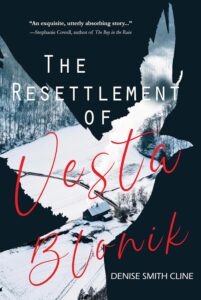 At thirty years old and unmarried, Vesta Blonik’ s future looks bleak when her widowed father remarries, sells the family farm, and moves away during the depths of the Great Depression, leaving her behind. Meanwhile, in eastern North Carolina, Gordon Crenshaw is engulfed in despair after losing his wife and newborn during childbirth. Concerned for his well-being, his family commits him to Dix Hill, the state mental hospital. Struggling against his grief, Gordon’ s disruptive behavior leads his family to seek his release, but they learn he can only be discharged if a suitable caretaker is found.
Through connections in the Carolinas and Minnesota, the Crenshaws find Vesta and pose as Gordon, and her suitor, through letters that hide the truth of his situation. When Vesta agrees to marry Gordon, unaware of the deception, she travels south, only to learn the full extent of the Crenshaws’ lie after the wedding. Bound by necessity and circumstance, Vesta and Gordon must navigate their new life amid the tobacco fields of North Carolina, confronting their pasts and discovering the possibility of love in unexpected places.
BUY HERE
Category: On Writing
Subscribe
If you enjoyed this article, subscribe to receive more just like it.










Such a fabulous novel– and I really enjoyed this inside look into Denise’s writing process. Brava!!