How Finding Grace Found me by Fiorella Ruas
 “She went out to buy wine. She didn’t mean to disappear.”
That single sentence sums up the question that had been preoccupying me for years. Why do so many women reach a point where they wonder how they became strangers in their own lives? The answer, for me, didn’t arrive all at once but in fragments, and it also became the premise of Finding Grace.
One fragment was a friend who left her family.
At the time it felt shocking, not because marriages don’t end, but because women, and particularly mothers, aren’t supposed to be the ones who walk away but are expected to keep going. Whatever happens, they are the ones who are supposed to carry on. So when my friend simply left, the question stayed with me for years. Not, How could she? but, What has to happen for someone to reach that point?
Another fragment came from living on the Camino de Santiago and from a particularly evocative photographic exhibition of pilgrims that I came across, which stayed with me for reasons I couldn’t quite work out at the time. All those faces carried different stories, different reasons for going on that walk: sometimes tragic, as a way of coming to terms with loss or overcoming illness; sometimes as seemingly frivolous as trying to lose weight. Yet they all shared that same sense of searching for something just beyond reach.
Then there was the rather less dramatic business of getting older.
Not in the headline-grabbing sense of midlife crises, but in the quieter realisation that life rarely turns out as expected. You become busy building a career, raising children, paying mortgages, doing all the things responsible adults do. Then one day you catch sight of yourself from a slight distance and wonder when exactly you became this version of yourself. Not necessarily unhappy. Not necessarily happy either. Just… someone you hadn’t entirely expected.
On a more personal level, this period was synonymous with going through a serious depression lasting years. From the outside, I seemed to have everything I was supposed to want, yet something no longer fitted. I kept asking myself: Who am I? Who have I become? Had I quietly given up on the dreams that once mattered most and settled instead for the life society told me should make me happy? And if so, when had I lost sight of myself?
Those events had, apparently, nothing obvious to do with one another. Yet they kept circling back.
I didn’t want to write a novel about a woman who abandons her family. Nor did I want to write a novel about the Camino or deep depression. What interested me was the emotional territory underneath. The gap between the person we imagine we’ll be and the person we eventually become. The stories we tell ourselves about success, marriage, motherhood and happiness. The strange feeling that you can be surrounded by people who love you and still feel oddly disconnected from your own life.
Just as importantly, I didn’t want to write an earnest novel. It isn’t in my nature as a writer. In my work as a playwright and screenwriter, I have always looked for that angle, that way of turning an emotional scene on its head. Life, even at its darkest, is rarely without humour. We, as humans, always have a knack for finding absurdity in the middle of heartbreak, even if it’s just as a way to cope. I wanted Finding Grace to reflect that dichotomy because I think that’s closer to the way most of us actually live.
The other thing that interested me was that one person’s act of leaving never belongs only to them. Whether Grace’s decision is seen as an act of courage, desperation or selfishness depends entirely on where you’re standing. What fascinated me was the ripple effect it creates. Grace’s journey becomes the catalyst for everyone else’s. Her husband, her children, all forced to confront their own assumptions, disappointments and buried dreams. In their different ways, they all end up going on the same parallel journey.
https://www.facebook.com/
https://www.instagram.com/
—
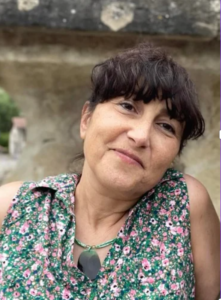
Bio : Fiorella Ruas writes with her partner Jonathan Pett whom she met on a night train between Paris and Venice. Their work spans fiction, theatre, film and television, including the Royal National Theatre Studio, BBC TV and major international film companies. Their stories often explore outsiders, female friendships, and the search for meaning and belonging.
FINDING GRACE
 She went out to buy wine. She didn’t mean to disappear.”
Grace is fifty.
She’s not a walker. She’s not even a brisk stroller. She’s the kind of woman who takes sips of Chardonnay whilst doing a thirty-day online yoga challenge stretched over an entire year.
On the night of a combined birthday and wedding-anniversary celebration, Grace leaves the house to buy more wine.
And keeps walking.
What follows is a journey across France and Spain on the Camino de Santiago, told through her eyes, the eyes of the family she left behind, and the strangers she meets along the way.
A sharp, funny and deeply human novel about marriage, depression, family mythology, lost dreams and the stories we tell ourselves to survive.
“The people in the photo were trapped in a different reality, one where things still felt possible.”
For readers who loved The Unlikely Pilgrimage of Harold Fry, Instructions for a Heatwave, Still Life and Eleanor Oliphant Is Completely Fine.
BUY HERE
Category: On Writing
Subscribe
If you enjoyed this article, subscribe to receive more just like it.