An Interview with CiCi Donohue of “How Could You Let This Happen” by Jen Craven
HOW COULD YOU LET THIS HAPPEN?
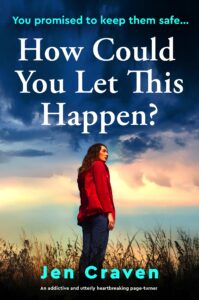 I fight back tears as my best friend clutches her son’s hand, the room silent except for the low beep of his life support machine. I couldn’t bear it if this was my own son. My pulse races as she slowly turns to me. “How could you let this happen?”
When my teenage son Miles and his best friend Isaac ask to have a party at our house, I immediately agree—as a single mom, I’m used to making the decisions and they need to let off steam. But later that night when I’m woken by the blare of sirens and see blue lights streaking across the sky, I realize I am living every parent’s worst nightmare.
They said they would stay in the garage. So why aren’t they there? Sprinting over to the lake at the bottom of the garden, my heart pounding all I can think is, where is my son? Is he hurt? Then in horror, I watch as Isaac is pulled onto a stretcher.
Guilt crashes over me in waves as I struggle to breathe. I never meant for any of this to happen, but I know this is all my fault. I should never have left them. Beth trusted me to look after her son and I already know that she’ll never forgive me.
As Isaac’s life hangs in the balance, I feel a rising sense of panic. What if he never wakes up? And if he does, will he tell everyone what really happened that night and tear our families apart forever?
An unforgettable and emotional story about how one moment can change our lives forever, and how far we will go to protect the ones we love. Perfect for fans of Diane Chamberlain, Jodi Picoult and Melissa Wiesner.
An Interview with CiCi Donohue of “How Could You Let This Happen”
by Jen Craven
As a writer, I spend months—sometimes years—inside my characters’ heads. But CiCi Donohue, the mother at the center of my upcoming novel How Could You Let This Happen, has a way of lingering. She doesn’t like to be misunderstood. So today, I’m sitting down with her directly.
This is her story, in her words.
Jen: CiCi, let’s start with the obvious. Who are you?
CiCi: I’m a mother. Everything else comes second to that, even if I don’t always want it to. I have two teenage sons, and I’ve spent most of my adult life trying to convince myself that I can handle things on my own. Sometimes that’s true. Sometimes it’s the lie that keeps me going.
Jen: When readers meet you, they meet you on one of the worst nights of your life.
CiCi: The worst. There’s no competition. One moment, I’m monitoring my kids and their friends. The next, there are sirens. Blue lights. A lake that suddenly feels like a threat instead of a backdrop. That night splits my life cleanly in two—before and after.
Jen: You give in and say yes to the party when Miles asks, even when the little voice in your head cautions you. Why?
CiCi: Because I’m tired. Because I don’t have another adult to check in with. Because I want to believe that trust counts for something. And because saying no feels like admitting I’m afraid—afraid of being the strict mom, the uncool mom, the mom whose kids pull away. I told myself it was harmless. I told myself I was in control.
I was wrong.
Jen: Many readers will ask the question Beth asks you: How could you let this happen? What’s your answer?
CiCi: I don’t have one that makes anyone feel better. I didn’t “let” it happen the way people want that word to work—like I stood there and watched. But I made a series of choices that led us there. I left them alone. I trusted rules to hold when I wasn’t there to enforce them. I underestimated how quickly things spiral with teenagers, and well…all things teenagers do.
And yes—I live with that every day.
Jen: Guilt plays a huge role in this story.
CiCi: Guilt is the story. It’s in every room I walk into, every conversation I have. It’s the way I replay the night over and over, looking for the moment I could’ve stopped it. Guilt is what makes me hesitate. What makes me quiet. What makes me dangerous to myself.
Jen: Dangerous?
CiCi: Because guilt doesn’t just want you to feel bad. It wants you to hide. To protect yourself at all costs. To convince yourself that the truth will destroy everyone—even when that’s not entirely true. I’m not just risking my personal reputation, but my business, my livelihood. My closest friendship in the world. It’s not easy.
Jen: Isaac’s condition hangs over the entire book.
CiCi: As it should. He’s a child. Beth’s child. A boy who trusted my home to be safe. Watching him in that hospital bed, listening to the machines breathe for him—it broke something in me. I kept thinking: If this were my son, I’d be feral with grief. And then I realized—I’m standing on the other side of that nightmare.
Jen: Your friendship with Beth is one of the emotional cores of the novel.
CiCi: Beth knows me. Or at least, she thought she did. There’s something uniquely painful about disappointing someone who’s seen you at your best. I didn’t just lose her trust—I lost the version of myself she believed in.
Jen: Without giving too much away, there are things from your past that complicate the present.
CiCi: Don’t they always? We like to pretend we’re only as guilty as our worst recent mistake. But history has a long memory. I learned early how to keep secrets, how to survive by staying quiet. Those instincts don’t disappear just because I grew up and had kids.
They resurface when the stakes are highest.
Jen: Do you want to comment on Chief Sullivan?
CiCi: No, I do not.
Jen: Do you think you’re a good mother?
CiCi: That’s the question, isn’t it? I love my sons more than my own life. I would step in front of a moving car for them. But love doesn’t equal perfection. I’m certainly not a perfect mother. But who is?
I think I’m a mother doing her best with the tools she has—and realizing too late that some of those tools are broken.
Jen: What do you want readers to understand about you?
CiCi: That I’m not a villain. I’m not a headline. I’m a woman who made a terrible mistake and then had to decide what kind of person she would be afterward. I want readers to sit in that discomfort. To ask themselves what they’d do if the truth threatened to shatter their family.
Because it’s easy to say, I’d never have let that happen in the first place. But would you? Would you really? I’m pretty sure it happens all the time.
Jen: Final question. If you could speak directly to the reader, what would you say?
CiCi: I’d say this: Don’t read my story looking for someone to blame. Read it looking for understanding. For the moment where you recognize yourself—in the fear, in the rationalizations, in the choices.
And then ask yourself the question that haunts me every day:
When it mattered most… what would you have done?
BUY HERE
—
How Could You Let This Happen (March 12, 2026, Bookouture) explores motherhood, guilt, secrecy, and the devastating ripple effects of one irreversible night. CiCi Donohue may be fictional—but her fears, her love, and her mistakes are painfully real. Learn more about Jen Craven and her emotionally charged domestic suspense novels at www.jencraven.com or on social @jencravenauthor.
Category: Interviews, On Writing
Subscribe
If you enjoyed this article, subscribe to receive more just like it.