Authors Interviewing Characters: Nicole Conn
DESCENDING THIRDS
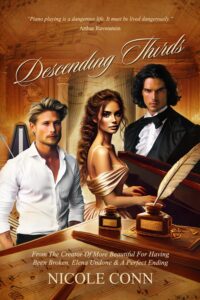 In the high-stakes world of classical music, Alexandra von Triessen, a gifted but insecure pianist, navigates the cutthroat International Ketterling Piano Competition. Dazzled by the charming Sebastian D’Antonio, she finds herself drawn into a web of intrigue surrounding his enigmatic and estranged brother, Conrad. Just as Alexandra’s star begins to rise, a shocking discovery sends her world crashing down, exposing secrets and lies that threaten to destroy everything she’s worked for.
Descending Thirds is a gripping story of ambition, betrayal, and the blurred lines between artistry and integrity. This page-turner explores the sacrifices we make in pursuit of our dreams and the devastating consequences of hidden truths. With two shocking twists that will leave you reeling, this unforgettable novel will resonate with anyone who has ever dared to reach for greatness.
Interviewing Alexandra von Triessen from Descending Thirds
There are some characters you create. And then there are the ones who seem to arrive fully formed, carrying pieces of your own history back to you. Alexandra von Triessen was that character for me. If anything, artistically, she’s my straight alter-ego.
Set against the ruthless backdrop of the International Ketterling Piano Competition, Alexandra lives inside a world where perfection is demanded, vulnerability is dangerous, and love has the power to both save and destroy. She is brilliant, emotionally guarded, deeply sensual, and torn between two extraordinary brothers—one a dazzling showman who commands every room he enters, the other a quiet genius who writes music as though he were born directly from it.
I sat down with Alexandra to ask her a few questions she has probably spent most of her life trying not to answer.
Nicole Conn: Alexandra, do you remember the first moment you realized music would cost you something?
Alexandra: I think all serious artists know very early that love becomes conditional around talent. You begin to understand that the thing people praise in you is also the thing they will eventually demand from you. Piano was never simply joy in my life – even when it provided me moments of absolute elation. It was expectation. Discipline. Survival. But it was also the one place where I could say things I was forbidden to say out loud.
Nicole Conn: Your mother, Claire, is such a powerful force in your life. Even when she isn’t physically present, she seems to shape so much of how you see yourself. Did you spend your life trying to please her or escape her?
Alexandra: Both. I think daughters often inherit their mothers’ unfinished longings before they even understand what they are carrying. My mother loved beauty, discipline, excellence… but there were always grief and anger woven into those things too. She began expecting my accomplishments even as she resented them. I spent years believing that if I became extraordinary enough, perhaps I could finally earn a kind of peace from her. But children eventually discover their parents are not gods. They are wounded people trying to survive themselves. Sadly, the less I have to do with my mother, the better.
Nicole: The Ketterling Competition feels almost like another character in the novel. Did you love it or hate it?
Alexandra: Both. That’s what made it dangerous. They are a necessary evil for serious pianists, where politics intersects with perfection and commerce. Competitions create intimacy through shared suffering. Everyone is exhausted, terrified, unraveling privately while pretending to be invincible publicly. There’s a strange seduction to that world. Every round feels like life or death. And when you survive a cut, you almost love the machine that’s destroying you.
Nicole: And then there were Sebastian and Conrad.
Alexandra: (laughs softly) Yes. Sebastian and Conrad – had I but known.
Nicole: You loved them differently.
Alexandra: Completely differently. Sebastian saw me as a woman before anyone else did. He understood appetite, glamour, danger, pleasure. Conrad saw something much more frightening. He saw right through me. There’s nowhere to hide from someone like that.
Nicole: Was there ever a moment you knew your life would never belong entirely to you again?
Alexandra: Love always changes the architecture of a life. But genius does too. The tragedy is when they arrive at the same time. When you’re travelling on tour, your life belongs to the orchestra, conductor and the audience. It’s easy to lose yourself along the way.
Nicole: Descending Thirds lives so deeply inside the world of elite classical piano. What would people be most surprised to learn about that world?
Alexandra: How lonely it is. Audiences see elegance and transcendence. They don’t see the psychological brutality underneath it. The endless practicing. The physical pain. The terror. The way your entire identity becomes attached to whether you succeed or fail in a single performance.
Nicole: What does success look like?
Alexandra: It depends on who you’re asking. For Sebastian it’s fame at all costs. For Conrad, playing for himself is all the success he requires. Sadly, most pianists end up becoming teachers, playing in ensembles and lounge acts. For the rare few of us, success is measured by being on tour as a principal as well as recording the repertoire. It’s tenuous and fleeting.
Nicole: Last question. After everything, do you believe great art is worth the cost?
Alexandra: (long pause) Only if you survive it long enough to still recognize yourself afterward.
Author’s Note: Long before I ever wrote Descending Thirds, my mother, Christa Hoven—a trained classical pianist who later became a piano teacher—and I spent years devouring videotapes of the legendary Van Cliburn International Piano Competition together. I would often buy one or two new Cliburn tapes for birthdays or Christmas, and we would lose ourselves in the breathtaking performances, emotional intensity, and impossible pressure these young musicians faced competing at the highest level. Those evenings became far more than a shared love of music; they became the emotional foundation for Descending Thirds and the inspiration behind the fictional International Ketterling Piano Competition that shapes Alexandra’s life and opens the novel.
BUY HERE
Nicole Conn has been a pioneering filmmaker for over thirty years, best known for her Cult Classic, Claire of the Moon – soon to have it’s 35th Year Re-Release following it’s 10th and 20th year Re-Releases. Among her best-selling features, Elena Undone, A Perfect Ending, little man and More Beautiful for Having Been Broken. Conn has achieved worldwide industry recognition with her lesbian-themed films and is perhaps the best-known Writer/Director of women’s films in the world. Notably, Elena Undone holds the record for the longest kiss in cinematic history.
In another pioneering effort, Conn created Coming Out For Love, the first ever LGBTQ+ Dating Competion Show (ala the Bachelor). In her earlier career she was published by Simon Schuster with Angel Wings, Passion’s Shadow and She Walks in Beauty. She’s written novelizations for Elena Undone and Claire of the Moon.
It took her 25 years, but finally iDescending Thirds was published March and is deeply personal like her films. She will also release Blue Love Dance – A CineRomance, a behind the scenes look at the making of her single favorite sequence of her career. Once again, breaking molds intercutting a love scene with dance and nature’s glorious sunset.
Category: Interviews, On Writing
Subscribe
If you enjoyed this article, subscribe to receive more just like it.