Authors Interviewing Characters: Susan Coventry
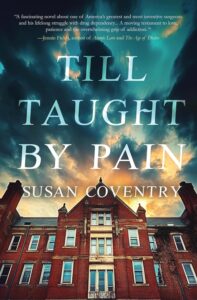 TILL TAUGHT BY PAIN
Inspired by the groundbreaking discoveries of ether and chloroform anesthesia, William Stewart Halsted pursues a surgical career with relentless ambition, daring to perform operations deemed impossible by his peers. His reputation skyrockets with each bold success— until his quest for an effective local anesthetic leads him to inject himself with cocaine. Caroline, the niece of Confederate General Wade Hampton, seeks to escape the constraints of post-war South Carolina by training as a nurse. When she takes a position at the prestigious Johns Hopkins Hospital, she finds herself captivated by the brilliant yet troubled chief of surgery, Dr. Halsted. Till Taught by Pain is a poignant exploration of love and sacrifice, as Caroline grapples with the difficult choice between enabling her husband’ s addiction and supporting his pioneering career. As their lives intertwine, both must confront the consequences of ambition, the nature of love, and the toll of personal demons on their shared dreams.
—
Interview with Characters from Till Taught by Pain
September 21, 1922: I believe in immortalizing great men and women by the telling of their life stories. This is why I’ve been escorted by a housekeeper into the office of the recently deceased Dr. William Halsted, to await an interview with his widow. And yet, my enthusiasm for the project, and my haste in undertaking it, is beginning to feel unseemly. With its stale odor of cigarettes, drawn curtains, barren desktop, and empty bookshelves, alongside of which are stacks of cardboard boxes tied with twine, the office itself accuses me of intruding upon a private loss. After all, Dr. Halsted passed a mere two weeks ago.
The door to the office reopens. A short woman dressed in black walks in, leaning on the arm of a barrel-shaped man in a dark suit with a black armband. I have never met either, yet I know them both: the widow, Mrs. Caroline Hampton Halsted, and the world-renowned medical school dean, Dr. Welch. This is mildly disappointing. I do want to interview him as well, as he is Dr. Halsted’s oldest surviving friend, but not the two together. I fear they will inhibit one another.
“Good afternoon,” I say to them both. “Thank you for agreeing to speak with me.”
“Yes, good afternoon.” Mrs. Halsted’s voice is steady, not tremulous as I expected from her appearance. She has a strong southern accent, reminding me that her uncle was a Confederate general. How must that have shaped her? I’m momentarily distracted by the tangent.
“Excuse the mess.” She gestures about. “I am donating William’s books and papers to the university.”
I cast a second look at the boxes and feel a tug of interest, but peel my eyes away, hoping my expression is not too eager or acquisitive.
“Please, take a seat,” she says, moving toward a leather armchair behind the desk, leaving me the only other chair, the narrow wooden kind designed to discourage visitors from overstaying their welcome. An assertion of dominance. Kudos to her. I sit. Dr. Welch remains standing, hovering like a guard. She broaches the subject first. “I understand you hope to write William’s biography.”
“Yes.” In a manner of speaking. I clear my throat. Here is where I will win her over. “Your husband was a brilliant man, a crucial figure in modern American medicine—”
“I know that.” She actually scowls. “But I can assure you, he would hate the idea of a biography.”
I refuse to be discouraged. Many men are falsely humble in their lifetimes, while still yearning to be remembered throughout the ages. “But his work—”
“His work speaks for itself.”
I try a different tack. “Surely, he was so much more than the sum of his work! People will want to see his human side as well.”
She remains quiet a moment, unmoved. Then she says, “William’s work defines him. I don’t believe in laying bare a person’s private life to sell a story.”
That is a slap in the face. She is accusing me of peddling gossip! And yet, I must admit to a shameful flare of curiosity. Of excitement. What is she hiding?
Did Dr. Halsted have an affair? Did she? Might there have been marital discord over her Confederate past? Or over his obsession with work? Maybe she was the brains behind his innovations and he took the credit. They have no children. Why is that?
I regard once more this small, fierce woman, guardian of the great surgeon’s legacy. And abruptly, my interest in Dr. Halsted palls. They say that behind every great man there is an even greater woman. What is her story? What is theirs?
“I understand,” I say, unwilling to be stymied. “And you must think me horribly ill-mannered. I should have told you first how sorry I am for your loss.” I tilt my head toward Dr. Welch. “And yours as well. I understand you were close friends.”
Dr. Welch nods. “I’ve known the man, knew him, for most of my life.”
“You met in New York, didn’t you? Before you came down to Johns Hopkins?”
“Yes.”
“And then he followed you down. Why was that?”
“Oh, many reasons I suppose.” He waves his hand. An evasive gesture. Interesting. “He could see the possibilities here.”
I turn to Mrs. Halsted again. “How did you come to be in Baltimore?”
She takes a moment to consider her answer. Or perhaps, if she should answer. Why so cagey? “I was trained as a nurse. I took a job at Johns Hopkins, on the surgical ward.”
“So that is where you met Dr. Halsted?”
She nods.
“Was it love at first sight?” I ask, smiling just a little, hoping a happy memory might draw her out.
“Hardly.” Looking beyond me, as if peering into the past, she says, “He nearly knocked me over in the hospital courtyard. It was mutual annoyance at first sight.”
Dr. Welch cracks a smile. “I believe he would give a different answer, Caroline. For him, it was very definitely love at first sight.”
She pulls a handkerchief from a hidden pocket and dabs at her eyes. Now I am certain. There is a story here, one that is far more interesting to me than a record of Dr. Halsted’s surgical accomplishments. There are secrets to uncover, but I won’t learn them here.
I rise from my uncomfortable chair.
“I trust you know your husband’s wishes, and I will respect them I won’t write his biography. Thank you for your time.”
She looks relieved as she shakes my hand. Dr. Welch escorts me to the door with a smile.
As I exit the house, I feel a twinge of guilt for misleading them. I said I wouldn’t write Dr. Halsted’s biography. But I am a novelist.
BUY HERE
—
Susan Coventry is a retired physician with a lifelong historical fiction obsession. Her first novel, The Queen’ s Daughter, was a YA historical set in the Middle Ages. She has since switched from YA to adult novels and moved on from medieval Europe to the turn-of- the-20th-century U.S. She lives in Louisville, KY with her historian husband, Brad Asher.
Category: Interviews, On Writing
Subscribe
If you enjoyed this article, subscribe to receive more just like it.