Hunting for Words by Deborah Lee Luskin
By Deborah Lee Luskin
Walking into the woods in the dark before dawn carrying a rifle was the hardest thing I’d done since I turned sixty. Writing about it was harder.
I became a deer hunter because I wanted to be able to find my way through the northern forest without following a marked trail. One day, while weeding the tomatoes, I looked over the garden fence at the woods that hemmed in the field, and I heard a voice from the universe say, “Learn from the deer.” That’s when I knew, against all odds of gender and heritage, I would become a hunter—and write about it. Writing is how I make sense of the world, and I knew telling friends, readers, and my radio audience about my intention to write my hunting story would hold me accountable. It did.
It took four years before I shot my first deer, and three to write the book. Sitting at my desk was similar in many ways to sitting in the forest, waiting for deer with one exception: at my desk, I was waiting for words.
Following the narrative thread of my story required the same courage, concentration, and observational skills as walking through the untracked forest. As with hunting, writing the story was an act of discovery. When I set out to hunt, I had no idea that I would love being outdoors in November from before dawn until noon. An unexpected consequence of seeing the sunrise and spending hours outdoors would be how the spiritual dullness I’d suffered in November eased even as the earth tilted away from the sun. Likewise, I had no idea that writing about learning to hunt would open doors to my past that I would examine in ways I never expected—or possibly never wanted to but could no longer avoid.
When I sat down to write, I was surprised by the turn the narrative took into how attitudes about gender formed me from birth, starting in my family of origin, where I was the third of four children, and the only girl. My parents were loving and well-meaning, and they believed it when they said they treated us all the same. They didn’t, and like many children born in the 1950s, I thought being a boy was better than being a girl. I know better now.
There were days when I was writing the book that I thought the task was beyond me, days when I wanted to give up, just as there were entire seasons in the field when I didn’t see a deer and wanted to walk out of the woods for good. I wondered what made me believe I could become a hunter this late in life, and I wondered what made me believe I could write a memoir about it. What started as a hunting narrative was turning into a story about an ordinary woman pushing against confining gender expectations, including expectations that a woman’s life ends with her menses. She becomes invisible, inaudible, sidelined. Invisibility and silence are important to maintain while hunting, and I write in isolation and silence, but writing for publication and meeting readers is anything but silent or invisible.
One of the stories I tell in the book is how the radio station where I’d been a regular storyteller wouldn’t let me tell the story about how women without fame or fortune often suffer sexual predation in silence. I knew this first hand, but the station wouldn’t allow me to broadcast that it was my grandfather who abused me. They were afraid someone who knew him might hear it, even though I never used his name and he’d been dead for almost fifty years. The irony that the very people who’d broadcast my voice for a dozen years tried to silence me from saying the word “grandfather” proved my point about women maintaining silence rather than risk discovering that a man’s reputation is more important than a woman’s suffering. But I would not be silenced. I told the story in the newspaper—and I recount it in my book.
But it was discovering Artemis, the goddess of the hunt, childbirth, and wild nature that surprised me the most. I’d already been hunting for a few years, always aware that I was trespassing on what I regarded as men’s turf. Meeting Artemis changed that narrative—and changed me. Before Zeus took the throne in the pantheon of Greek gods, Artemis was known as the mother goddess who was worshipped at her temple in Ephesus. Men and women made pilgrimages to the temple, which was destroyed and rebuilt three times. The third of these temples was bigger than the Parthenon in Athens, and was counted as one of the seven wonders of the ancient world.
While Artemis is best known as goddess of the hunt, she’s also goddess of wild nature, which predates agriculture. I was channeling her by becoming a sustenance hunter, a hunter interested in food, not trophies. Foraging and hunting augment the poultry I keep for eggs and raise for meat, and for the fruits and vegetables I grow each year, all as part of reducing the carbon footprint of the food I eat.
Finally, I saw how hunting and storytelling are so intimately related. We tell stories to educate, persuade, and entertain, and we do so over many platforms, from the campfire to the internet. Storytelling is central to human experience. So, too, is hunting. Reviving Artemis: The Making of a Huntress, is my story about learning to hunt, and about the privilege, wonder, and freedom of becoming an older woman with a voice, a presence, and a story to tell.
—
Deborah Lee Luskin moved from New York City to Vermont in 1984 to write, garden, keep bees, and raise daughters. Luskin has been an editorial columnist, radio commentator, pen-for-hire, and blogger. Her first novel, Into the Wilderness, won the Independent Publishers Gold Medal for Regional Fiction. Luskin has also enjoyed a long career as an educator, teaching writing and literature-based humanities classes to gifted elementary writers, college students, new adult readers, life-long learners, healthcare workers, and prison inmates. She holds a PhD in English Literature and expected to become an academic, not a deer hunter. She lives in Vermont with her husband,their dog, usually a cat, and a variable number of chickens.
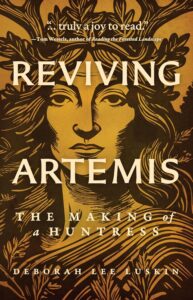
Reviving Artemis: The Making of a Huntress
 FINDING A PLACE IN THE NATURAL WORLD AS A HUNTRESS
After thirty years cultivating fruits and vegetables, raising children, and teaching literature, Deborah Lee Luskin stepped out of her garden and into the forest. At sixty, it was time to age fiercely, overcome her suburban fear of getting lost in the woods and her urban reliance on street signs to know where she was. She wanted to forge her own path through the forest by following the deer. A dedicated locavore, Luskin didn’t want just to read the landscape, she also wanted to eat it.
Luskin overcame her ambivalence about guns as she gained a deeper understanding of the hunter’s role in the ecosystem of the northern forest. Her literary acumen helped her read the landscape and—as thoughtfully as she hunts for words—to hunt for deer. With the stories of Artemis, goddess of the hunt, childbirth, and wild nature to inspire her, Deborah became a deer hunter. Reviving Artemis is her story of finding her place in the natural world.
BUY HERE
Category: On Writing
Subscribe
If you enjoyed this article, subscribe to receive more just like it.