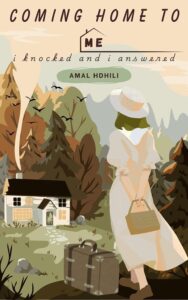
Coming Home to Me: The Story Before the Story by Amal Hdhili
By Amal Hdhili
 Every story starts somewhere. Not always in a childhood memory or a grand epiphany, but sometimes in the quietest, most fragile moments — the ones we barely notice while living them. And every book begins with something small yet powerful enough to provoke us: a question, a crack in our confidence, a heaviness we can no longer carry in silence. We don’t wake up one morning choosing to write; writing chooses us when life pushes us toward a truth we’ve avoided for too long.
It hasn’t been long since I walked through one of the hardest patches of my life. The kind of season where the heart grows too tired to pretend, and the mind too overwhelmed to negotiate with pain. I found myself wanting to escape everything — the noise, the responsibilities, the expectations, even the version of myself I had been performing so diligently. All I wanted was to go home.
But then came the question that stopped me mid-escape:
Where is home anyway?
The simplicity of the question was disarming. It followed me from room to room, from morning coffee to midnight thoughts. Where do you run when the world becomes unbearable? Where do you hide when your own emotions exhaust you? Do you return to where you were born and raised? To the people who shaped your earliest understanding of love? To the last place you felt laughter? To the city where your heart once bloomed? To the memories that still taste like safety?
Or is home nothing but a comforting illusion we carry from one disappointment to another?
This realization unsettled me deeply. I had been using the word home so casually — daily, even — without acknowledging that somewhere along the way, I had lost its meaning. The word had become empty, almost decorative. And that emptiness forced me to pause. To question. To analyze. And most importantly, to write.
Writing became my way of tracing the outlines of my own life. As I moved from one paragraph to the next, I started lifting emotional dust from old corners I had ignored. I revisited every place I once called home — rooms, streets, cities, faces. I listened to the echoes of conversations I had forgotten, the laughter, the silence, the hesitations. I examined every pair of eyes I once trusted, every warmth I mistook for permanence, every goodbye disguised as a beginning.
And slowly, those fragments began forming patterns.
People, places, voice tones, memories — they started aligning like tiny colourful tiles on a table. Not one of them complete on its own, not one of them capable of holding the weight of “home” alone. But together, they created something unexpected:
a mosaic painting.
A portrait.
My portrait.
It was then that I realized:
I had been home all along.
Every emotion I had ever lived, every street I had ever walked, every mistake I had forgiven myself for — they were all bricks in the foundation of the only home that had never left me: me.
My home shook every time I fell sick.
It trembled with every failure I swallowed quietly.
It lost its shine each time sadness rested on my chest longer than planned.
It became messy every time work consumed me.
Yet through all of this, I left it unattended. Neglected.
I walked into the houses of others, seeking comfort, seeking belonging, seeking something that could fill a gap I never dared to name. I looked for homes in people who couldn’t shelter themselves. I leaned on cities that were never meant to carry my weight. I searched for reassurance in timelines that had already expired.
I was like someone searching frantically for the remote control, only to discover it had been in my hand the entire time. I spent years looking for home while the keys were quietly resting in my pocket.
And when I finally stopped searching outward and turned inward, I found something I hadn’t expected:
a home built from resilience rather than geography,
from experience rather than walls,
from stories rather than furniture.
I found a home shaped by the laughter of my childhood, the tenderness of my parents, the softness of friendships, the stillness after heartbreaks, the courage after disappointments, and the quiet strength that blooms only when life bends us without breaking us.
I knocked.
And for the first time in years — I answered.
Because coming home is not about returning to where you once lived. It is about returning to who you once were, and to who you are becoming. It is a decision, not a destination. A slow, intentional walk back to yourself. A quiet recognition that you are worthy of your own presence.
Coming Home to Me was born from that moment of recognition.
From that act of turning inward.
From the realization that the person I had been searching for was waiting patiently behind a door I kept locked out of fear, exhaustion, and habit.
And perhaps — if you are reading this — you are on your way home too.
Maybe you’ve been carrying the keys without noticing.
Maybe you’ve been walking past the door, thinking it belonged to someone else.
But when the moment comes — and it always comes —
listen for the knock.
It might be your own voice calling you back.
And when you hear it, no matter how softly it speaks —
answer.
—
Amal Hdhili is a Tunisian-born author whose work blends psychological depth with evocative, object-centered storytelling. She writes from the belief that the quiet things we overlook—mirrors, wardrobes, forgotten rooms, unspoken memories—carry the emotional weight we are often unable to name.
She is the creator of the thriller short-story series If Objects Could Whisper, a two-book collection that imagines the secrets held by inanimate witnesses. Her memoir, Coming Home to Me: I Knocked and I Answered, traces a heartfelt journey toward self-discovery and inner belonging. Her latest book, The Day After You Kill Yourself, explores the fragile border between despair and awakening through a deeply psychological lens.
Amal’s work has gained international attention. She was featured in NY Weekly as one of the Top 20 Influential Female Entrepreneurs to Watch in 2025, and received a 5-star rating from Reader’s Favorite for the emotional resonance and originality of her writing. Her pieces have also been showcased by literary platforms such as Women Writers, Women’s Books and AllAuthor.
Born and raised in Jendouba, Tunisia, and now based in Turkey, Amal continues to expand her literary universe—one story, one object, and one whispered truth at a time.
Buy HERE
Category: On Writing
Subscribe
If you enjoyed this article, subscribe to receive more just like it.