Publish a Book, Lose a Friend by Laura Bonazzoli
By Laura Bonazzoli
We shared everything. Over bowls of thick soup in our favorite café, we’d swap recipes and healthcare tips and stories: her father’s drinking, my father’s rage, our siblings who’d died too young, the misogyny we’d had to overcome. And we were both writers. I’d published more— academic and technical works, dozens of poems, a few essays, and several short stories—but Jodie (not her real name) had published some poems and essays as well. Through years of submissions and rejections and the occasional recognition, we’d cheered each other on.
So when, in the fall of 2021, I finally found a small, indie press for Consecration Pond, my novel in stories, Jodie was the friend with whom I most wanted to share the news. She seemed happy for me, asked me a couple of questions—pub date, royalties—and then our conversation moved on. But for the next several months, as I worked with my publisher on editing, cover design, and production, Jodie spoke of my book only if I mentioned it. That hurt a little, but I reminded myself not to expect any of my friends to be as engaged in the process as I was. Still, many friends would ask me for updates each time we met, perhaps out of genuine curiosity or because they understood the book’s importance to me. Jodie never did.
On a Sunday morning in August of 2022, Jodie and I tried a new café that had just opened in my coastal Maine village. We sat at a table overlooking the harbor, sipping cappuccinos and—I thought—sharing everything. As we chatted, I had no idea that this was the last time I would ever see this dear friend. If I’d known—if I’d had any inkling at all—I’m sure I would have paid closer attention to her words and body language, and now, perhaps, would better understand what happened. Instead, I remember little about our conversation except that she mentioned she and her husband were considering selling their house and moving to a town about an hour away. I remember suggesting that, if they did end up moving there, she and I could meet halfway in a lovely coastal town we’d visited together before. Since Consecration Pond was to be released the following Friday, I’m sure the topic of my book launch must have come up, but I don’t remember it. When we hugged goodbye, I assumed I’d see Jodie again soon.
My publisher and I had scheduled two book events for September within a few miles of Jodie’s home. Via email, I invited her to both. She replied that she was busy shopping for a new home and couldn’t make it. In early October, I emailed again. Would she like to meet somewhere for lunch? Sorry, she was busy preparing to put her home on the market. A few weeks later, I read an online essay that I thought she’d enjoy. I sent her the link, saying that it had reminded me of her and that I was thinking of her. She thanked me but said the essay hadn’t spoken to her. At Christmas, I sent a card. Nothing. In mid-January, I tried one final time, a two-sentence email mentioning that I hadn’t heard from her in a while and asking if she was okay. Again, her reply was brief: “Yes all is well—just having to focus on change and staying grounded taking all my attention. Wishing you a happy healthy new year.”
I never saw or heard from her again.
For a long time, little reminders of her, like passing the sign to her town or seeing a stranger who wore the same coat or spoke in the same husky voice, caused a wave of grief as intense and familiar as my grief for my late siblings.
Why had Jodie ghosted me? Over and over again, I’d ask myself that question. She was planning to move, so was it simply her way of cutting ties in advance? Or was it because I’d published a book, and somehow that success challenged her confidence in her own writing? Had she ghosted me to protect herself from a relationship that now provoked pain?
I’ll never know. In the summer of 2025, I learned from an acquaintance that Jodie had died of cardiac arrest in her sleep in August of 2024, about two years after we’d last seen each other. Online I found her obituary, and dozens of photos all lit by her brilliant smile.
A quick online search suggests that the experience of losing a friend following success is common. Though I couldn’t locate any studies with specific data, articles from Psychology Today, Medium, and other outlets explore the phenomenon. Still, knowing you’re not alone won’t necessarily help you cope. Instead, if you’re experiencing such a loss, try the following steps, which continue to help me:
- Accept that you’ll never know what caused the rift. In fact, it may have little or nothing to do with you. So stop trying to figure it out. Make peace with the question.
- Forgive yourself. No relationship is perfect. Looking back, you can probably recall things that your friend said or did that hurt you. In the same way, accept that something you might have said or done could inadvertently have hurt your friend. Make peace with your good intentions—and your imperfection.
- Don’t try to suppress your memories of your friend. They’ll come to mind without your consent. When they do, take a moment to acknowledge the pain, then breathe your friend a blessing.
- Focus on the friends who do celebrate your success. And whether they’re also writers—or dancers, doctors, or chimney sweeps—celebrate their successes, too.
- Finally, keep writing. Someday you may even find yourself dedicating that new poem, essay, or novel to your absent friend.
In memory of Jodie. I still miss you.
—
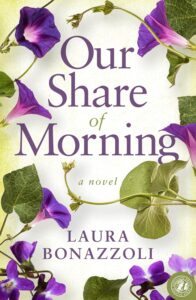
OUR SHARE OF MORNING
 Her eyes were fixed on my face. “Men,” she said simply. “And women. Make mistakes. Blissful, dreadful mistakes. But more often than not, women pay the price.”
1933. A three-story tenement in a mill town west of Boston. In the third-floor apartment hangs a portrait of unforgettable beauty: Ada, a neighbor’s daughter, who disappeared years before. In the apartment below, two sisters—thoughtful, sensible Violet and gifted but fragile Glory—come of age unaware of how the missing Ada haunts their lives. As disease and poverty threaten their family, they are each other’s refuge. But as they reach adulthood, the fallout from a broken love affair—while unraveling the mystery of Ada—threatens their bond.
Narrated in turns by each of the sisters, Our Share of Morning reveals how contagion, misogyny, and a series of betrayals force Violet and Glory to face immutable loss. Poignant and poetic, the novel is a meditation on meaning, fate, forgiveness, and the fierce endurance of sisterly love.
BUY HERE
Laura Bonazzoli’s 2022 novel-in-stories, Consecration Pond, was praised by Publishers Weekly as “poetic and haunting.” Kirkus Reviews called her 2025 historical novel, Our Share of Morning, “a vivid portrait of resilience and love.” Laura has also published short fiction, poetry, and essays in dozens of literary magazines and several anthologies. She works as a freelance editor and ghostwriter, and teaches creative writing with Maine Media Workshops. She is working on a new novel.
Category: Contemporary Women Writers, On Writing
Subscribe
If you enjoyed this article, subscribe to receive more just like it.