Dr. Ellenmorris Tiegerman: On Writing
In a novel of startling relevancy, with the recent assassination of right-wing political activist Charlie Kirk, Dr. Ellenmorris Tiegerman has written the second of her past life mysteries with God Denied (Scholar Dreams Publishing, March 10, 2026).
When a conservative news commentator is murdered on the eve of his controversial campus appearance, Professor Ashford Connor finds himself at the center of a storm over free speech, moral responsibility, and truth. As tensions rise, Connor begins to suspect that the roots of the conflict stretch far deeper — perhaps even into another lifetime, when he and others were members of the resistance in Nazi Germany.
Blending the political and the spiritual, God Denied asks: Are we destined to repeat our past mistakes, or can we finally awaken to something greater?
Dr Ellenmorris Tiegerman shares her writing journey with us.
 To my colleagues who have already embarked on the writing journey and to prospective writers,
I would like to take this opportunity to share my experiences over the past few years writing in both the realms of fiction and non-fiction (i.e., academic textbooks). I started out as an Assistant Professor at Adelphi University some 30 years ago where the pressure was both spoken and unspoken to “publish or perish.” So, in order to obtain tenure and promotion, I was faced with the daunting task of collaborating with other young Professors to write clinical textbooks on topics such as: Language and Communication Disorders in Children.
The process was not that complicated in terms of finding a book publisher who was interested in the topic and very quickly, I was provided with a work schedule and a deadline by Merrill and MacMillan Publishing Companies to produce a college textbook with several other writers. We each shared several chapters in the textbook, and we were on a very tight writing schedule.
The manuscript was sent out for review to five senior academicians in universities throughout the United States; they were all experts in areas covered by the textbook. We received detailed reviews and proceeded to make changes and updates based on the comments that we received from our reviewers.
The writing process required a tremendous amount of research and little creativity, but over the years, my career benefitted from the five books that I wrote while I was teaching at Adelphi University in New York. I enjoyed working collaboratively with other Professors who were experts in their particular area of academia. I learned a great deal about what other people were doing educationally and clinically, but I found that something was missing.
I wrote religiously for almost 20 years and updated my textbooks from one publication year to the next. And while this was all going on, I kept thinking about writing a fiction book/story that was at the complete opposite end of the continuum from content to process. I had in mind a murder mystery which involved a young clinical Professor at a local university somewhere in the Midwest in the Department of Psychology.
The storyline as well as the characters were based on and taken from events that I had personally experienced while I was teaching at the University. generated a manuscript which sat in my closet because again, I felt that something was missing. I received a notification that Dr. Brian Weiss who had written Many Lives, Many Masters was giving a training seminar to therapists in Reinbeck, New York about past lives regression, and I decided to register for the training seminar. The seminar changed everything for me.
I spent a week with Dr. Weiss and about 100 other interested registrants/therapists listening to Dr. Weiss talk about past life regression, its underlying theory, and how effective it is therapeutically. Something clicked for me during that week because I realized that the missing piece in my novel had to do with my heroine, Professor Caitlyn Morrys, and her use of past life regression to solve a murder mystery. I went home from that seminar and pulled out the manuscript just at the time that COVID changed everything for so many of us at home and at work.
I was home during this period of time, and I decided to re-write the manuscript with this new underlying theme of past life regression infused within my novel. But I needed a new procedure/process to address the writing since the experience of writing a novel versus a textbook is completely different. Writing a novel and/or fiction is a totally creative process which allows you an expansiveness into your imagination that a textbook does not provide for and/or allow. Being creative is not something that you can just turn on and off, and there is always a concern about writer’s block along the journey.
My personal process involved getting up at 4 a.m. every morning, going to the gym for an hour, and then sitting down to write for exactly one hour. I wrote whatever I wrote during that 60-minute period, which could include five pages or five words. I worked from a chapter outline, and as I continued writing each chapter, I filled in the chapter outline to reflect exactly what I was doing in developing the characters and the content. This was much harder than writing an academic textbook, because you started with a totally blank page, and you delved into your imagination, which could take you anywhere.
Was I faced with writer’s block? Of course. Some chapters were easier to write than others. But I never moved away from my process which put me in front of a computer for 60 minutes at five in the morning. I finished the manuscript and sent it out to an editor for review. His comments, suggestions and criticisms were greatly appreciated, since this was my first novel, Past Lives Denied. I loved the experience because it was so generative and creative, but it was also very challenging.
I have now finished my second novel entitled, God Denied, which presents Professor Ashford Connor as the leading figure in the manuscript and book who deals with past life regression to solve a problem.
My recommendation to young writers is to create a detailed chapter-by-chapter outline and give it to someone to review. If you could find an agent, which I could not, that would be a good starting point. If you can find a publisher, that would also be a good starting point, but I could not.
Do not be discouraged, because you can always self-publish, which is what I have done and will continue to do. Creative writing is a journey. It’s a marathon, not a sprint race. Finally, I also think that there are many reasons that people write. Sometimes people write to provide knowledge for others. Sometimes people write because they truly enjoy the creative process. You need to find out and determine what works for you along this journey, because it is time-consuming and at times frustrating and at times enthralling.
I think writing is all about self-exploration, and I recommend it very highly for all of you who would like to take an adventure into the unknown of yourself. If you would like to correspond with me, you can contact me at dremt1@aol.com.
Good luck!
Dr. Ellenmorris Tiegerman
—
GOD DENIED
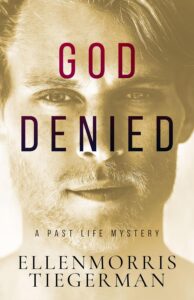 What if denying God meant denying yourself?
Professor Ashford Connor has everything: power, prestige, and the woman he loves. But when a celebrated journalist is murdered on campus, the fragile balance of his world collapses. As political tensions ignite and old hatreds resurface, Ash finds himself ensnared in a deadly web of vengeance and deceit.
What begins as an academic scandal spirals into something far darker as memories that are his own begin to invade his dreams. Each vision pulls him closer to a truth buried across lifetimes-and to a killer whose motive defies reason.
When reason fails and the unseen takes hold, Ash must decide: Is he truly the skeptic he’s always claimed to be?
Or is he a believer reborn through the power of what he cannot deny?
Faith, reason, and redemption collide in this propulsive fusion of psychological suspense and spiritual discovery.
PREORDER HERE
—
Dr. Ellenmorris Tiegerman is the Executive Director of Tiegerman School and a Professor Emeritus at the Derner Institute for Advanced Psychology Studies at Adelphi University. As the founder of Tiegerman School, Dr. Tiegerman is responsible for the creation and the development of the preschool, school age and integrated programs within the School. Dr. Tiegerman holds a Ph.D. from the City University of New York. She also has Masters degrees in: Speech Language Pathology (M.S. and M.Phil.), Special Education (M.S.) and Social Work (MSW). She has extensive experience in the areas of child language development and disorders. She has been involved in many research projects and is the author of textbooks in the areas of language disorders, early intervention, parent language training and childhood autism.
: https://www.
: https://www.
Category: On Writing
Subscribe
If you enjoyed this article, subscribe to receive more just like it.